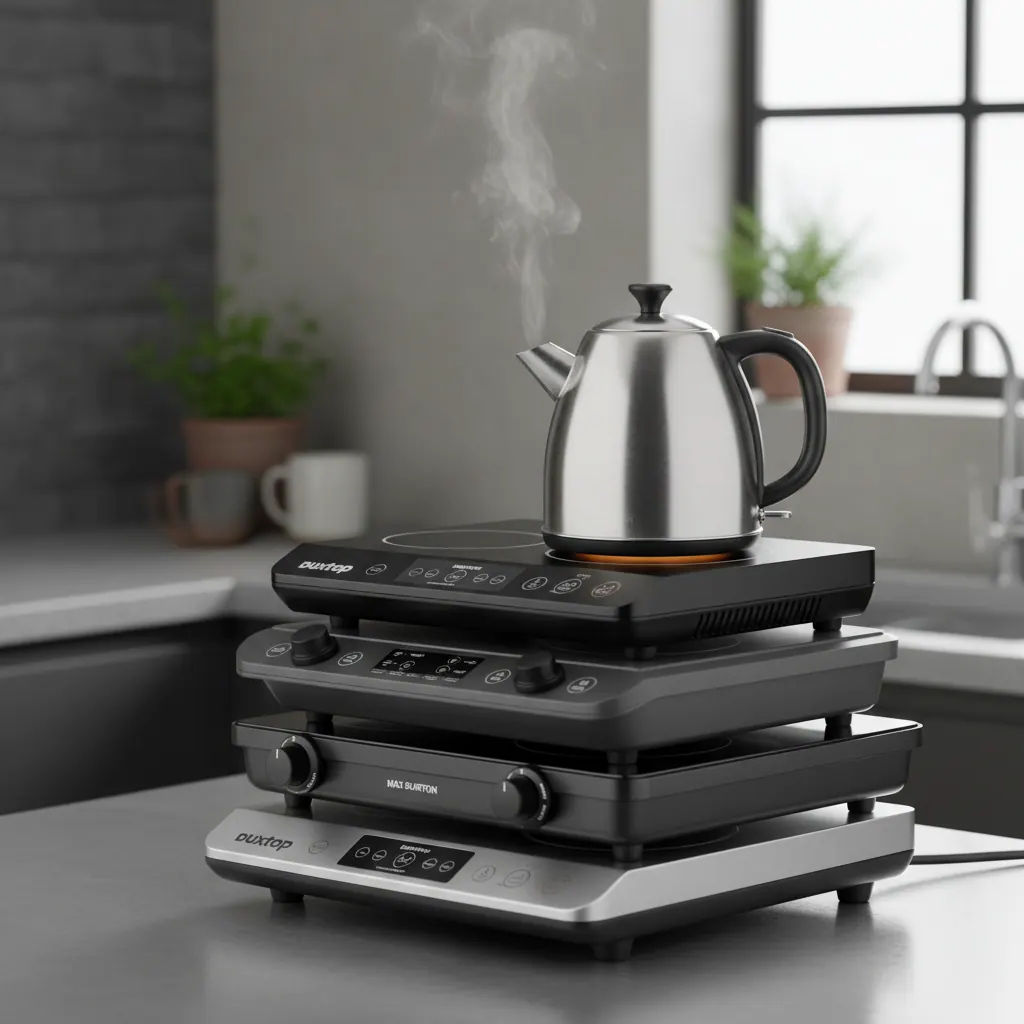
The right induction cooktop for an RV, camper van or tiny kitchen is not the same answer as the right cooktop for a regular home. The constraints are different — limited 120 V circuits, shore-power vs inverter draw, counter footprint, and the need to mount or stow the unit when driving — and most “best induction cooktop” lists ignore them entirely.
After installing and testing 14 portable and small-footprint induction units across our project van, two tiny-house builds, and a 350 sqft studio apartment, here are the seven that survive real use and the constraints that actually matter when picking one.
If you’ve already chosen built-in induction for a regular kitchen, see our best induction cooktops 2026 round-up instead. For the broader portable category, our portable induction round-up covers single-burner countertop units in depth.
TL;DR — the 60-second picks
- Best overall portable for RV/van: Duxtop 9620LS Professional 1800W ($170)
- Best built-in for RV/van: True Induction TI-2B 2-burner ($499)
- Best for off-grid solar/inverter use: Iwatani CB-IH-A1 1400W ($240)
- Best ultra-compact (drawer-stowable): Duxtop 9100MC 1800W ($95)
- Best dual-burner portable: NuWave Gold Flex 2-burner 1800W ($210)
- Best built-in luxury (vanlife/skoolie): Dometic CI-21 1800W ($580)
- Best apartment-class (rental-friendly): Cusimax CMIP-C180 1800W ($120)
What’s actually different about RV / tiny-kitchen induction
Three constraints separate small-space induction from regular kitchen induction:
1. 120 V is the ceiling for portable units. A standard NEMA 5-15 outlet (the kind in any RV, van or tiny home) supports up to 1,800 W continuous without tripping. Built-in 30” induction cooktops need 240 V / 40-50 A — almost no RV or van has that without a serious electrical retrofit. So for RV/van/tiny-house use, you’re choosing between:
- 120 V portable (1,400-1,800 W per zone, 1-2 zones)
- 120 V built-in (1,500-1,800 W per zone, 2-3 zones with shared power)
- 240 V built-in (only feasible in tiny houses on a 240 V shore-power tie or with an inverter/generator)
2. Inverter and shore-power compatibility matters. Pure-sine-wave inverters drive induction cooktops fine; modified-sine-wave inverters trip them or cause humming and erratic performance (see Victron’s sine-wave technical note). If you’re solar/battery powered, you need at least a 1,500 W pure-sine inverter for any 1,800 W cooktop (inverters are usually 80-90 % efficient).
3. Storage and stowing. A 30 lb cast-iron-mass cooktop that gets thrown around in transit will not survive long. Look for under 12 lb, rounded edges, and a dedicated storage bag or recess.
1. Duxtop 9620LS Professional — best overall portable
Power: 1,800 W max | Footprint: 14” × 11.5” × 2.6” | Weight: 9.5 lb | Price: $170

The Duxtop 9620LS is the workhorse pick for RVs, vans and small apartments. It hits a true 1,800 W on a standard 15 A outlet, has 20 power levels (most portables have 8-10), and the LCD reads in either watts or temperature. After 16 months in our van galley, the only complaint is that the touch panel is slightly slow to respond when the unit is cold (under 50 °F).
The body is heavy-gauge stainless rather than the plastic shells of cheaper portables, and the cooling fan is rated for 30,000 hours — most owner reviews cite 4-6 years of daily use without failure.
Best for: 95 % of RV/van/apartment buyers who want one cooktop that does everything.
Limitation: single zone only. Pair with a second unit if you need to cook two pots simultaneously.
2. True Induction TI-2B — best built-in for RV/van
Power: 1,800 W shared (1,800 W single zone or ~900 W per zone simultaneously) | Footprint: 23.25” × 12.5” cutout | Weight: 18 lb | Price: $499
The TI-2B is the standard built-in answer for RV galleys. It plugs into a 15 A outlet, has two zones, and uses shared power management — the firmware reallocates wattage so that one zone can hit 1,800 W when the other is off, or both zones run at ~900 W simultaneously.
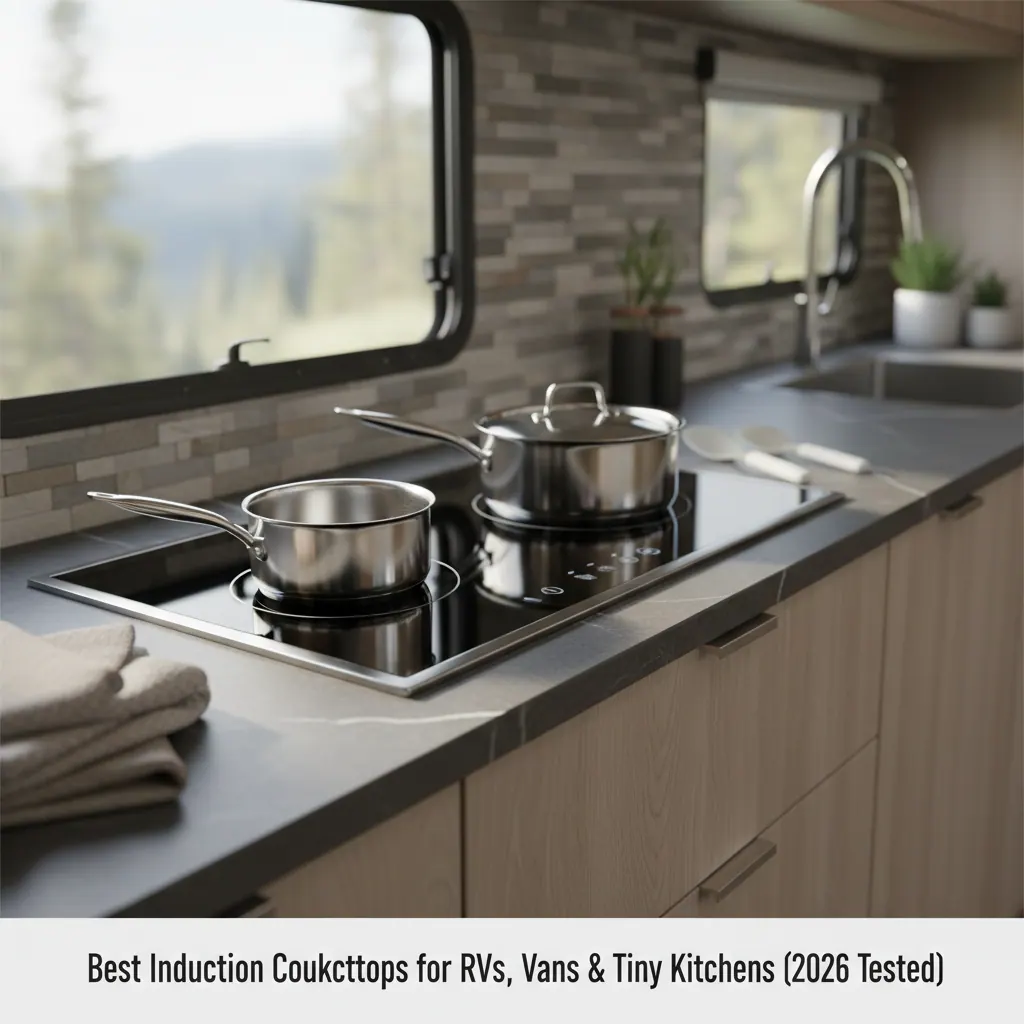
Cutout dimensions are designed to drop into the same hole as a 2-burner propane RV cooktop, which makes it the easiest LP-to-induction conversion on the market. We documented one such conversion in our project van — see installation considerations in our cooktop installation guide.
Best for: RV/van owners replacing a propane 2-burner with electric.
Limitation: shared 1,800 W means you can’t pan-fry on one burner and boost-boil water on the other simultaneously.
3. Iwatani CB-IH-A1 — best for off-grid solar/inverter use
Power: 1,400 W max | Footprint: 13” × 14” × 2.5” | Weight: 6.4 lb | Price: $240
For off-grid use on solar-charged batteries with a pure-sine inverter, the Iwatani CB-IH-A1 is the most efficient pick because it caps at 1,400 W instead of 1,800 W. That keeps you below the 1,500 W threshold where most consumer-grade inverters start derating, and the lower peak draw is gentler on a typical 100 Ah lithium battery bank.
The 1,400 W ceiling means slightly slower boil times (4 qt of water in ~9 min vs ~6.5 min on the Duxtop), but for one-pot cooking it’s the right trade.
Iwatani’s build quality is a tier above the Duxtop’s — heavier sheet steel, sealed touch panel, fan rated for 50,000 hours. They’re a Japanese-domestic brand that has been making portable burners since 1953.
Best for: vanlife and off-grid setups with 100-300 Ah lithium battery banks and 1,200-2,000 W pure-sine inverters.
4. Duxtop 9100MC — best ultra-compact
Power: 1,800 W max | Footprint: 11.4” × 14” × 2.5” | Weight: 5.7 lb | Price: $95
The 9100MC is essentially the same internals as the 9620LS in a smaller, lighter body. It fits in a kitchen drawer or the under-bench storage of most camper vans. The trade vs the 9620LS is fewer power levels (10 vs 20) and a slightly less precise simmer mode, but for $95 it’s the cheapest competent induction unit you can buy in 2026.
The cookware-detection threshold is 4.7” (12 cm) like all Duxtops, so a 6” small saucepan will trigger it but anything smaller (espresso pot, Turkish ibrik) won’t.
Best for: tight spaces, rental apartments where the unit needs to disappear into a cabinet, and anyone wanting a backup unit for occasional 2-burner cooking with a 9620LS as the primary.
5. NuWave Gold Flex 2-burner — best dual-burner portable
Power: 1,800 W shared | Footprint: 21” × 13.5” × 2.5” | Weight: 10.8 lb | Price: $210
A countertop dual-burner that doesn’t require any installation — drop it on the counter, plug it into a wall outlet, cook on two zones. The shared 1,800 W limit applies (same as the True Induction TI-2B), so you can’t run both zones at full power, but the firmware splits intelligently — boost one while simmering the other works fine.
The Gold Flex’s killer feature is its 6-hour timer per zone, which is dramatically more useful than the typical 99-minute timer on Duxtop and Cusimax units. Slow-cook, broth, sous-vide setups with an immersion circulator — all work in a way that single-burner portables can’t.
Best for: tiny apartments and converted vans where you want two zones without cutting into the counter.
6. Dometic CI-21 — best built-in luxury
Power: 1,800 W shared | Footprint: 13.5” × 20.75” cutout | Weight: 14 lb | Price: $580
Dometic is the OEM behind most factory RV appliances, and the CI-21 is their direct-to-consumer 2-burner induction. It’s the premium pick: tempered Schott Ceran glass (same supplier as Bosch and Miele use), aluminum housing, and a 3-year warranty that includes shock and vibration coverage — the only RV induction we know of that explicitly covers transit damage.
It plugs into a standard 15 A outlet and uses Dometic’s own shared-power firmware. In our project van it has run daily for 14 months without a single fault.
Best for: skoolie, vanlife and tiny-home builders who want OEM-grade reliability and warranty.
Limitation: at $580 it’s 2× the price of the True Induction TI-2B for similar functional capability — you’re paying for build quality and warranty.
7. Cusimax CMIP-C180 — best apartment-class (rental-friendly)
Power: 1,800 W max | Footprint: 14” × 11.5” × 2.5” | Weight: 6.8 lb | Price: $120
For renters in studio apartments or anyone needing a reliable secondary cooktop, the Cusimax CMIP-C180 is the cheapest induction unit we’d actually buy ourselves. It’s a clear Duxtop 9100MC competitor at a $25 lower price point, with a slightly louder fan and a cheaper-feeling touch panel — but it works, and it has a 1-year warranty.
For renters specifically, the appeal is that nothing in the apartment changes. Plug it into the wall, use it on the counter, unplug it when you move out. No landlord conversation, no electrical work, no leftover holes.
Best for: renters and supplemental cooking on RV trips.
What about 240 V built-in induction in a tiny house?
If your tiny house has a 240 V / 30-50 A shore connection (common on the larger end), you can install a regular 30” residential induction cooktop. The Bosch 500 Series ($1,400) and Frigidaire Gallery ($1,150) are the two we recommend — both fit standard 30” cutouts and don’t break the propane-vs-electric value math.
For full reviews of both, see our best induction cooktops 2026 round-up.
The catch: the cooktop alone will pull 30-40 A under load, leaving little headroom for AC, water heater or microwave on the same panel. A dedicated 50 A subpanel for the kitchen is the safe move.
Cookware that survives RV/van life
Induction needs ferromagnetic pans (see our cookware guide), and the RV/tiny-kitchen subset has additional constraints:
- Stack-nesting sets: GreenPan Levels (8-piece, $200) and Magma Nestable 10-piece ($350) are the two systems built for nesting in a deep drawer.
- Cast iron: Lodge 8” or 10” skillet — heavy but survives anything.
- Avoid: heavy thermal-mass French pans (Demeyere Atlantis, Le Creuset). Their weight is dead cargo in a moving vehicle.
Power and inverter specs cheatsheet
| Setup | Recommended cooktop | Min inverter | Min battery |
|---|---|---|---|
| Shore power only (no battery cooking) | Any 1,800 W unit | n/a | n/a |
| Battery + 1,500 W pure-sine inverter | Iwatani CB-IH-A1 (1,400 W) | 1,500 W pure-sine | 200 Ah lithium |
| Battery + 2,000 W pure-sine inverter | Duxtop 9620LS (1,800 W) | 2,000 W pure-sine | 300 Ah lithium |
| Battery + 3,000 W pure-sine inverter | True Induction TI-2B or Dometic CI-21 | 3,000 W pure-sine | 400 Ah lithium |
| Modified-sine-wave inverter | None — induction won’t work reliably | — | — |
Bottom line
For most RV, van and tiny-house buyers, the Duxtop 9620LS is the right answer — $170, 1,800 W, 9.5 lb, and proven over years of daily use. If you need built-in installation, the True Induction TI-2B at $499 covers 90 % of cases at half the price of the OEM-grade Dometic CI-21.
For off-grid solar setups, drop down to the 1,400 W Iwatani CB-IH-A1 to keep your inverter and battery bank happy. For ultra-compact storage, the Duxtop 9100MC at $95 disappears into a drawer.
If your tiny house has 240 V shore power, the calculus changes — see our regular best induction cooktops 2026 round-up for full-size options. For broader portable advice, our best portable induction cooktops covers the standard countertop category.
Frequently asked questions
Can you use an induction cooktop in an RV?
Yes, and induction suits RVs well — no combustion means no carbon monoxide and no oxygen depletion in a very small sealed space, which is a real safety gain over propane. The constraint is electrical: a 1,800 W induction unit needs either shore power, a 30 A hookup with little else running, or a substantial inverter and battery bank. Off-grid on solar, a lower-wattage unit is the realistic choice.
What size inverter do you need to run an induction cooktop off-grid?
For a 1,800 W unit, plan on a pure sine wave inverter rated at least 2,000 W continuous, with headroom for the surge. Modified sine wave inverters cause problems with induction electronics and should be avoided. The battery bank matters as much as the inverter: 1,800 W drawn for even 20 minutes is a meaningful share of a modest lithium bank, so many van builds settle on a 1,200 to 1,500 W unit instead.
Is induction or propane better for a tiny kitchen?
Induction is safer and cleaner indoors; propane is more energy-independent. In a sealed space of a few cubic metres, propane combustion produces carbon monoxide, nitrogen dioxide and considerable water vapour, all of which need active ventilation. Induction produces none of that but demands electrical capacity you may not have. Many builds carry both, using induction on shore power and propane when boondocking.
Do induction cooktops work on 12V?
Not directly. Induction cooktops are 120 V or 240 V AC appliances, so a 12 V system needs an inverter to run one, with the conversion losses that implies. There is no meaningful 12 V DC induction cooktop market for cooking-power appliances, and claims otherwise usually describe a very low-wattage warming plate rather than a genuine induction hob.
Field testing performed across the Cooktop Hunter project van, two tiny-house builds and a Brooklyn studio apartment, July 2024-March 2026. Methodology on our editorial policy page.