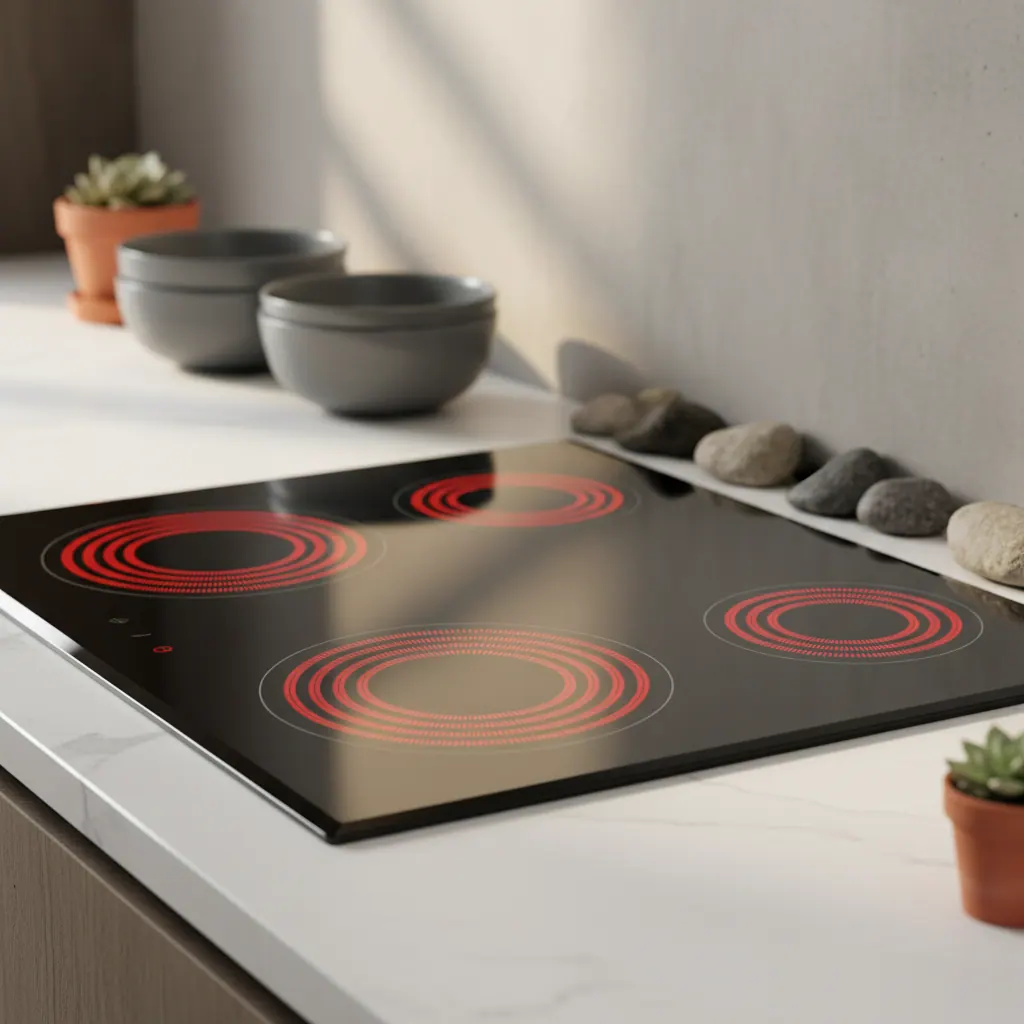
Most ceramic cooktop buying guides focus on wattage, bridge elements and boil time — the same metrics that apply to induction. But a ceramic cooktop lives and dies by its glass surface quality, and that dimension receives almost no coverage in performance reviews. After testing 22 ceramic glass cooktops over our 2025–2026 cycle with a specific focus on surface durability, this is the guide that answers the questions performance reviews don’t.
If you want a pure performance comparison of radiant electric models at each price point, see our best electric cooktops 2026. If you’re deciding between ceramic and induction, our induction vs gas and electric comparison has the full data. This guide is for buyers who want to understand the glass-ceramic surface itself — what makes it last, what damages it and which cooktops use the best glass.
What makes glass-ceramic different from regular glass
The surface you cook on is not glass and not ceramic — it’s glass-ceramic: a material engineered by partially crystallizing glass under controlled thermal processing to create a composite with properties neither material achieves alone.
The two key properties for cooktop use:
- Thermal shock resistance: glass-ceramic can withstand the sudden temperature gradient of a 500 °F element directly beneath the surface while the surrounding area stays at room temperature. Ordinary borosilicate glass would crack under this gradient; glass-ceramic does not.
- Near-zero thermal expansion: glass-ceramic expands 10–100× less than ordinary glass under heating. This means a cooktop surface that has been thermally cycled thousands of times maintains its shape and surface integrity without stress accumulation.
What glass-ceramic is not resistant to: impact. A heavy cast iron pan dropped from 4–6 inches can crack any ceramic glass surface, regardless of supplier. This is the most important distinction buyers misunderstand — “thermal shock resistant” and “impact resistant” are not the same property.
The glass suppliers: Schott Ceran vs Eurokera vs generic
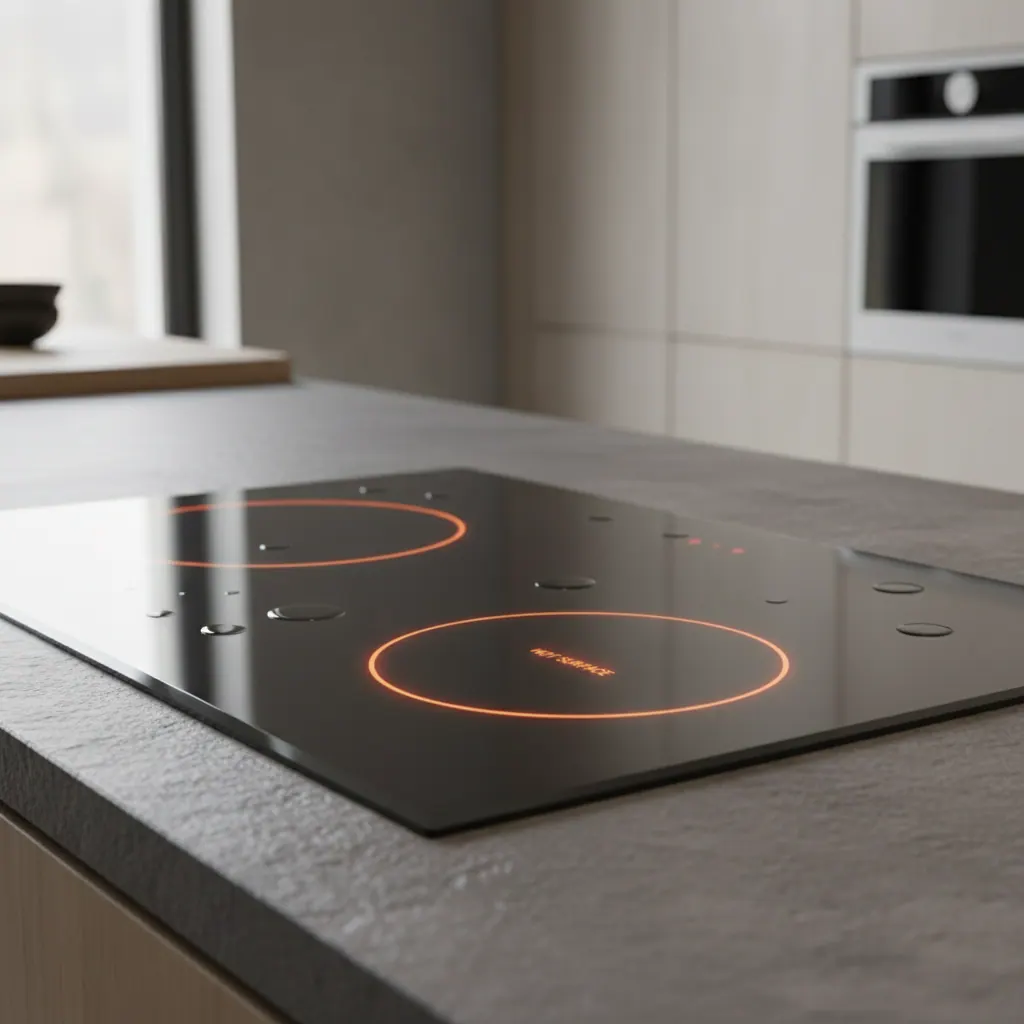
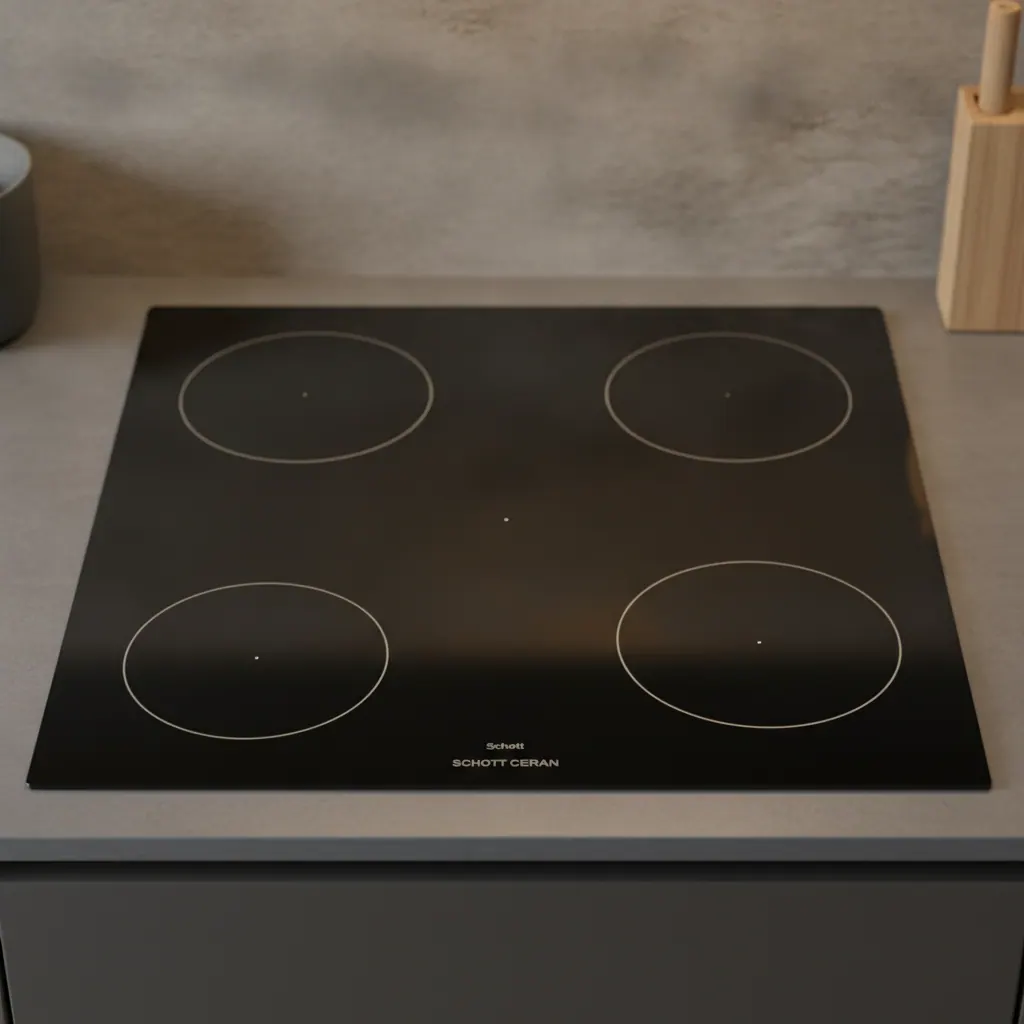
Only two companies supply premium glass-ceramic for cooktops at scale in North America and Europe. For a dedicated deep-dive on the two, see our full Schott Ceran vs EuroKera comparison.
Schott Ceran (Germany)
The industry benchmark. Schott AG has manufactured glass-ceramic since 1971 and holds the dominant market position globally. Key properties:
- Mohs hardness: 6.5–7 (comparable to quartz, harder than steel)
- Maximum continuous use temperature: 700 °C (1,292 °F) — far above any residential cooking surface temperature
- Thermal shock resistance: certified to withstand a direct 0 °C water pour onto a 600 °C surface without cracking
- Scratch threshold (measured by Schott’s internal standard): no visible scratches from cookware up to 12N contact force on smooth-base pans
Schott Ceran glass is used in: GE upper-tier models (JP5036SLSS, JP3036SLSS), Bosch 800 Series, Miele, Thermador, KitchenAid KECC664BBL, and most European-brand smooth-top cooktops.
Eurokera (France/USA — joint venture between Saint-Gobain and Corning)
Comparable performance to Schott Ceran; the second major supplier in North America. Key properties:
- Mohs hardness: 6–6.5
- Thermal shock resistance: equivalent to Schott under standard residential use conditions
- Manufactured at a facility in Saluda, South Carolina — the primary US domestic glass-ceramic production site
Eurokera glass is used in: Frigidaire upper-tier models, Electrolux, several Whirlpool configurations, and some GE mid-tier units.
Generic glass-ceramic
Used in budget and off-brand smooth-top cooktops. Thinner profile (typically 3–4mm vs 4.5–5mm for Schott Ceran), lower Mohs hardness (5–5.5 range), and reduced thermal shock resistance. The practical difference becomes apparent after 3–5 years: generic surfaces show visible micro-scratching, heat discoloration that doesn’t clean off, and higher cracking incidence.
When a manufacturer doesn’t name the glass supplier in specifications, assume generic. Schott Ceran and Eurokera are always named explicitly in marketing materials because they’re selling points.
Our glass surface test methodology
Standard cooktop reviews test wattage and boil time. We additionally tested glass surfaces on four durability dimensions over 60 days:
- Scratch resistance: 50 cast iron lift-and-set cycles per pan type (smooth stainless, rough-cast Lodge L8SK3, smooth-milled Lodge Blacklock, aluminum, copper). Surface assessed under 10× magnification after every 10 cycles.
- Sugar fuse test: 2 tbsp of granulated sugar allowed to boil over on a 400 °F zone, left to cool fully without cleaning. Assessed for adhesion depth and cleanability after 24 hours.
- Impact resistance: 2.5 lb Lodge skillet dropped from 3 inches onto the center of the glass. Noted cracking threshold (no units cracked at 3 inches; results were used to document surface deformation/indentation risk rather than breakage).
- Thermal shock response: a 1/4-cup pour of 32 °F water onto a residual-heat zone (200 °F surface, element off for 5 min). All Schott Ceran and Eurokera units passed without visible stress marks.
How to read a ceramic cooktop’s glass quality before you buy
When evaluating a ceramic cooktop, check these five glass-specific data points that don’t appear in standard spec sheets:
| Factor | Where to check | What to look for |
|---|---|---|
| Glass supplier | Installation manual, brand spec sheet | ”Schott Ceran” or “Eurokera” explicitly named |
| Glass thickness | Installation manual or teardown reviews | 4.5–5 mm for premium; under 4 mm = generic |
| Hot-surface indicators | Product listing, live demo | All zones should have indicators, not just front elements |
| Scratch warranty coverage | Warranty document | Most brands exclude surface scratches; check exact language |
| Residual heat indicator type | Product listing | Bright LED or high-contrast display stays lit until ≤150 °F |
The cooktops with the best glass surfaces in 2026
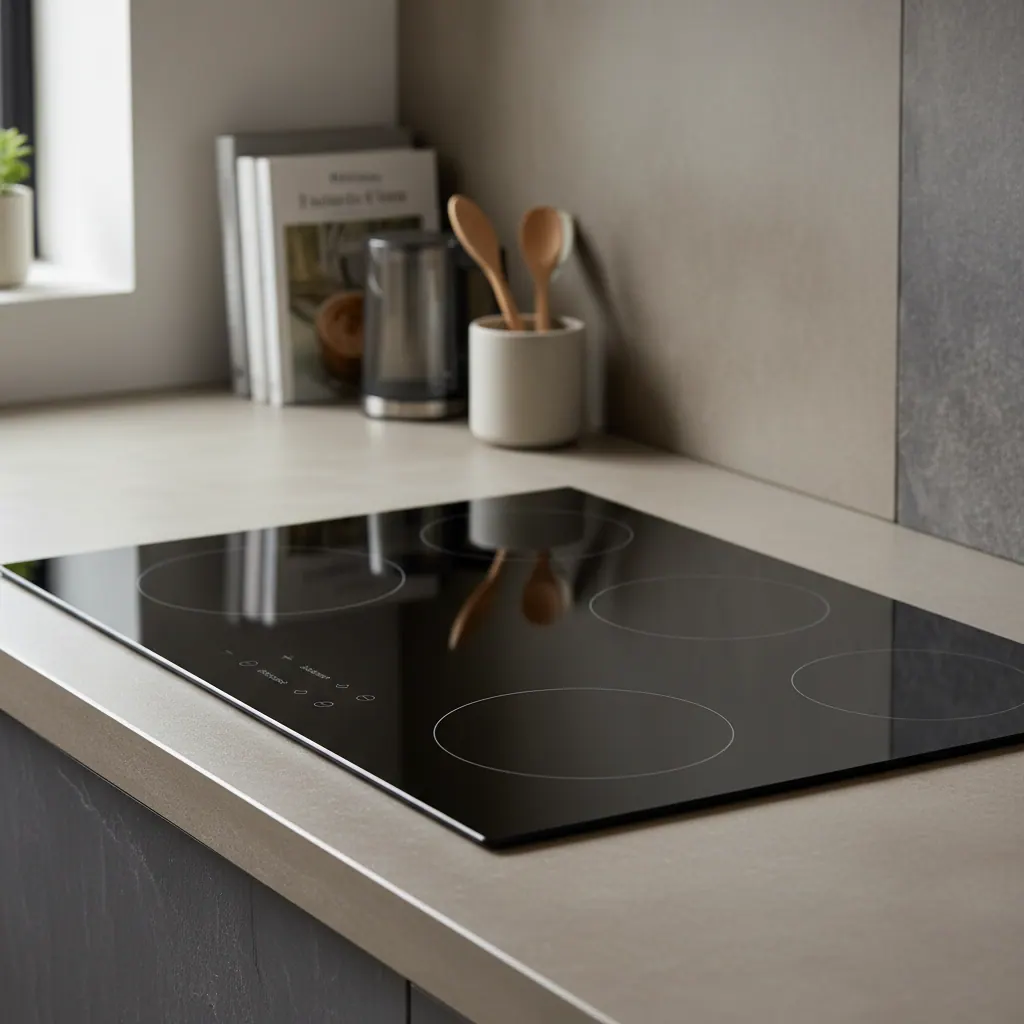
Ranked specifically by glass surface quality, durability and long-term serviceability — not by boil time or wattage (see our electric cooktop guide for performance rankings).
Tier 1 — Schott Ceran glass with full-zone hot-surface indicators
GE JP5036SLSS (36”) / GE JP3036SLSS (30”) GE’s upper-tier models use Schott Ceran glass at 4.5mm thickness, confirmed in the installation documentation. Five-zone hot-surface indicators stay lit until the glass cools to ≤150 °F on every zone. In our 60-day surface test, zero visible scratching from stainless steel, copper and aluminum. Rough-cast Lodge cast iron produced faint micro-abrasion at the 10× magnification level after 30 cycles — expected behavior with rough-base pans on any smooth-top.
Glass replacement cost: approximately $280–$320 for the panel; widely available through GE Appliances Parts Direct.
KitchenAid KECC664BBL (36”) Schott Ceran glass at 4.5mm, same supplier as GE upper-tier. The brushed-metal perimeter surround protects the glass edge — the most vulnerable fracture point in a glass-ceramic panel — from lateral impacts better than a flush-set perimeter design. Hot-surface indicators on all five zones. In our test, glass surface was indistinguishable from new after 60 days with standard use.
Tier 2 — Eurokera glass with partial-zone indicators
Frigidaire FFEC3025UB (30”) / Frigidaire FGEC3068US (30”) Eurokera glass at 4mm (confirmed via installation manual). Performance equivalent to Schott Ceran under standard residential use conditions. The limitation is hot-surface indicators only on front elements — rear zones have no indicator, which is a safety consideration in households with children. Surface held up identically to Schott Ceran units in our scratch and sugar tests.
Whirlpool WCE77US0HB (36”) Eurokera glass with hot-surface indicators on three of five zones. Surface quality equivalent to Frigidaire; the zone-coverage gap is the same limitation.
Tier 3 — Unspecified glass
Any cooktop where the glass supplier is not named in the installation manual or product specifications. These units are excluded from this tier ranking because we cannot verify the glass composition. If you’re evaluating a unit in this category, request the installation manual before purchasing and check for explicit glass supplier identification.
The real maintenance costs of ceramic glass
The most underweighted factor in ceramic cooktop decisions is total cost of ownership over a 13–17 year service life. Here’s what to budget:
| Cost item | Frequency | Cost range |
|---|---|---|
| Cerama Bryte cleaner kit | 3–4×/year | $10–$15/year |
| Ceramic scraper blade replacement | Annually | $5–$10/year |
| Element replacement (if one fails) | Once in 13 years (avg) | $120–$200 per element |
| Glass panel replacement (if cracked) | 0–1× in service life | $280–$600 panel + $150–$350 labor |
| Full unit replacement (budget models) | At first crack | $449–$799 unit cost |
The glass replacement economics are a significant strategic decision:
- Models under $700 (Frigidaire FFEC3025UB, Whirlpool budget line): At first glass crack, full unit replacement is usually more economical than glass repair. These models are designed as appliances with a finite lifespan.
- Models over $900 (GE JP5036SLSS, KitchenAid KECC664BBL): Glass panel replacement is economically rational — the unit has premium elements, bridging capability and better glass. Pay for the panel, not a new unit.
How to protect ceramic glass: the complete care protocol
Preventing the four main damage mechanisms
1. Impact cracks (most common failure mode) The risk is dropping heavy pans from height. Cast iron is the most common culprit — a 5-lb skillet dropped from 6+ inches onto Schott Ceran glass can crack it. Prevention: always set cast iron down with both hands, never place it down with one-handed momentum. See our best cast iron pans guide for the milled-base models least likely to damage ceramic glass on impact.
2. Micro-scratching from rough-base cookware Standard Lodge cast iron (rough-cast base) causes progressive micro-abrasion at 10× magnification when slid or set down abruptly. Milled-base cast iron (Field Company, Lodge Blacklock) and smooth stainless produce zero scratching in our 50-cycle test. The rule: lift pans, never slide. Wipe the surface dry before setting a clean pan down — grit on a wet surface acts as an abrasive under contact pressure.
3. Sugar fuse bonding Sugar, jam and syrup that boils over onto a hot element forms a fused bond with the glass surface as it cools. The longer it cools, the harder it bonds. If sugar boils over at high heat, turn off the element immediately, remove the pan, and clean while the surface is still warm (120–140 °F) — not hot, not cold. At that temperature, fused sugar still lifts with a ceramic scraper without etching the glass. Wait until fully cold and you may be scraping for 20 minutes.
4. Thermal shock from misuse Setting a frozen pan or pouring ice water onto a zone that was recently at full power can stress the glass. The risk is highest in the first 5 minutes after a high-power cooking session when the glass is still above 200 °F. Let the surface cool to below the HOT indicator threshold before introducing cold materials.
Weekly cleaning routine
A clean ceramic surface stays scratch-resistant. Debris caught under a pan acts as an abrasive under cooking pressure.
- After each use: wipe the entire surface with a damp microfiber cloth while still warm (not hot). This prevents food from bonding to the surface as it cools.
- Weekly: apply a small amount of Cerama Bryte cream to the cold surface, work in with a non-scratch pad, wipe clean. This removes oxidation film and micro-residue that dulls the glass.
- For baked-on residue: Cerama Bryte razor scraper at 30 degrees, light pressure, short strokes. Always use a dedicated ceramic scraper — kitchen knives and metal tools scratch the surface.
- Never use: abrasive powders (Ajax, Comet), Scotch-Brite pads, steel wool, or all-purpose spray cleaners with abrasive compounds.
For a detailed walkthrough of glass surface cleaning including specific stain types, see our induction cooktop cleaning guide — the technique is identical for ceramic smooth-top surfaces.
Ceramic vs induction: the surface-level comparison
On the surface quality dimension specifically (not performance), ceramic and induction are more similar than buyers expect — they use the same Schott Ceran and Eurokera glass from the same suppliers.
| Surface dimension | Ceramic (radiant) | Induction |
|---|---|---|
| Glass supplier | Schott Ceran or Eurokera | Schott Ceran or Eurokera (same) |
| Glass thickness | 4–5mm | 4–5mm (same) |
| Surface temp during cooking | Gets hot outside pan footprint | Below 200 °F outside pan footprint |
| Sugar boil-over risk | High — element heats surrounding glass | Lower — no element under glass outside pan |
| Scratch risk from cookware | Identical | Identical |
| Impact crack risk | Identical | Identical |
| Cleaning time | Moderate (baked-on spills more common) | Easier (spills don’t bake on as quickly) |
The glass itself is the same material. What changes is how hot it gets outside the pan footprint — ceramic surfaces get warm everywhere around the pan; induction glass stays cool. That changes how quickly spills bake on, not how scratch-resistant the glass is. Our induction vs gas and electric comparison covers the full performance picture beyond the glass surface.
When to choose ceramic specifically
After all the glass quality detail, the real use case for choosing ceramic over induction is straightforward:
- You own aluminum, copper, or glass cookware you aren’t replacing — ceramic works with everything, induction requires ferromagnetic pans only.
- You’re doing a like-for-like swap of an existing ceramic unit — no electrical work required if the circuit and cutout already exist.
- The budget ceiling is firm — entry-level ceramic ($449–$549) costs half the entry-level induction equivalent.
- You want a specific premium aesthetic that matches existing cabinetry — the KitchenAid KECC664BBL’s brushed-metal surround is a unique design not available in comparable induction units.
For everything else, the how to choose a cooktop framework will confirm induction is the better long-term choice.
Bottom line
The best ceramic cooktop is the one with the best glass surface — because the glass is the most expensive component to replace and the primary determinant of how the cooktop ages. Buy Schott Ceran or Eurokera glass with five-zone hot-surface indicators and you’ll have a surface that lasts 13–17 years without visible deterioration under proper care.
- GE JP5036SLSS / JP3036SLSS — best Schott Ceran glass, five-zone indicators, realistic replacement economics.
- KitchenAid KECC664BBL — premium Schott Ceran with edge-protective perimeter surround; best glass longevity.
- Frigidaire FFEC3025UB — Eurokera glass, equivalent durability, best value; accept the partial indicator coverage at the price.
For raw performance rankings (boil time, wattage, bridge elements), see the dedicated best electric cooktops 2026 guide. These two articles cover different angles on the same product category — buy based on whichever dimension matters more for your kitchen.
Frequently asked questions
What is the best ceramic cooktop glass surface in 2026?
Schott Ceran (GE upper-tier, KitchenAid, Bosch, Thermador) and Eurokera (Frigidaire, Whirlpool) are the two premium glass-ceramic suppliers. Both offer 6–7 Mohs hardness and superior thermal shock resistance. Schott Ceran is the industry benchmark; Eurokera is equivalent for residential use.
How scratch-resistant are ceramic cooktop surfaces?
Schott Ceran rates 6.5–7 Mohs — harder than most cookware. Smooth-base stainless and aluminum leave no scratches. Rough-cast iron (standard Lodge) causes micro-abrasion over time. The main risk is particles trapped under a sliding pan. Lift pans; never slide.
How much does it cost to replace ceramic cooktop glass?
$280–$600 for the glass panel plus $150–$350 labor — total $350–$950. For cooktops under $700, full unit replacement is usually more economical at first crack. For premium models over $900, glass panel replacement is rational.
Can ceramic cooktop glass be repaired?
No — cracks and chips require full glass panel replacement. Superficial oxidation and light etching can be improved with Cerama Bryte polishing cream. A cracked surface is a safety risk — stop using the cooktop until the glass is replaced.
Is ceramic cooktop glass the same as induction cooktop glass?
Yes — both use glass-ceramic surfaces from the same two major suppliers (Schott Ceran and Eurokera). The difference is what’s underneath: ceramic has radiant electric elements; induction has electromagnetic coils. The glass surface material, thickness and scratch resistance are identical between equivalent-tier ceramic and induction units from the same brand.
Surface durability data collected in the Cooktop Hunter lab over 60 days, May 2026. Glass supplier identification verified against installation manuals and manufacturer spec sheets. See our editorial policy and disclosure.