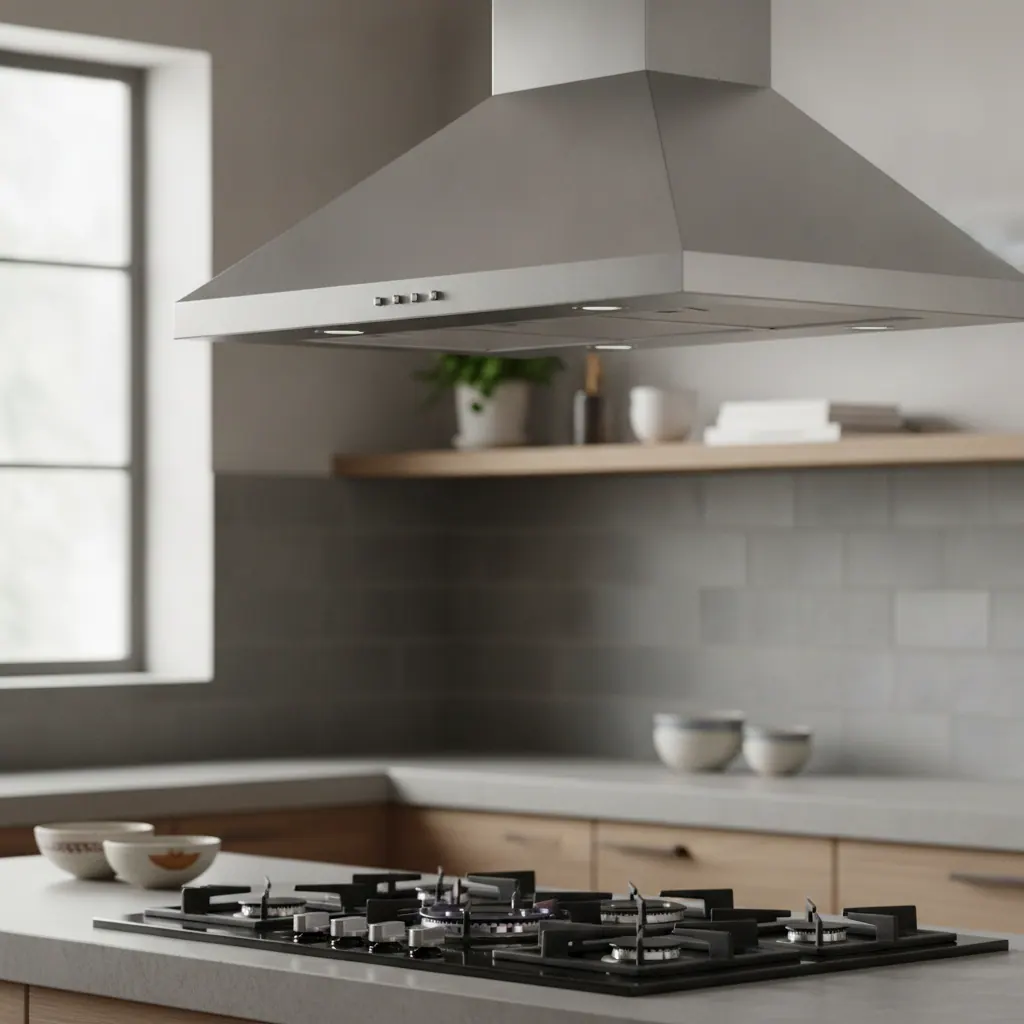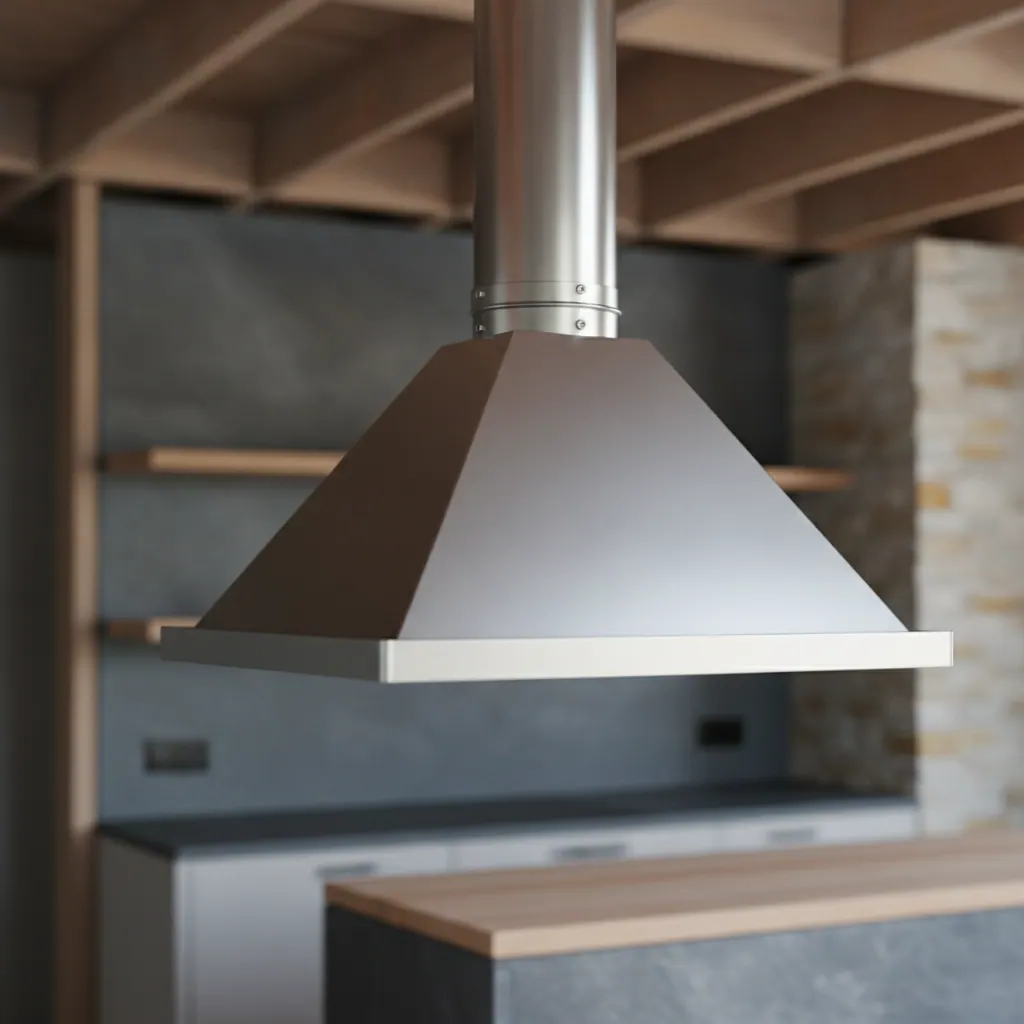
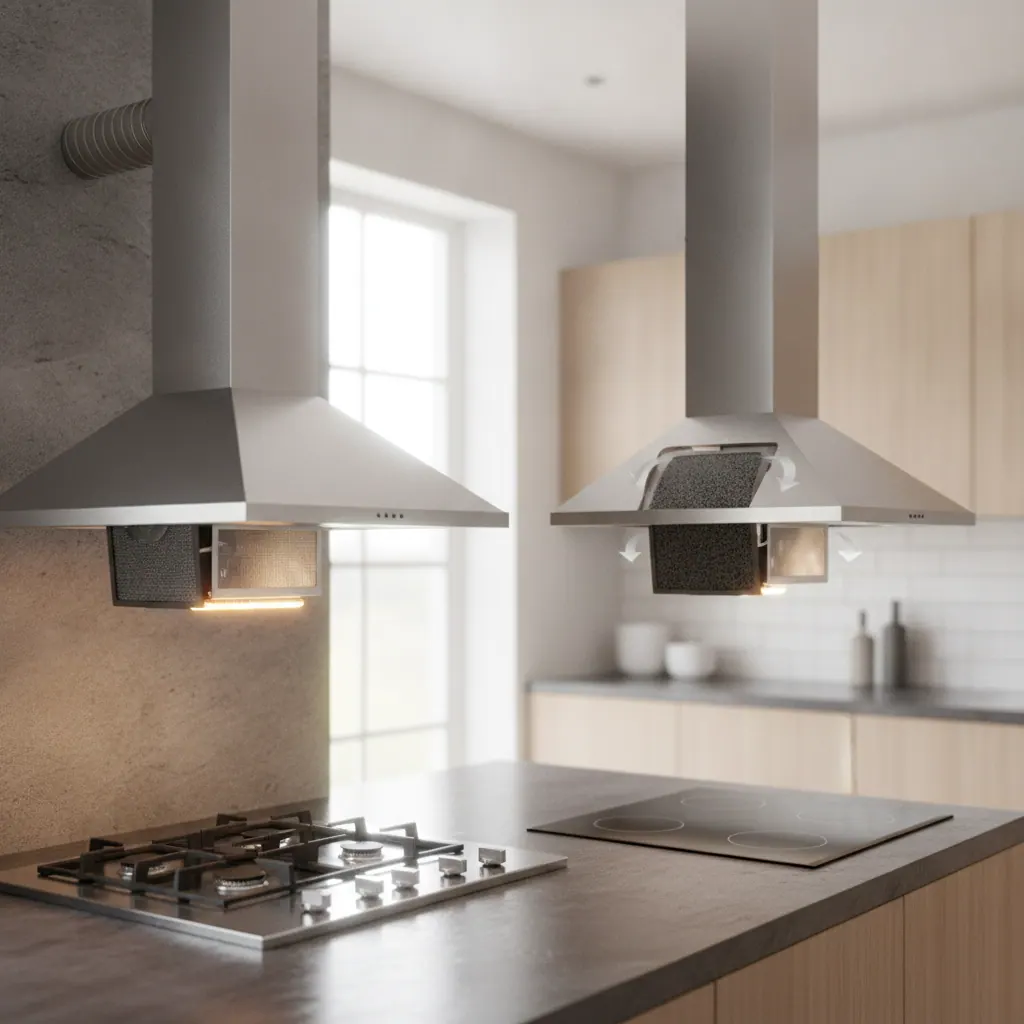
A ducted range hood moves kitchen air outside the building. A ductless hood — also called recirculating — pulls air through filters and hands it straight back to the room. That is the whole distinction, and it decides everything else.
The short version: ducted wins on every performance measure that matters, and the only honest case for ductless is a kitchen where no duct path exists. But the strength of that case depends enormously on what you cook with. Over induction it is a defensible compromise. Over gas, it is not ventilation.
What each type actually removes
| Removed from the kitchen | Ducted | Ductless |
|---|---|---|
| Grease aerosols | Yes | Partially (baffle + charcoal) |
| Cooking odors | Yes | Partially (charcoal, until saturated) |
| Moisture / steam | Yes | No |
| Heat | Yes | No |
| Combustion byproducts (NO₂, CO) | Yes | No |
| Fine particulates (PM2.5) | Yes | Minimal |
The pattern is not subtle. A recirculating hood can only remove what a filter can physically trap. Charcoal adsorbs odor compounds. A grease baffle catches aerosolized fat. Neither one removes water vapor, neither removes heat, and neither removes gases produced by burning methane.
Quotable takeaway: A ductless range hood removes nothing from the kitchen — it filters air and returns it to the room. Moisture, heat and combustion byproducts all stay, because nothing physically leaves the building.
The gas problem
Gas combustion produces nitrogen dioxide, carbon monoxide, formaldehyde and ultrafine particulates in proportion to burner run time. EPA guidance and a substantial peer-reviewed literature link unvented gas cooking to indoor NO₂ concentrations above WHO exposure limits in a meaningful share of homes. Our article on gas stoves and indoor air quality covers the evidence in depth.
An activated charcoal filter is engineered to adsorb odor molecules. It is not a scrubber for NO₂ and it does nothing for CO. So a recirculating hood over a gas cooktop captures some grease, softens the smell of last night’s fish, and returns the combustion products to the room essentially untouched — while also keeping every calorie of waste heat and every gram of water vapor indoors.
If you cook on gas and a duct run is genuinely impossible, be clear-eyed about it: the hood is an odor appliance. Open a window while you cook. Consider whether the kitchen is a candidate for converting to induction, which removes the combustion question entirely.
The induction exception
Induction is where the ductless argument becomes reasonable rather than merely convenient.
An induction cooktop produces no combustion byproducts at all — there is no flame, no fuel and no exhaust. It also dumps far less waste heat into the room, transferring 85–90 % of its energy into the pan against 32–40 % for gas. Two of the three fatal weaknesses of recirculating ventilation therefore shrink considerably.
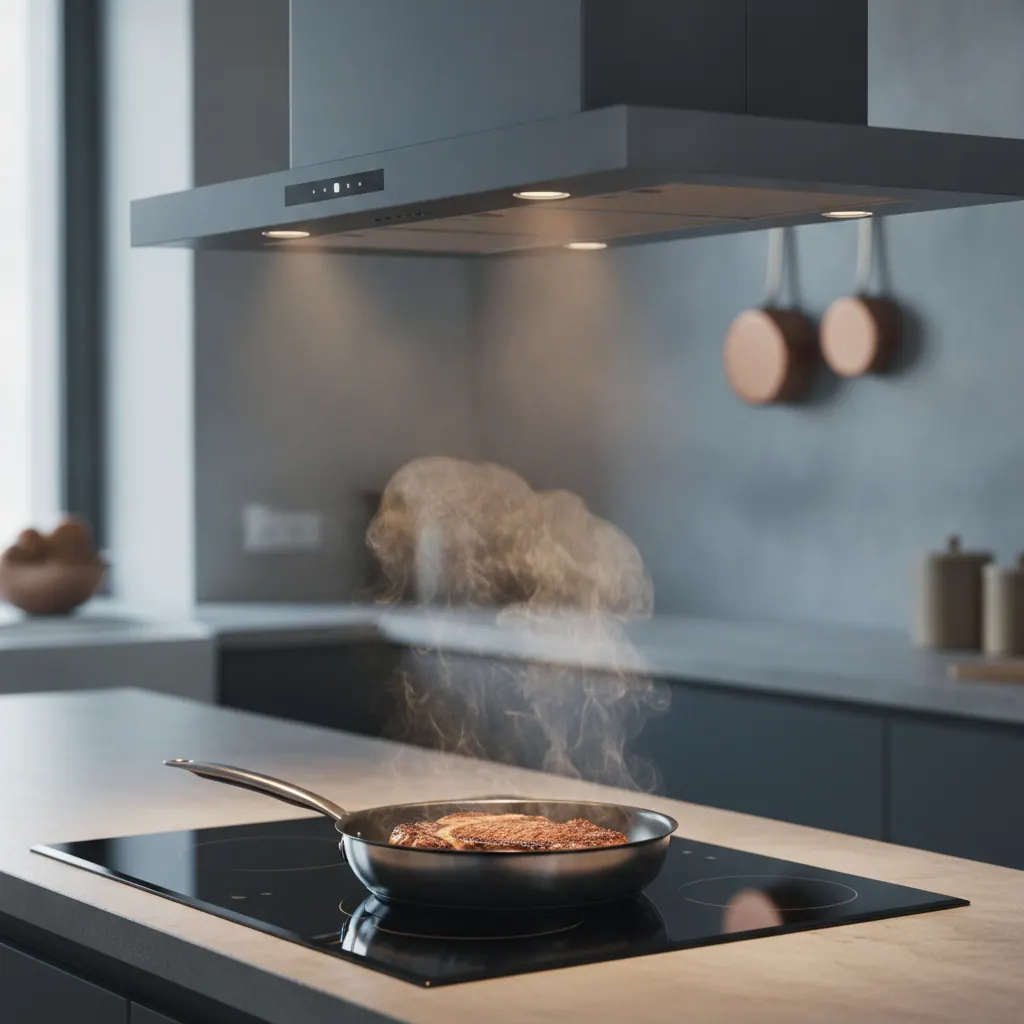
What remains is real but narrower: cooking itself still generates pollutants, regardless of heat source. Searing a steak, frying, and heating oil past its smoke point all produce grease aerosols, PM2.5 and acrolein from the food and the fat, not from the fuel. Boiling still produces steam that a charcoal filter cannot touch.
So the honest position for an induction kitchen with no duct path: a good recirculating hood handles odor and grease acceptably, moisture remains your problem, and you should still crack a window when frying. That is a genuine compromise rather than a failure. For a gas kitchen, the same setup leaves the actual hazard unaddressed. Do induction cooktops need a range hood goes further into what induction ventilation actually needs.
The moisture problem nobody plans for
Of everything a ductless hood fails to remove, moisture causes the most damage over time.
Boiling a large pot of pasta releases a substantial volume of water vapor. Ducted, it leaves the building. Recirculating, it stays — and condenses on whatever surface in the kitchen is coldest. In practice that means window glass, the underside of wall cabinets, and exterior wall surfaces behind cabinetry where you will not see it until there is a problem.
Older, leaky houses tolerated this because they exchanged air constantly through the building envelope. Modern tight construction does not. This is why building science guidance has moved steadily toward exhausting kitchen air outdoors, and why kitchen exhaust appears in ASHRAE residential ventilation standards at all.
The running cost people forget
Ductless looks cheaper. Over a decade, it frequently is not.
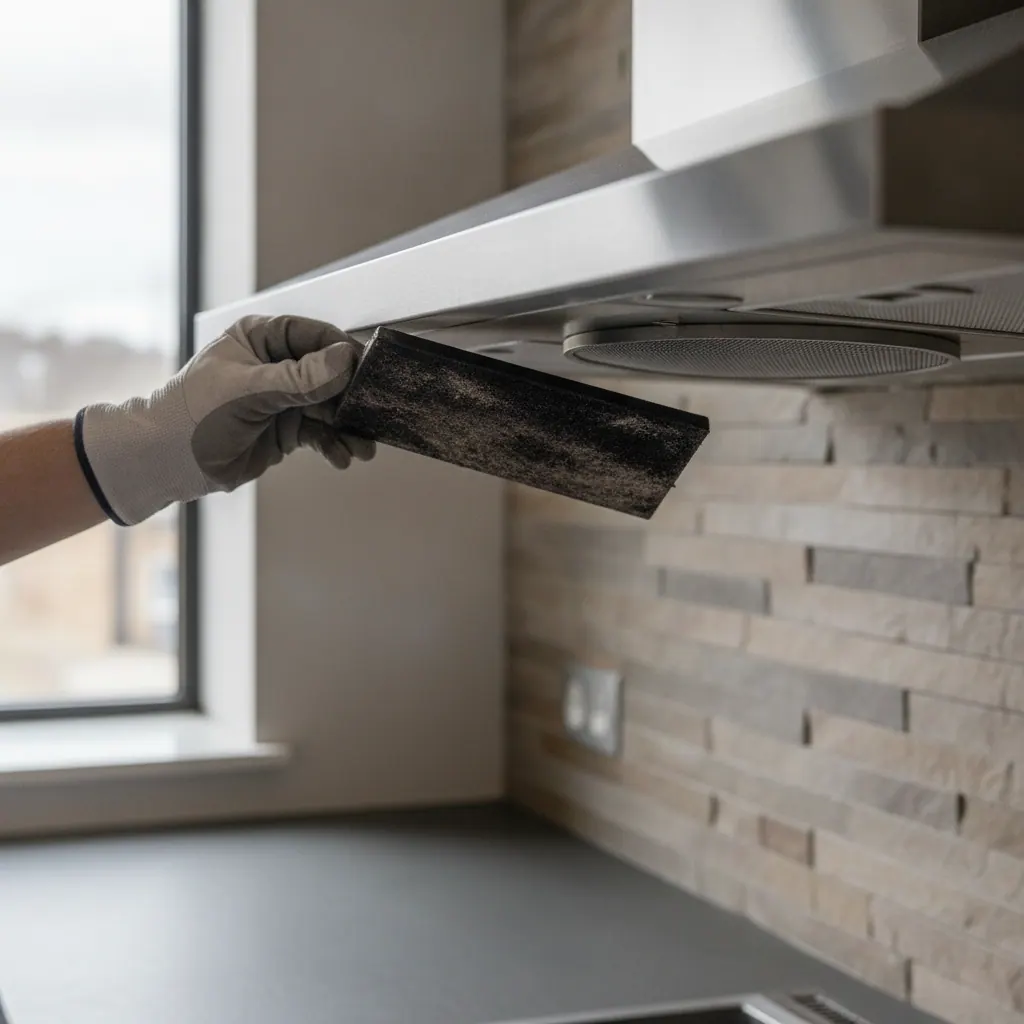
Charcoal filters are consumable. They adsorb until saturated, then stop working — with no visible change and no indicator light on most units. Typical replacement intervals run three to six months, shorter if you fry often, at $30–60 per set.
At four-month intervals and $45 a set, that is roughly $135 a year, or $1,350 over ten years. Running an 8-inch duct through an exterior wall in an accessible kitchen frequently costs less than that as a one-time expense. The economics only favor recirculating when the duct path is genuinely difficult — a slab-on-grade island, an interior condo kitchen, a historic façade you cannot penetrate.
Performance in practice
Even setting filtration aside, recirculating hoods lose airflow. Pushing air through a dense charcoal cartridge adds static pressure the blower must overcome, and the same unit typically delivers meaningfully less airflow in recirculating configuration than in ducted. Manufacturers usually publish both figures — read the recirculating column, not the headline.
This compounds the sizing problem covered in our range hood CFM guide: you are already asking a smaller effective airflow to do a job that filtration has made harder.
Quotable takeaway: The same hood delivers less airflow in recirculating mode than ducted, because charcoal filters add static pressure. Compare the recirculating CFM figure, not the headline number.
When ductless is the right call
It is a defensible choice when all of these hold:
- The cooktop is induction or electric, not gas.
- There is no practical duct path — interior condo kitchen, slab-on-grade island, protected façade, or an HOA that prohibits exterior penetrations.
- You cook mostly low-moisture, low-smoke food rather than frying daily.
- You will actually replace the filters on schedule.
Fail the first condition and you should be looking at a duct route or a different fuel. Fail the last and you have installed a decorative light fixture with a fan in it.
Converting ductless to ducted
Many hoods are sold as convertible: a knockout panel on top, a recirculating kit in the box, and a transition collar available as an accessory. Conversion then means removing the charcoal filters, fitting the collar and running duct.
The hood is rarely the obstacle. The duct path is. Whether this is a $300 afternoon or a $3,000 project depends on joist direction, exterior wall access, roof penetration requirements and how far the cooktop sits from an outside wall. Our range hood installation guide covers duct sizing, equivalent length and the mounting rules that determine what is feasible.
One thing to settle early: if the converted system will be capable of exceeding 400 CFM, IRC jurisdictions will require makeup air. See range hood makeup air requirements before you commit to a blower size.
Bottom line
- Ducted is better on every measure. Choose it whenever a duct path exists.
- Never treat a ductless hood as ventilation over gas. It does not remove the combustion products that make gas cooking an air-quality question in the first place.
- Ductless over induction is a real compromise, not a failure — odor and grease are handled acceptably, moisture is not.
- Budget the filters. $1,000+ over a decade changes the comparison.
- Check the recirculating CFM, not the ducted headline figure.
Still weighing fuel types? Our induction vs gas comparison covers the full case, and how to choose a cooktop covers size and budget alongside it.
Frequently asked questions
Are ductless range hoods effective?
Partially. A ductless hood pulls air through a grease baffle and an activated charcoal filter, then returns it to the room. That removes a useful share of grease aerosols and odor molecules, but it removes no moisture, no carbon monoxide, no nitrogen dioxide and no heat, because nothing physically leaves the kitchen. For an induction or electric cooktop in an apartment with no duct path, that is a reasonable compromise. Over gas, it is not ventilation in any meaningful sense.
Can I use a ductless range hood over a gas stove?
You can install one, and many apartments have exactly that, but it does not address the actual hazard. Gas combustion produces nitrogen dioxide, carbon monoxide, formaldehyde and ultrafine particulates. A charcoal filter is designed to adsorb odor compounds, not to capture NO2 or CO, and recirculating returns those gases to the room along with all the moisture. If you cook on gas and cannot duct outdoors, open a window while cooking and treat the hood as an odor appliance rather than a safety device.
How often do you replace a charcoal filter in a ductless hood?
Every three to six months for typical household cooking, and closer to every three months if you fry regularly. Charcoal filters adsorb until they are saturated, at which point they stop working without any visible change — there is no obvious signal that the filter is spent. Budget 30 to 60 dollars per replacement. Over a ten-year ownership period, that recurring cost often exceeds the one-time price difference of ducting properly in the first place.
Can a ductless range hood be converted to ducted?
Frequently yes. Many hoods ship as convertible units with a knockout panel on top and a recirculating kit in the box, so conversion means removing the charcoal filters, fitting a transition collar and running duct to an exterior wall or roof. The hood itself is rarely the obstacle. The obstacle is the duct path — finding a route through joists, exterior walls or a roof penetration is what determines whether conversion costs a few hundred dollars or a few thousand.
Does a ductless range hood remove steam?
No. This is the clearest limitation of recirculating ventilation. Moisture is not filtered by charcoal or by a grease baffle, so every bit of steam from a boiling pot stays in the kitchen and condenses on the coolest surfaces available — windows, cabinet undersides, walls. In tight, well-insulated homes that accumulated moisture is a genuine mold risk, and it is the reason building science guidance consistently favors exhausting kitchen air outdoors.