Range hood sizing comes down to two rules, and which one applies depends on what you cook with. For induction and electric cooktops, plan on 100 CFM per linear foot of cooktop width. For gas, size by burner output: roughly 1 CFM per 100 BTU of total rated output. Everything else — island placement, duct losses, hood width — adjusts those baselines up or down.
After a decade of specifying ventilation alongside the cooktops we test, the single most common mistake I see is not buying too little CFM. It is buying a big number on a box and then destroying it with 30 feet of corrugated duct and three elbows. The rated CFM and the delivered CFM are different quantities, and only one of them ever cooks dinner.
TL;DR — the 60-second answer
| Cooktop | Width | Baseline CFM (wall) | Island CFM |
|---|---|---|---|
| Induction / electric | 30” | 250 | 350 |
| Induction / electric | 36” | 300 | 450 |
| Gas, ~40,000 BTU | 30” | 400 | 550 |
| Gas, ~60,000 BTU | 36” | 600 | 800 |
| Pro-style gas, 25,000 BTU burner | 36”–48” | 900+ | 1,200+ |
Quotable takeaway: Induction and electric cooktops are sized at 100 CFM per linear foot of width. Gas cooktops are sized at 1 CFM per 100 BTU of total burner output — a rule that produces a much larger number, because combustion adds heat, moisture and pollutants the electric cooktop never creates.
Why gas and induction use different formulas
A cooktop’s ventilation load is not really about the cooktop. It is about how much of its energy ends up in the room rather than in the pan.
Induction transfers roughly 85–90 % of its energy directly into the cookware. Electric smooth-top manages 74–77 %. Gas manages 32–40 %. The rest becomes waste heat, and in the case of gas, it arrives alongside combustion byproducts — nitrogen dioxide, carbon monoxide, formaldehyde and ultrafine particulates. Our induction vs gas comparison covers the efficiency data in detail, and gas stoves and indoor air quality covers what the combustion side actually emits.
That gap is why the formulas diverge. The linear-foot rule sizes a hood to capture a thermal plume. The BTU rule sizes a hood to capture a plume plus the products of combustion. Applying the induction rule to a gas cooktop leaves you chronically under-ventilated even though the arithmetic looked fine.
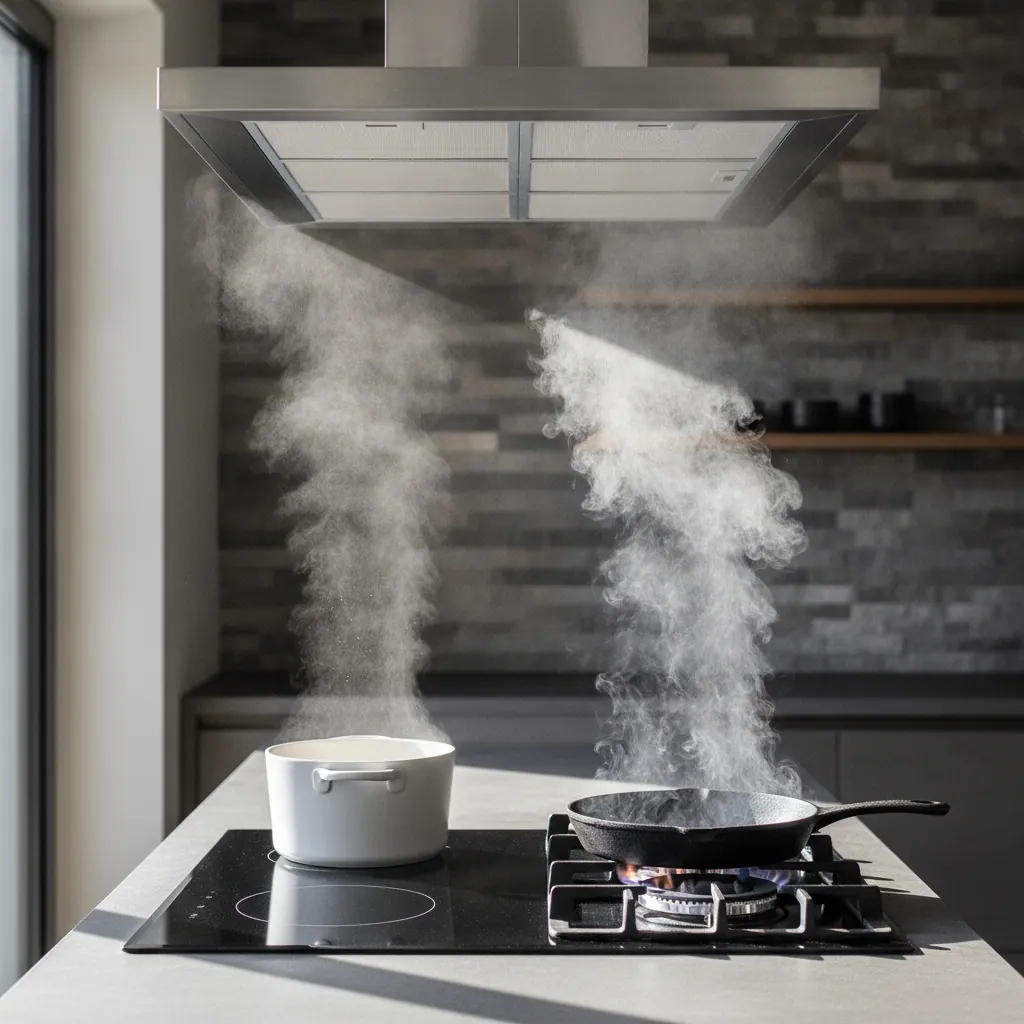
To run the gas calculation, you need your cooktop’s total rated output, not its headline burner. Add every burner: a typical 30-inch four-burner unit lands at 55,000–65,000 BTU/hr combined, which is why 600 CFM is such a common recommendation at that size. Our gas cooktop BTU guide explains how much of that rated output reaches the pan in the first place — and the answer, again, is that most of it does not.
Islands need more, and here is why
The same hood that performs well against a wall underperforms over an island. A wall installation gets help from the wall itself and often from adjacent cabinetry: the plume is contained on at least one side and pushed toward the capture area. An island hood is working in open air, exposed to cross-drafts from HVAC registers, doorways and foot traffic.
Add 30–50 % to the wall figure for an island. A 36-inch induction cooktop that wanted 300 CFM against a wall wants 400–450 on an island. For gas the penalty is steeper, because a hotter plume is also a faster-rising, more turbulent one.
If ducting to an island is impractical — a common problem in slab-on-grade construction and upper-floor condos — a downdraft cooktop sidesteps the geometry entirely, at the cost of capture performance on tall stockpots.
The number on the box is not the number in your kitchen
Manufacturers rate blowers at zero static pressure. That is a laboratory condition: the blower runs with nothing attached. Add real ductwork and the delivered airflow falls, sometimes dramatically.
Resistance accumulates in equivalent feet of straight duct:
| Component | Approximate equivalent length |
|---|---|
| 90° elbow | 15 ft |
| 45° elbow | 9 ft |
| Wall cap with damper | 30 ft |
| Roof cap | 30–40 ft |
| Transition to a smaller diameter | 5–25 ft, depending on severity |
A run with two 90° elbows and a roof cap has already spent 60–70 equivalent feet before a single foot of actual duct is counted. This is how a 600 CFM hood ends up delivering something closer to 400.
Two rules protect you. Never reduce the duct below the hood’s outlet diameter — a 10-inch outlet necked down to 6-inch round is the single most destructive thing you can do to a ventilation system. And never use flexible or corrugated duct; its ribbed interior generates several times the friction of smooth rigid metal. Our range hood installation guide covers duct sizing, mounting height and static pressure in full.
More CFM is not automatically better
There is a ceiling, and it is a safety ceiling rather than a comfort one.
A powerful hood in a well-sealed house is a large air pump removing conditioned air from an enclosed volume. That air has to be replaced from somewhere. In a tight modern build, “somewhere” can mean backwards down the flue of an atmospherically vented water heater or furnace, dragging carbon monoxide into the living space. This is called backdrafting, and it is the reason the building code intervenes.
In jurisdictions following the IRC, a kitchen exhaust system capable of exceeding 400 CFM triggers a makeup air requirement. That threshold explains a curious pattern in the market: an implausible number of hoods are rated at exactly 395 or 400 CFM. They are engineered to sit just under the line so the installation avoids a makeup air system. Whether that is good ventilation or good marketing depends on what you cook.
Our range hood makeup air requirements guide covers the code language, the exemptions and what a compliant makeup air system actually costs.
Quotable takeaway: A kitchen exhaust system capable of exceeding 400 CFM triggers a makeup air requirement under the IRC. Hoods rated at exactly 395 or 400 CFM are engineered to stay below that threshold, not because 400 CFM is the right amount of ventilation.
Hood width: match the cooktop, then add margin
A rising plume spreads as it climbs. By the time smoke from a 30-inch cooktop reaches a hood mounted 30 inches above it, the plume is wider than the cooktop that produced it. A hood that merely matches the cooktop footprint is therefore already undersized at capture height.
- Minimum: hood width equals cooktop width.
- Better: 3 inches of overhang on each side, so a 36-inch hood over a 30-inch cooktop.
- Gas, especially pro-style: treat the overhang as mandatory rather than optional.
Mounting height interacts with this. Most manufacturers specify 24–30 inches above induction and electric, and 27–36 inches above gas. Mounting higher than spec to clear a tall cook means capturing a wider, more diffuse plume — which requires more CFM to achieve the same result. Always follow the specific model’s installation manual; the clearance is a fire-safety figure as much as a performance one.
Sones: the spec buyers ignore until they live with it
CFM sells hoods. Sones determine whether you actually run the thing.
A sone is a linear loudness unit: 2 sones is twice as loud as 1 sone. This is different from decibels, which are logarithmic, and it makes sone figures unusually easy to reason about. A quiet refrigerator sits around 1 sone.
- 1–3 sones: normal cooking speeds on a well-built hood. Conversation is unaffected.
- 6–9 sones: boost mode. Tolerable in bursts, not for an hour of frying.
- Above 9 sones: you will not use it, which makes the CFM rating irrelevant.
Prefer HVI-certified sone ratings. Uncertified manufacturer numbers are frequently measured at conditions that flatter the product. A common workaround for noise is a remote or inline blower mounted in the attic or on an exterior wall, which moves the motor away from the kitchen and can cut perceived noise substantially at the same airflow.
Putting it together: a worked example
A 36-inch gas cooktop with five burners totalling 62,000 BTU, installed against a wall, ducted 12 feet horizontally with two 90° elbows to a wall cap.
- Baseline: 62,000 BTU ÷ 100 = 620 CFM.
- Wall installation: no island penalty.
- Duct losses: 12 ft actual + 30 equivalent ft (two elbows) + 30 equivalent ft (wall cap) = 72 equivalent feet. Expect to lose roughly a third of rated airflow on this run.
- Specify: a hood rated 900 CFM to reliably deliver ~600 at the cooktop, with 8-inch rigid duct minimum.
- Code: 900 CFM exceeds 400, so a makeup air system is required in IRC jurisdictions. Budget for it at design time, not after the drywall is up.
That last step is the one that derails kitchen remodels. Makeup air is cheap to plan and expensive to retrofit.
Bottom line
- Induction and electric: 100 CFM per linear foot. 250 for a 30-inch, 300 for a 36-inch.
- Gas: 1 CFM per 100 BTU of total output. Usually 400–700 CFM for residential, 900+ for pro-style.
- Island: add 30–50 %.
- Duct losses: budget a third of rated CFM on a typical run with two elbows and a cap.
- Above 400 CFM: expect a makeup air requirement.
Still choosing the cooktop itself? Our how to choose a cooktop framework covers fuel, size and budget, and our cooktop installation guide covers the electrical and gas side of the same project. If you have landed on induction, do induction cooktops need a range hood answers the question most induction buyers ask next.
Frequently asked questions
How many CFM do I need for a range hood?
For induction and electric cooktops, plan on 100 CFM per linear foot of cooktop width — 250 CFM for a 30-inch unit, 300 CFM for a 36-inch. For gas, size by burner output instead: roughly 1 CFM per 100 BTU of total rated output, so a 60,000 BTU cooktop wants about 600 CFM. Island installations need 30 to 50 percent more than the same hood mounted against a wall, because there are no side walls to help contain the plume.
Is 400 CFM enough for a gas cooktop?
It depends entirely on burner output. A modest 40,000 BTU four-burner cooktop is well served by 400 CFM. A 60,000 BTU unit is not, and a pro-style 20,000 BTU power burner will overwhelm it during hard searing. There is also a code consequence: in most jurisdictions adopting the IRC, a kitchen exhaust system capable of exceeding 400 CFM triggers a makeup air requirement, which is why so many hoods are rated at exactly 395 or 400 CFM.
Can a range hood have too much CFM?
Yes. Over-ventilating depressurizes a tight house and can backdraft combustion appliances — pulling carbon monoxide from an atmospherically vented water heater or furnace into the living space. That is precisely the hazard the makeup air provisions in the building code exist to prevent. A 1,200 CFM hood in a well-sealed home without makeup air is a genuine safety problem, not just an oversized purchase.
Does duct length reduce range hood CFM?
Significantly. The CFM printed on the box is measured at zero static pressure — essentially a bare blower on a bench. Real duct runs, elbows and termination caps add resistance that a blower must overcome, and each 90-degree elbow costs roughly the equivalent of 15 feet of straight duct. A 600 CFM hood on a long, elbow-heavy run with a restrictive roof cap can deliver closer to 400 CFM at the cooktop.
How wide should a range hood be compared to the cooktop?
At minimum, match the cooktop width. Better practice is to go 3 inches wider on each side, which is why a 36-inch hood over a 30-inch cooktop captures noticeably better. Rising plumes spread as they climb, so a hood that only matches the cooktop footprint is already undersized at capture height. For gas in particular, the extra overhang is worth the cost.
What is a sone and how quiet should a range hood be?
A sone is a linear loudness unit — 2 sones is genuinely twice as loud as 1 sone, unlike decibels. A quiet refrigerator is roughly 1 sone. Good hoods run 1 to 3 sones at normal speed and 6 to 9 sones on boost. Look for HVI-certified ratings, since uncertified manufacturer figures are often measured under favorable conditions that do not reflect installed performance.
Sizing guidance in this article reflects HVI recommendations and IRC provisions current to 2026. Local code adoption varies — confirm requirements with your building department before finalizing a ventilation design. See our editorial policy.