Most people worry about kitchen fires when they think about gas stove safety. That concern, it turns out, barely scratches the surface. A growing body of peer-reviewed research — particularly studies published between 2022 and 2024 — has confirmed that gas cooking appliances pump a genuinely alarming mix of toxic pollutants directly into the air your family breathes every day. Nitrogen dioxide, carbon monoxide, benzene, ultrafine particles — these things don’t wait politely in the kitchen. They drift into living rooms, hallways, and bedrooms within minutes of ignition. For the approximately 40 million American households still cooking with gas, this is a health story that deserves far more attention than it currently gets.
Below, we break down exactly which pollutants are involved, what the research actually shows about health outcomes, who faces the greatest risk, and — most importantly — what you can do about it right now.
So What Exactly Is Coming Out of Your Gas Stove?
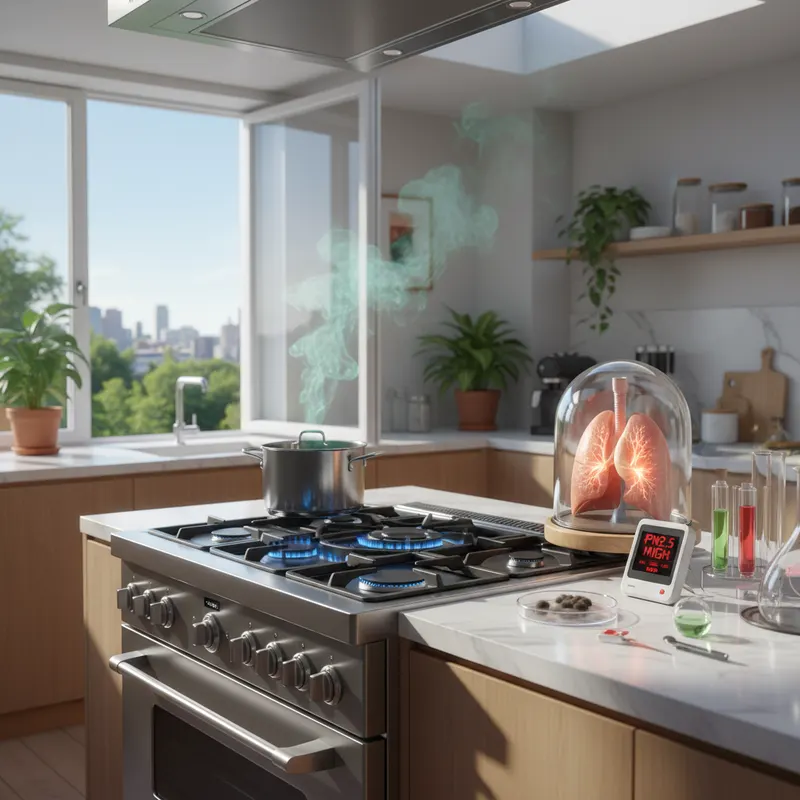
Gas stoves produce at least five distinct categories of harmful pollutants — and here’s the part that surprises most people — some of those emissions happen even when the stove is completely switched off.
Nitrogen Dioxide (NO2)
This is the big one. NO2 is the primary combustion pollutant that gas burners release, and the concentration levels researchers have been measuring in real homes are genuinely alarming. A 2023 Stanford University study published in Environmental Science & Technology monitored 87 California homes and found that running a single gas burner for just 15 minutes could drive kitchen NO2 concentrations above 400 µg/m³ — that’s more than 16 times the WHO’s outdoor air quality guideline of 25 µg/m³. And in smaller kitchens without a functioning range hood? Levels in adjacent rooms crossed the outdoor safety threshold within half an hour.
Carbon Monoxide (CO)
Incomplete combustion produces CO, and incomplete combustion happens more often than you’d think — worn igniters, inconsistent gas pressure, or a burner running on its lowest setting can all contribute. When indoor CO climbs above 35 ppm (OSHA’s 8-hour ceiling), the effects include headaches, dizziness, and cognitive impairment. A poorly adjusted burner can briefly spike CO to genuinely dangerous levels right at startup.
Benzene and Other Volatile Organic Compounds
This is the finding that genuinely shocked researchers when it first came out. A 2022 investigation by PSE Healthy Energy discovered that every single gas appliance tested was leaking unburned natural gas — even when the stove was completely off. Natural gas isn’t pure methane; it contains trace quantities of benzene, which the WHO’s International Agency for Research on Cancer has classified as a confirmed Group 1 human carcinogen. Benzene leakage was detected from stove connections in 73% of the homes tested, with no meaningful relationship to how old the appliance was or what brand it came from.
Fine Particulate Matter (PM2.5)
Cooking generates PM2.5 regardless of what type of stove you use — but gas flames add an additional layer of combustion-derived particles on top of the food-derived ones. PM2.5 is dangerous precisely because it’s small enough to penetrate deep into lung tissue, where it contributes to both cardiovascular and respiratory disease. There is no established safe exposure threshold.
Formaldehyde and Ultrafine Particles
Gas combustion also produces formaldehyde (classified as a probable human carcinogen) along with ultrafine particles measuring less than 0.1 µm. These particles are too small for standard air filters to catch — they bypass most filtration systems and deposit directly into bronchial tissue.
What Does the Health Research Actually Show?
The scientific literature here isn’t thin or preliminary anymore. It’s substantial, it’s consistent, and it points in one direction.
Childhood Asthma — A Statistically Significant 13% Elevated Risk
A 2023 meta-analysis in the International Journal of Environmental Research and Public Health pooled data from 41 separate studies conducted across 12 countries. The conclusion: children raised in homes where gas stoves are used have a 13.8% higher lifetime risk of developing asthma compared to kids in homes with electric cooking. To put that in perspective, that’s comparable to the asthma risk associated with living with a cigarette smoker. Researchers at Harvard’s T.H. Chan School of Public Health went further and estimated that gas stove exposure accounts for roughly 12.7% of all childhood asthma cases in the United States — approximately 650,000 children.
Respiratory and Cardiovascular Effects in Adults
Sustained NO2 exposure above 40 µg/m³ (annual mean) has been associated with a range of serious outcomes in adults, including:
- Measurable decline in lung function (reduced FEV1)
- Higher rates of hospital admission for COPD flare-ups
- Increased incidence of ischemic heart disease
The EPA’s Integrated Science Assessment for Oxides of Nitrogen — first published in 2016 and reaffirmed in 2022 — classifies NO2 as a direct causal factor for respiratory inflammation at acute concentrations above 200 µg/m³. Gas stove cooking routinely blows past that level.
Cancer Risk From Benzene
Benzene is a carcinogen for which no safe exposure level has been established — any exposure carries some degree of risk. IARC links it specifically to leukemia and other blood cancers. The PSE Healthy Energy research team estimated that the chronic low-level benzene leakage detected in poorly ventilated homes could translate to an annual excess cancer risk of roughly 1 in 10,000 for regular occupants — a threshold the EPA considers potentially concerning enough to warrant action.
Who Faces the Greatest Risk?
Not every household is equally exposed, and not everyone exposed is equally vulnerable. Here’s a breakdown of who has the most reason to be concerned.
| Group | Why They’re More Vulnerable |
|---|---|
| Children under 6 | Faster respiratory rates, still-developing lungs, more time spent indoors |
| Adults over 65 | Reduced respiratory reserve, greater time spent at home near cooking |
| People with asthma or COPD | Already-compromised airways react to NO2 with acute inflammation |
| Pregnant women | Fetal NO2 exposure linked to preterm birth and reduced birth weight |
| Renters in small apartments | Limited ability to install ducted ventilation; smaller air volume to dilute pollutants |
| Lower-income households | Older, less efficient appliances; fewer resources for upgrades or mitigation |
The environmental justice angle here is worth sitting with for a moment. A 2024 analysis from RMI (Rocky Mountain Institute) found that lower-income households and communities of color are disproportionately more likely to rely on gas for cooking and far less likely to have range hoods that actually vent to the outside. The people most exposed to this problem are often the least equipped to solve it.

What You Can Actually Do About It
Here’s the part most articles skip over in favor of vague advice. You don’t have to rip out your stove this weekend to meaningfully reduce your family’s exposure. These interventions are ranked by how much of a difference they actually make.
1. Run a Ducted Range Hood — Without Exception
A properly ducted range hood (one that genuinely vents air to the outdoors, not just through a charcoal filter and back into the room) can cut peak NO2 concentrations during cooking by 60 to 70%, according to data from Lawrence Berkeley National Laboratory. That’s a huge reduction, and it costs nothing beyond the hood itself. Our ducted vs ductless range hoods guide covers why a charcoal filter cannot substitute, and the range hood CFM guide covers how much airflow a gas cooktop actually needs.
A few habits that matter:
- Switch the hood on before you light the burner, not after
- Keep it running for at least 5 minutes after you’re done cooking
- Confirm your hood actually vents outside — hold a tissue near the exterior duct output to check
- Clean or swap out filters every 3 to 6 months; clogged filters dramatically reduce effectiveness
2. Open Windows and Create Cross-Ventilation
Even cracking a single window near the kitchen reduces NO2 concentration by 25 to 40% compared to a sealed room — LBNL field measurements back this up. If you can create cross-ventilation with openings on opposite sides of the space, you’ll do even better. Simple, free, and genuinely effective.
3. Use the Back Burners When Possible
This one surprises people. Range hood capture efficiency varies depending on which burners you use — the hood’s intake is positioned to capture cooking plumes from the back of the stove most effectively. Front burners, which most of us use most often (guilty), actually have the lowest capture rates because the rising plume tends to bypass the hood entirely. The Stanford study specifically flagged this issue.
4. Add a Quality Air Purifier to the Kitchen
A standalone unit with both a true HEPA filter and activated carbon media can make a real dent in PM2.5 levels and some VOC concentrations. That said — and this is important — air purifiers are not efficient at removing NO2. Physical ventilation is irreplaceable for that particular pollutant. Think of the purifier as a complement to ventilation, not a substitute.
5. Seriously Consider Making the Switch to Induction
This is the complete solution rather than a workaround. Induction cooktops generate zero combustion byproducts because they transfer heat electromagnetically rather than through flame. No burning means no NO2, no CO, no benzene from combustion. And unlike ventilation strategies, switching to induction also eliminates the passive benzene leakage that happens even when your gas appliances are sitting completely idle. For a thorough side-by-side comparison of induction, gas, and electric cooking across efficiency, running costs, and health outcomes, our full guide is here: Induction vs Gaz vs Électrique : Duel d’Efficacité et Coût Réel.
What Regulators Have Been Doing (2023–2026)
This debate has migrated from academic conferences to legislative chambers, and the pace of change has been faster than many expected.
- January 2023: U.S. Consumer Product Safety Commission commissioner Richard Trumka Jr. publicly stated the agency was “looking at all options” for gas stove regulation — a comment that set off a furious national debate and more than a few misleading headlines about a federal stove “ban.”
- 2023: New York City enacted Local Law 154, prohibiting gas in new residential buildings under seven stories — the most ambitious restriction of its kind anywhere in the country at the time.
- 2024: The California Air Resources Board finalized its plan to phase out the sale of new gas appliances, including cooktops, in the residential sector by 2030.
- 2025: The EU’s recast Energy Performance of Buildings Directive pushed member states to accelerate cooking electrification in public buildings and social housing projects.
- 2026: The U.S. Department of Energy finalized updated efficiency standards that effectively disqualify most standing-pilot gas ranges from compliance with new construction energy codes.
The political arguments are loud. The toxicology, however, isn’t seriously challenged by any major public health institution.
Gas vs. Electric vs. Induction: How Do They Stack Up on Air Quality?
| Cooktop Type | Combustion Byproducts | Passive Leaks When Off | PM2.5 During Cooking | NO2 Generated |
|---|---|---|---|---|
| Gas (natural gas) | Yes — NO2, CO, benzene | Yes — methane + benzene | Moderate to High | High (potentially 400+ µg/m³) |
| Electric coil / radiant | None | None | Moderate (food-derived only) | Zero |
| Induction | None | None | Low (faster cooking = less prolonged heat exposure) | Zero |
| Gas (propane) | Yes — similar profile to natural gas | Lower than natural gas, but present | Moderate to High | High |
The pattern here is pretty unambiguous. Electric and induction surfaces don’t generate combustion pollutants — full stop. The food-derived PM2.5 that any cooking method produces is best managed through ventilation regardless of what’s heating your pan.
Putting It All Together
The case against gas stoves from an indoor air quality standpoint isn’t speculative or politically motivated — it’s built on dozens of peer-reviewed studies accumulated over several years, with consistent findings across different research teams, different countries, and different methodologies. Gas cooking regularly pushes NO2 concentrations past WHO safety thresholds. Passive leaks introduce a confirmed carcinogen into your home even when nothing is turned on. And the childhood asthma connection, at this point, is as well-documented as many risks we take far more seriously as a society.
None of this means you have to panic or feel guilty about every meal you’ve cooked. But it does mean the issue deserves a serious response — and the good news is that the response doesn’t have to be expensive or disruptive to get started.
Use the ducted hood, open the windows, use the back burners. Pick up an air quality monitor that reads both CO and NO2 — knowing your actual exposure levels is genuinely eye-opening. And if you’re in a position to consider switching to induction, the IRA rebates of up to $840 available through 2032 make this a more realistic option than it’s ever been before.
Want to dig into the full picture before making any decisions? Our detailed comparison of Induction vs Gaz vs Électrique : Duel d’Efficacité et Coût Réel covers everything from cooking performance and running costs to long-term health considerations — so you can find what actually makes sense for your household.
Frequently asked questions
Do gas stoves really pollute indoor air?
Yes. Studies show gas stoves emit nitrogen dioxide (NO2), carbon monoxide (CO), benzene, and fine particulate matter even when burners are off, due to passive leaks of unburned natural gas.
What is a safe NO2 level indoors from a gas stove?
The WHO outdoor standard is 25 µg/m³ (annual mean). Research from Stanford (2023) found gas stoves can push kitchen NO2 above 400 µg/m³ during cooking — 16× that threshold.
Is switching to induction safer for air quality?
Yes. Induction cooktops produce zero combustion byproducts. They are widely considered the healthiest cooking surface option for indoor air quality.
Does ventilation solve the gas stove air quality problem?
A ducted range hood vented outside reduces NO2 and PM2.5 significantly, but does not eliminate passive leaks of methane and benzene that occur even when the stove is off. The word ducted matters: a recirculating hood filters odor and grease and returns everything else to the room, so it does not address NO2 or CO at all.