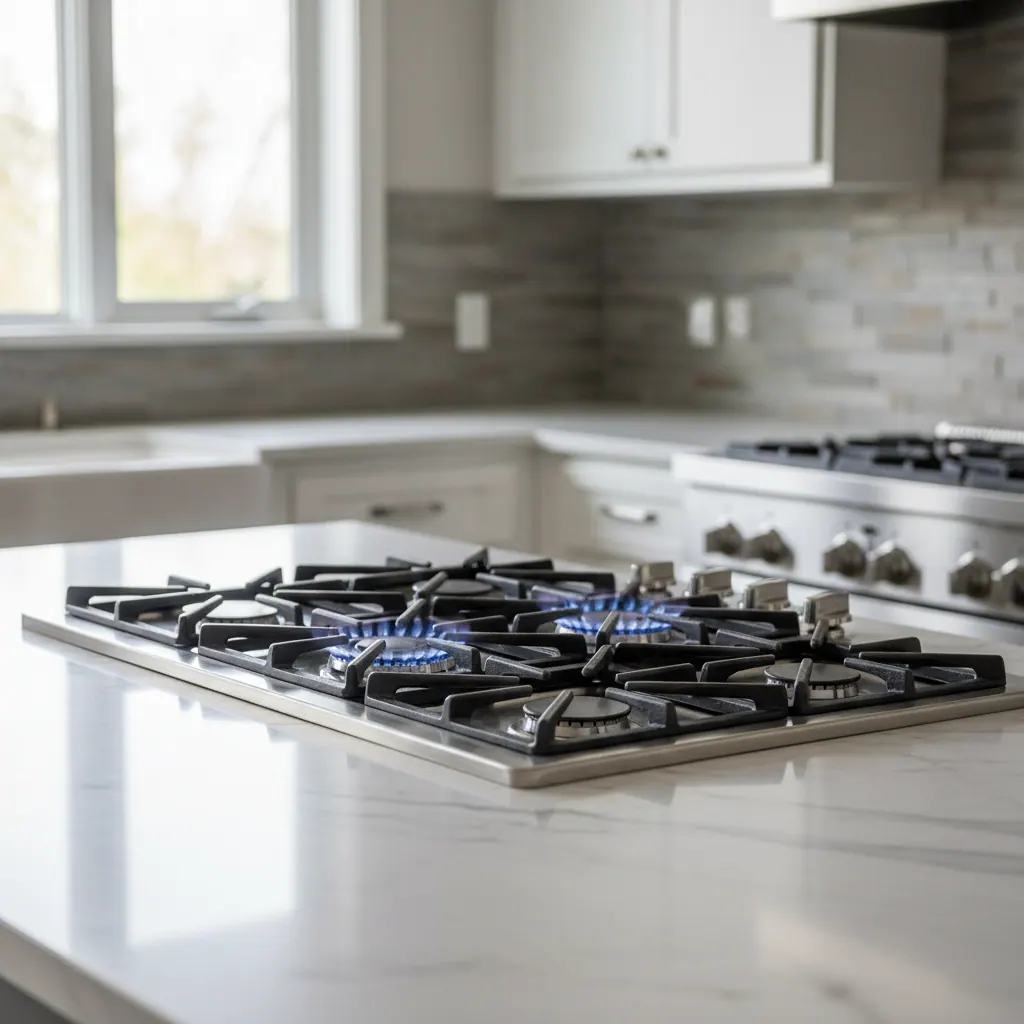
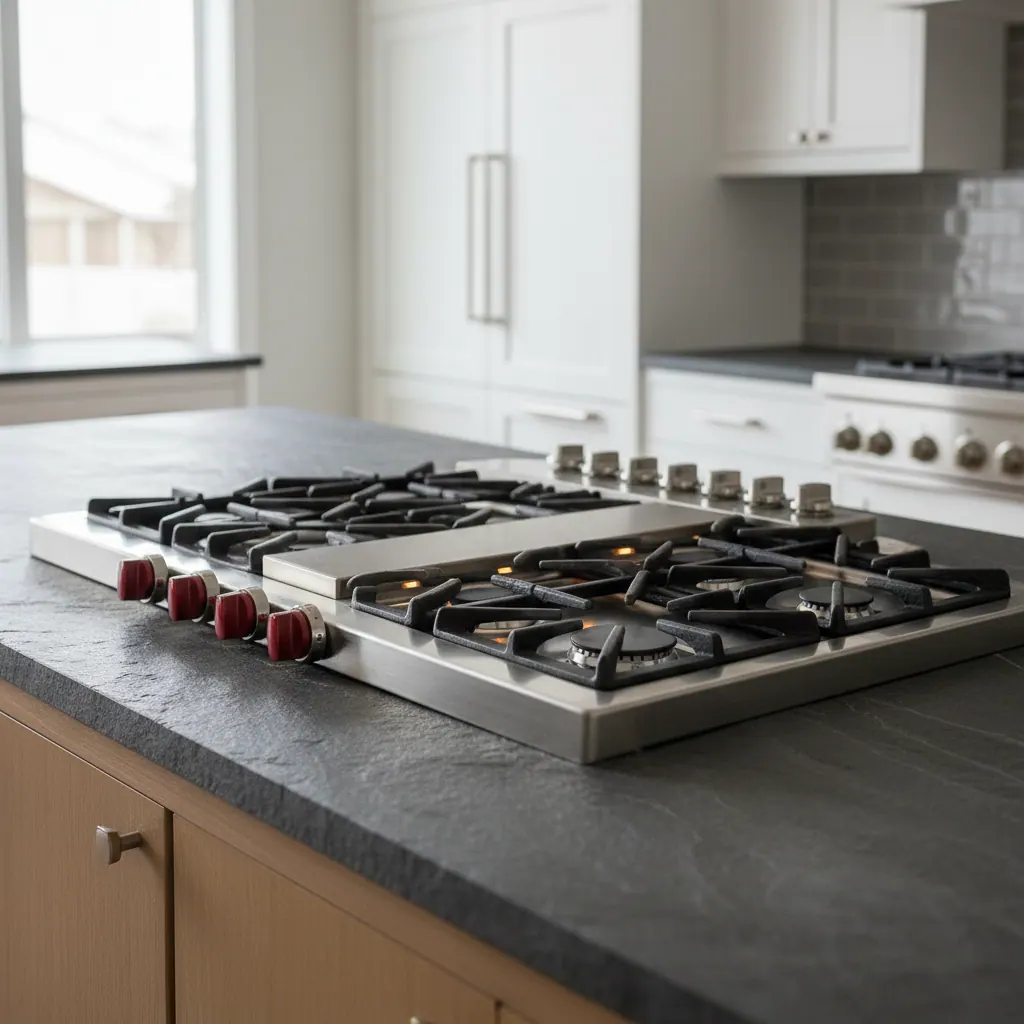
The Wolf vs Thermador question comes up in nearly every premium kitchen remodel where the homeowner has already decided on gas. Both brands sit at the top of the pro-style residential market. Both are sold at the same dealers, featured on the same showroom floors and in the same budgets. Choosing between them is a real decision.
After testing both brands extensively — including the Wolf CG365P/S and Thermador PCG365WS 36-inch models head-to-head — here is the honest comparison.
If you’re still deciding between gas and induction, our induction vs gas comparison is where to start. If you’ve already committed to pro-style gas, keep reading. Want Wolf’s full range — gas, induction and electric? See our Wolf cooktops guide.
The short answer
- Choose Wolf if you cook at high heat frequently — wok work, hard searing, large-pot boiling — and value the dual-stack burner’s ability to drop from a 20,000 BTU sear to a 300 BTU whisper simmer on the same burner without changing zones.
- Choose Thermador if you cook more gently — long braises, stocks, chocolate work, custards — and value the Star burner’s even heat distribution and ExtraLow’s 100 BTU floor.
Both are excellent. The decision is about your cooking style, not quality.
Side-by-side specs: Wolf CG365P/S vs Thermador PCG365WS
| Spec | Wolf CG365P/S | Thermador PCG365WS |
|---|---|---|
| Size | 36” | 36” |
| Burners | 6 | 5 |
| Max BTU | 20,000 BTU | 18,000 BTU |
| Min BTU | 300 BTU | 100 BTU (ExtraLow) |
| Burner design | Dual-stack, sealed | Star burner, sealed |
| Grates | Continuous cast iron | Individual cast iron |
| MSRP | $4,299 | $3,999 |
| Warranty | 5-year parts + labor | 2-year parts + labor |
| Country of final assembly | USA (Madison, WI) | USA (New Bern, NC) |

Burner design: dual-stack vs Star burner
This is the core technical difference between the two brands.
Wolf: dual-stack burners
Wolf’s patented dual-stack sealed burner uses two concentric flame rings:
- Outer ring: the primary high-BTU ring that fires from roughly 3,000 BTU (medium-low) up to 20,000 BTU at full power.
- Inner micro ring: a separate inner flame that maintains burns as low as 300 BTU independently, engaging automatically when you turn the knob below a certain threshold.
The practical result: every Wolf burner functions as both a power burner and a simmer burner. You don’t need to plan which zone is for high heat and which is for simmering — all six zones do both.
In our simmer test (30-minute hold at 180 °F, 3-qt All-Clad D3 saucier, inner ring engaged), the Wolf held ±5 °F. For a gas burner, that is class-leading precision at anything above 300 BTU.
Thermador: Star burners
Thermador’s Star burner replaces the circular flame ring with a 5-point star flame pattern. The design creates five angular heating points that — at medium and medium-low settings — distribute heat more evenly across the bottom of a pan than a circular ring.
In our thermal imaging test (12-inch All-Clad D3 stainless skillet, medium flame, 5-minute steady state):
- Thermador PCG365WS: pan-base temperature variance of 8 °F across 12 inches.
- Wolf CG365P/S: pan-base temperature variance of 19 °F across 12 inches.
The Thermador wins on evenness. The Wolf wins on simmer floor depth.
Thermador also has a dedicated ExtraLow simmer position on one burner per zone group — a separate low-BTU manifold that holds as low as 100 BTU, the lowest in the residential gas market. For chocolate tempering, hollandaise and delicate custard work, Thermador’s ExtraLow is genuinely without peer in gas cooktops.
Boil speed and high-heat performance
In our standardized boil test (6 qts, 70 °F tap water, All-Clad 12-qt stockpot, full power, three runs):
| Cooktop | Burner | Time to rolling boil |
|---|---|---|
| Wolf CG365P/S | Front-right, 20,000 BTU | 7 min 48 s |
| Thermador PCG365WS | Front-left, 18,000 BTU | 8 min 22 s |
| Bosch 800 Series gas | Front-center, 18,000 BTU | 8 min 58 s |
Wolf wins on boil speed by 34 seconds — a function of the extra 2,000 BTU on the primary power burner. In wok cooking, where you need to sustain 20,000 BTU for extended stir-fry sessions, that gap is more noticeable.
For reference, the best induction units bring the same 6-qt pot to a boil in 5:42 (Bosch Benchmark, 3,700 W). Both Wolf and Thermador trail induction on boil speed by roughly 2 minutes. See our induction vs gas head-to-head for the full data table.
Simmer and low-heat precision
Gas burners as a category are imprecise at very low settings — the BTU floor matters more than the ceiling for daily cooking. Our full simmer comparison:
| Model | Simmer precision (30 min at 180°F) | Absolute low (BTU floor) |
|---|---|---|
| Thermador PCG365WS ExtraLow | ±4 °F | ~100 BTU |
| Wolf CG365P/S inner ring | ±5 °F | ~300 BTU |
| Bosch 800 Series gas | ±6 °F | ~500 BTU |
| GE Café gas | ±14 °F | ~1,200 BTU |
Thermador wins at the absolute floor. If your cooking regularly includes:
- Chocolate melting at 104–113 °F
- Hollandaise holding at 145–160 °F
- Long-simmered stocks at 160–170 °F for 8+ hours
- Candy work that requires sub-200 BTU sustained holds
…Thermador’s ExtraLow is worth the choice. For everything else, the Wolf’s ±5 °F simmer on the inner ring is more than sufficient.
Our gas cooktop BTU guide breaks down the BTU-to-technique mapping in more detail.
Grate design and ergonomics
Wolf: continuous grates
The Wolf CG365P/S uses continuous cast-iron grates spanning the full 36-inch surface. You can slide a heavy stockpot from the back-right burner to the front-left burner without lifting. This is not a small thing when you’re managing a 16-qt stockpot.
The continuous grate design also means pans rest on a level surface from any starting position — there’s no height variation between grate sections.
Thermador: individual grate sections
Thermador uses individual grate sections (two per 36-inch model), with a slight gap between them. Pan movement across the cooktop requires a lift at the gap. The individual sections are lighter and easier to remove for cleaning.
Wolf’s continuous grate has the ergonomic edge. Thermador’s individual sections have the cleaning edge — each section fits in a dishwasher, while Wolf grates must be hand-washed.
Reliability and service
Both Wolf and Thermador are at the top of pro-style reliability rankings, but the warranty and service network differ:
| Wolf | Thermador | |
|---|---|---|
| Warranty | 5 years parts + labor | 2 years parts + labor |
| Service network | Sub-Zero Wolf factory service, all 50 states | BSH-authorized service, strong in major metros |
| Parts availability | Stocked at regional Wolf parts centers | BSH distribution network — longer lead times in some regions |
Wolf’s 5-year warranty is the longest standard coverage in the pro-style gas segment, and the Sub-Zero Wolf service network is the most comprehensive. Thermador’s 2-year coverage is competitive with most appliance brands but falls short of Wolf at this price point.
For buyers in major metros (NYC, LA, Chicago, Houston, Miami), both service networks are strong. For rural buyers more than 50 miles from a major market, Wolf’s denser factory-service footprint is a material advantage.

Cleaning and maintenance
Both brands use sealed burners that prevent food debris from entering the burner assembly. Both have cast-iron grates that require hand washing or occasional soaking.
Wolf grates: heavy, continuous, require removal as large sections. Hand wash only with a non-abrasive cleaner; no dishwasher. The burner caps and heads are stainless and wipe clean.
Thermador grates: individual sections, lighter, dishwasher-safe. Easier to maintain in weekly cleaning rotations.
One cleaning note relevant to both: the Star burner and dual-stack burner ports are susceptible to clogging from baked-on debris at the igniter. If a burner is clicking without lighting, the port cleaning procedure in our gas cooktop clicking not lighting guide covers both brands.
Price comparison
| Model | Size | MSRP | Typical street |
|---|---|---|---|
| Wolf CG304T/S | 30” | $2,099 | $1,850–$2,099 |
| Wolf CG365P/S | 36” | $4,299 | $3,800–$4,299 |
| Thermador PCG304W | 30” | $2,499 | $2,100–$2,499 |
| Thermador PCG365WS | 36” | $3,999 | $3,400–$3,999 |
The Wolf 36-inch is $300 more than Thermador at MSRP but includes six burners (vs Thermador’s five), a 5-year warranty (vs 2 years) and a higher peak BTU. At 30-inch, the positions reverse: Wolf is $400 cheaper than Thermador.
Both brands are sold at premium appliance dealers — BSH dealers (Ferguson, AJ Madison, Abt) typically discount both brands 10–20% off MSRP during promotional events.
Which should you buy?
Choose Wolf if:
- You cook at high heat regularly — wok stir-fry, hard searing, fast boiling
- You want every burner to function as both a power zone and a simmer zone
- Long-term warranty and the best available service network matter to you
- You prefer continuous grates for pan sliding
Choose Thermador if:
- Low-and-slow cooking is your dominant style — stocks, braises, custards, chocolate
- Even heat distribution across the pan bottom matters more than peak BTU
- You want the lowest absolute simmer floor in the residential market (100 BTU)
- Individual grates that go in the dishwasher are worth the cleaning convenience
Consider alternatives if: Either brand is over-budget. The Bosch 800 Series gas cooktop (see our 30-inch review) delivers 80% of the performance at 40–50% of the price. At the Wolf/Thermador price point, it’s also worth asking whether induction makes more sense for your kitchen — our how to choose a cooktop guide has the full 6-step framework.
The cooking-style decision tree
Do you frequently cook at 18,000+ BTU (wok, searing, large-pot boiling)?
  → YES: Wolf (20,000 BTU, dual-stack, faster boil)
  → NO:
    Do you frequently cook below 400 BTU (chocolate, hollandaise, delicate sauces)?
      → YES: Thermador (ExtraLow to 100 BTU, better Star burner evenness)
      → NO: Either will work — buy on price, grate preference and service coverage
Bottom line
Both Wolf and Thermador are at the top of the pro-style residential gas market in 2026. The difference is not quality — it’s philosophy.
Wolf builds a burner designed to perform across the full BTU range on every zone. Thermador builds a burner designed for even heat and an ultra-low floor. Which you need depends entirely on how you cook.
For our full Wolf lineup analysis, see our Wolf cooktops review. For Thermador’s full lineup — including the Freedom full-surface induction line — see our Thermador cooktops review. If you want to see how these brands compare against the premium induction tier, our best 36-inch induction cooktops puts them in context.
Frequently asked questions
Is Wolf or Thermador a better gas cooktop?
It depends on how you cook. Wolf wins on dual-stack burner precision, peak BTU (20,000 vs 18,000), warranty length (5 years vs 2 years) and service coverage. Thermador wins on Star burner heat distribution, ExtraLow simmer floor (100 BTU vs 300 BTU) and individual grates that are dishwasher-safe.
How much does a Wolf gas cooktop cost vs Thermador?
Wolf CG365P/S (36-inch, 6-burner): $4,299 MSRP. Thermador PCG365WS (36-inch, 5-burner): $3,999 MSRP. At 30-inch, Wolf CG304T/S is $2,099 versus Thermador PCG304W at $2,499. Both brands discount 10–20% through authorized dealers.
Are Wolf and Thermador owned by the same company?
No. Wolf is owned by Sub-Zero Group (Madison, Wisconsin). Thermador is owned by BSH Home Appliances (a Bosch and Siemens joint venture, Munich). They are independent brands.
How long does a Wolf gas cooktop last?
Wolf designs for a 20-year service life, backs it with a 5-year parts and labor warranty, and stocks parts through the Sub-Zero Wolf factory service network in all 50 states.
Do Thermador Star burners make a real difference?
Yes — measurably. In our thermal imaging test, the Thermador Star burner produced 8 °F pan-base temperature variance versus 19 °F on the Wolf’s circular ring burner at the same medium setting. The effect is most pronounced at medium-low settings and with wider pans.
Test data from the Cooktop Hunter lab, May 2026. We buy cooktops we test outright or take clearly-disclosed loaners. See our disclosure and editorial policy.