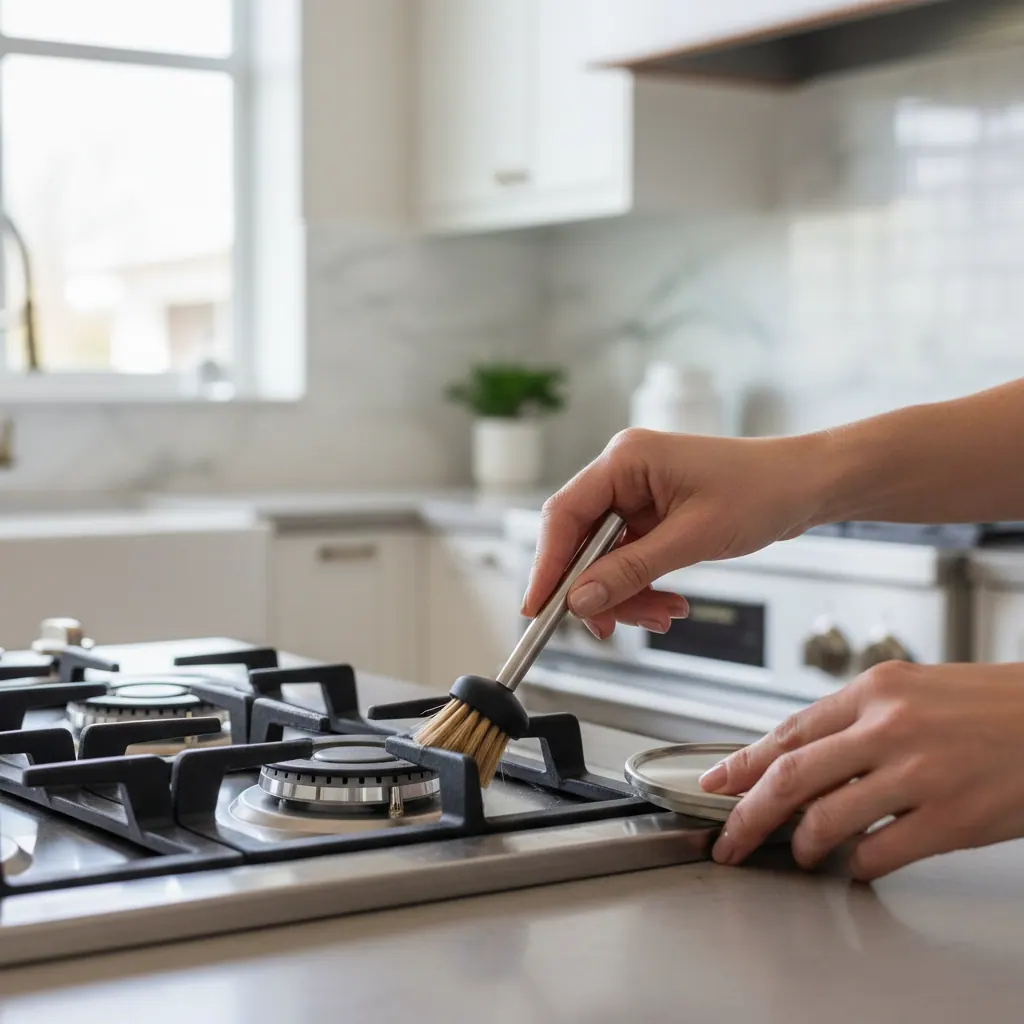
A gas cooker that clicks but won’t light, simmers unevenly, or smells like gas isn’t always broken — eight times out of ten, it’s a 15-minute clean. The other twenty percent need a service call. Knowing which is which saves you time, money and an unnecessary technician visit.
After 22 years cooking on gas in professional kitchens and five years testing residential cooktops, here is the complete repair playbook — what you can fix yourself, what you cannot, and how to tell the difference in under five minutes.
For specific symptoms, see our gas cooktop clicking not lighting and gas cooktop smells like gas guides — this article covers the full diagnostic decision tree.
Safety first: the absolute rules
Before touching any gas appliance:
- Turn the cooktop off and let burners cool completely (at least 15 minutes after last use).
- Turn off the gas supply at the wall shutoff before removing burner caps or accessing internal components. The shutoff is the lever-handle valve behind or beside the cooktop — turned perpendicular to the pipe = closed.
- Never use water on a gas component — moisture causes igniter failure and can damage the wiring.
- Never test for gas leaks with an open flame. Use a soapy water solution and watch for bubbles, or a combustible gas detector.
- If you smell gas at any point, stop, ventilate, and call your gas utility’s emergency line from outside the building. Do not flip electrical switches.
The 5-minute diagnostic decision tree
Run through these questions in order. The answer tells you what kind of repair you’re dealing with.
1. Does the burner click when you turn the knob?
- Yes, but no flame → cause 1, 2 or 3 below (igniter or alignment issue)
- No clicking, no flame → cause 5 or 7 (electrical or safety valve)
- Clicks and lights but flame is weak/yellow → cause 1 or 4 (clog)
2. Does it smell like gas?
- Brief smell at ignition only → normal, no action
- Persistent smell → STOP, see emergency protocol in our gas smell guide
- Smell with cooktop off → leak — DO NOT use the cooktop, call a plumber
3. Is the flame pattern uneven?
- Yes, irregular shape → cause 1 (clogged ports) or 3 (misaligned cap)
- Yellow tips → cause 4 (clogged orifice — incomplete combustion)
- Even but weak → cause 4 or 9 (orifice or regulator pressure)
4. Does this affect one burner or all of them?
- One burner only → almost certainly user-correctable
- All burners → likely supply pressure (regulator) or gas line — call a pro
Cause 1: Clogged burner ports (the #1 fix)
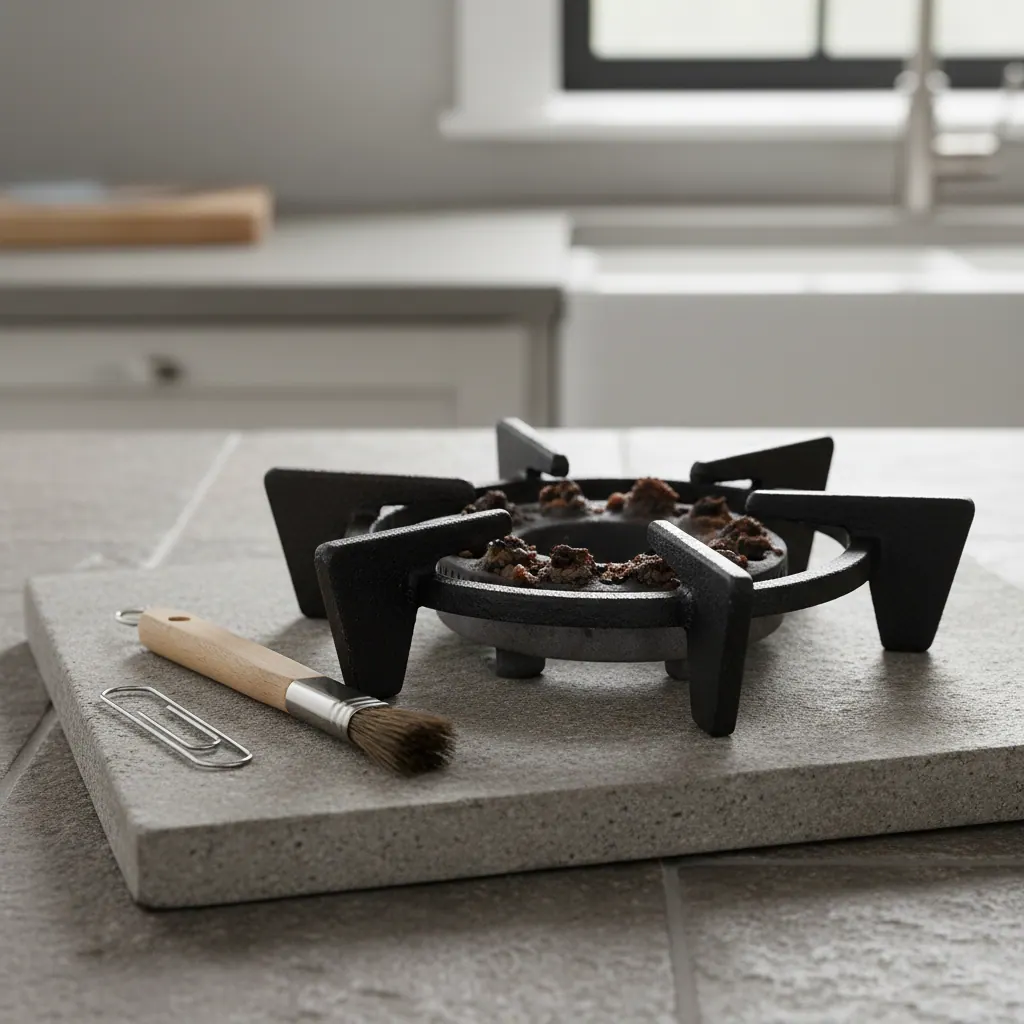
Burner ports are the small holes drilled into the brass or aluminum burner head — typically 0.5–2mm in diameter. When food debris, dried liquid, or grease clogs these ports, gas exits unevenly, producing irregular flames, weak combustion, and sometimes failure to ignite.
Symptoms:
- Uneven flame pattern (taller on one side, missing in another section)
- Yellow flame tips (incomplete combustion — visual sign of soot)
- Weak burner output even at maximum knob setting
- Burner only lights after multiple clicks
Fix (15 minutes per burner):
- Turn off the cooktop and shut off the gas at the wall valve.
- Remove the grate, burner cap, and burner head. The burner head lifts off — if it doesn’t, check for a small set screw or clip.
- Inspect the ports under good light. Clogs appear as dark specks in the holes.
- Clear each port with a straightened paper clip or a dedicated burner cleaning brush (about $4 on Amazon). Push the wire through each port from the outside, then from the inside if accessible.
- Never use a toothpick — wood fragments break off inside the port and worsen the problem.
- Rinse the burner head with warm water, dry completely (use compressed air or a clean towel — never reassemble a wet burner, the moisture can extinguish ignition).
- Reassemble: burner head → burner cap → grate. The cap must sit flat with no rocking.
- Open the gas, test ignition, and check that the flame is now even and blue.
When this fix doesn’t work: if cleaning the ports doesn’t restore the flame, the issue is upstream — either the orifice (cause 4) or the gas pressure (cause 9). Move down the list.
Cause 2: Wet or dirty igniter
The igniter is a small ceramic-tipped electrode mounted next to each burner. When you turn the knob to ignite, it produces a 15,000-volt spark across a 2–3mm gap. A wet or coated igniter can’t generate the spark, or the spark fires but doesn’t reach the gas.
Symptoms:
- Burner clicks normally but won’t light
- Burner only lights after 5–10 clicks (intermittent)
- One specific burner consistently fails while others work
Fix (10 minutes):
- Turn off cooktop and gas supply.
- Remove the burner cap and burner head.
- Locate the igniter — small white or beige ceramic tip, 6–8mm wide, mounted on a metal bracket near the burner.
- Inspect: is it shiny, or coated in residue? Is it wet?
- Clean with a stiff-bristled toothbrush dipped in 90% isopropyl alcohol (NOT 70% — needs to evaporate quickly). Brush gently — the ceramic is brittle.
- Allow to dry completely for 1–2 hours. A residual film of alcohol won’t ignite the gas.
- Reassemble and test.
When this fix doesn’t work: if the igniter is cracked or you don’t see any spark when you turn the knob (room must be dim — the spark is faint), the igniter itself is dead and needs replacement. This is a service call — the wiring inside connects to the spark module and is not user-replaceable on most modern cooktops.
For the full igniter cleaning procedure, see our dedicated gas cooktop clicking not lighting guide.
Cause 3: Misaligned burner cap
The burner cap sits on top of the burner head and directs the flame upward and outward. If the cap is rotated incorrectly, raised on one side, or sitting on debris, the flame is distorted or the ignition spark misses the gas stream entirely.
Symptoms:
- Flame all on one side of the burner
- Burner won’t light despite clicking and clean ports
- Flame “lifts off” the burner (visible gap between the burner and the flame base)
Fix (2 minutes):
- Lift the cap off — usually a simple lift, sometimes with a small notch that needs to align with a tab.
- Wipe the underside of the cap and the top of the burner head with a dry cloth.
- Check the burner head for any debris (a piece of pasta, a fallen breadcrumb, a piece of foil).
- Reseat the cap. It should sit completely flat with no rocking. If your cap has an alignment notch, line it up with the matching tab on the burner head.
- Test the burner.
If the cap rocks or sits raised even after cleaning, the burner head itself may be warped (rare) or there is debris inside the burner that you didn’t clean during cause 1.
Cause 4: Clogged gas orifice
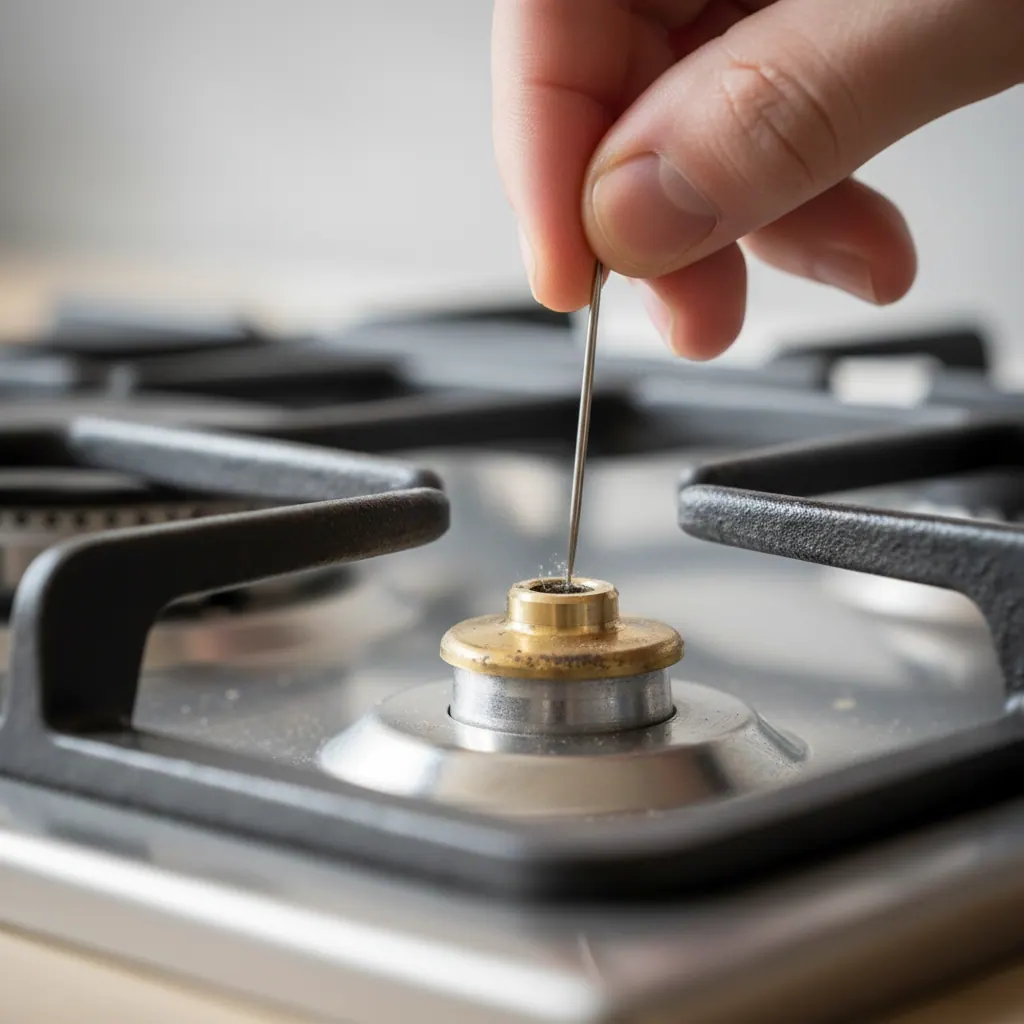
The orifice is a brass fitting inside the burner that meters gas flow — a precisely-drilled hole that determines BTU output. Orifices clog from rust, mineral deposits, or insect debris (on cooktops that haven’t been used in months, especially in summer cottages or RVs).
Symptoms:
- Weak flame across the entire burner even with clean ports
- Burner that takes 30+ seconds to reach full output
- A burner that worked fine until a specific event (camping trip, long unused period)
- Yellow flame across the whole burner (incomplete combustion from gas-air ratio shift)
Fix (20 minutes):
- Turn off cooktop, gas supply, and let the burner cool completely.
- Remove burner cap, burner head, and locate the orifice — typically a brass fitting at the base of the burner, recessed 5–10mm.
- Use an orifice cleaning needle (a fine wire 0.4–0.8mm — sold in gas appliance kits, NOT a paperclip). Insert gently, twist, and withdraw to dislodge debris. Do not enlarge the hole — the orifice diameter is engineered to a specific BTU rating.
- Blow compressed air through the orifice to clear residual debris.
- Reassemble and test.
When this fix doesn’t work: if the orifice is corroded or visibly damaged, replacement is a service call. Orifices are part-specific to each model and BTU rating — using the wrong size can produce dangerous overheating or under-firing.
Important note for propane conversion: if you converted between natural gas and propane and burners are weak, the orifices may be the wrong size for the fuel. Natural gas orifices are larger than propane orifices — using NG orifices on propane will produce massive over-fueling and a soot-yellow flame. This is a service call for re-orificing.
Cause 5: Weak or worn ignition module
The ignition module is the electronic component that generates the spark voltage for all burners. After 8–15 years of use, modules wear and produce inconsistent or weak sparks.
Symptoms:
- All burners click weakly or intermittently (vs. one burner only — that points to the igniter, cause 2)
- Clicking sound is weaker than it used to be
- Burners take more clicks to light than they did when new
Fix: module replacement — service call. The module costs $40–$120 in parts, $80–$150 in labor. Replacement on a 15+ year cooktop is rarely cost-effective; consider replacement.
Cause 6: Loose gas supply connection
A loose flexible gas hose between the cooktop and the wall shutoff leaks gas continuously, even when the cooktop is off.
Symptoms:
- Gas smell with the cooktop completely off
- Smell coming from the rear or under the cooktop
- Hissing sound near the gas line
Fix: service call only. Do not attempt to tighten gas fittings without proper tools and training — an incorrect reconnection can worsen the leak. Turn off the gas at the wall shutoff and call a licensed plumber. See our gas cooktop smells like gas guide for the full safety protocol.
Cause 7: Faulty flame failure device (FFD)
Modern cooktops have flame failure devices — small thermocouples that detect the flame and shut off gas if the burner extinguishes. A faulty FFD shuts off the gas mid-cook, or prevents ignition entirely (the FFD blocks gas until it senses heat).
Symptoms:
- Burner lights when the knob is held in but extinguishes when the knob is released
- Burner fails to ignite at all despite spark and gas flow
- Burner randomly extinguishes during cooking with no draft or boil-over
Fix: thermocouple cleaning is sometimes possible (gentle wipe with a dry cloth), but most cases require thermocouple replacement — $30–$80 part, service call labor. On a 10+ year cooktop, factor this into the repair-vs-replace decision.
Cause 8: Tripped gas safety valve
If the cooktop has not been used in months (vacation home, summer cottage), the internal safety valve may have closed automatically. This is rare on residential cooktops but common on RV and propane installations.
Symptoms:
- All burners suddenly stopped working at once
- Cooktop sat unused for 3+ months
- New propane tank installed and burners won’t light
Fix: for propane systems, the regulator may need to be reset by closing and slowly reopening the supply valve. For natural gas, this is almost always a service call — the cooktop’s internal valve must be inspected by a licensed technician.
Cause 9: Propane regulator pressure issue
Propane cooktops require a pressure regulator that drops tank pressure (250+ psi) to operating pressure (11 inches water column). A failing regulator produces low or fluctuating gas pressure across all burners.
Symptoms (propane only):
- Weak flames on all burners simultaneously
- Flames that flutter or vary unpredictably
- Worse symptoms when ambient temperature is cold (regulator freezing)
Fix: regulator replacement — service call. Cost $80–$200 for the regulator plus $80–$150 labor.
Repair-vs-replace: when not to fix
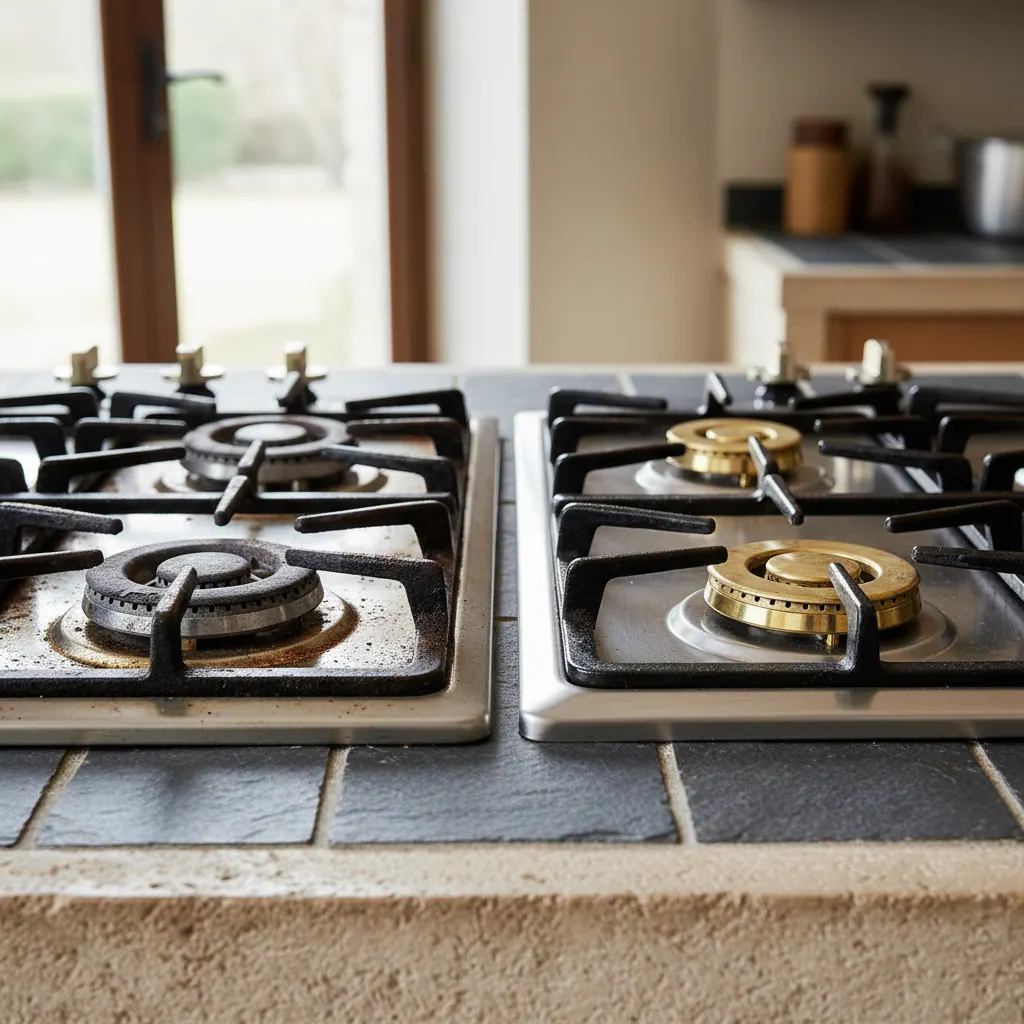
A 6-year-old gas cooktop with a clogged port should be cleaned and used. A 16-year-old cooktop needing a new ignition module, two igniters, and a regulator should usually be replaced.
| Cooktop age | Repair scenario | Recommendation |
|---|---|---|
| 0–7 years | Any failure | Repair — well within service life |
| 8–12 years | Single component (igniter, FFD) | Repair if cost < $200 |
| 8–12 years | Multiple failures | Replace — cascading failures suggest aging |
| 13+ years | Any major repair | Replace — components past designed life |
| 15+ years | Cosmetic + functional issues | Replace — modern cooktops have FFD, more efficient burners, better simmer |
For replacement guidance, see our how to choose a cooktop guide and the size-specific buying guides — best 30-inch gas cooktops, best 36-inch gas cooktops and best 5-burner gas cooktops.
Maintenance checklist: prevent the most common repairs
Most gas cooker problems are preventable with 30 minutes of maintenance every three months.
Monthly:
- Wipe burner caps and burner heads after every spill — dried liquid is the #1 cause of clog and ignition failure.
- Verify all knobs return firmly to the off position.
Every 3 months:
- Remove all burner caps and heads; clean ports with a paper clip or burner brush; rinse and dry completely.
- Wipe igniters with isopropyl alcohol on a soft brush; allow to dry 1–2 hours.
- Visually inspect the gas hose at the rear of the cooktop for kinks, cracks, or loose fittings.
Annually:
- Have a licensed plumber check all gas fittings with leak-check solution (soapy water — bubbles indicate leaks).
- Test each flame failure device: light the burner, then cup your hand to extinguish the flame (do not blow). The FFD should shut off the gas within 4 seconds. If not, schedule service.
For the deep-cleaning protocol, our gas cooktop smells like gas guide covers the same maintenance steps in step-by-step detail.
Bottom line
Most gas cooker problems are not broken parts — they are dirty parts. Clean burner ports, dry igniter, properly seated cap, clear orifice. That fixes 80% of complaints in under 30 minutes for $0–$15 in supplies.
The 20% that aren’t user-fixable — gas valve, regulator, ignition module, supply line — should not be DIY-attempted. The cost of a service call ($80–$150) is minor compared to the cost of an incorrectly repaired gas line.
If your cooktop is over 12 years old and developing multiple problems, repair-vs-replace math usually favors replacement. A new mid-tier 30-inch gas cooktop ($1,200–$1,800) with modern flame failure devices, even-heat burners and continuous grates is a meaningful upgrade over a worn 15-year-old unit.
For the cleaning supplies kit and a step-by-step video walkthrough of the most common fix, see our gas cooktop clicking not lighting guide and gas cooktop smells like gas guide.
Frequently asked questions
Why is my gas cooker not working properly?
Nine common causes ordered from most to least likely: clogged burner ports, wet/dirty igniter, misaligned burner cap, clogged orifice, weak ignition module, loose gas connection, faulty flame failure device, tripped safety valve, regulator pressure (propane). Causes 1–4 are user-fixable; 5–9 require professional service.
Can I fix a gas cooker myself?
Yes for cleaning and reseating user-removable parts (burner caps, heads, igniters, orifices). No for anything involving the gas line, valve, regulator, or internal wiring — these are licensed-technician work in most jurisdictions.
How much does a gas cooker repair cost?
DIY cleaning: $0–$15. Service call: $80–$150 visit fee. Typical repairs: igniter $80–$200, gas valve $150–$350, regulator $120–$300, full burner $200–$500. Replace if cooktop is 13+ years old or facing multiple failures.
Why does my gas cooker click but not light?
The igniter is sparking but gas isn’t catching — usually a wet or dirty igniter, misaligned burner cap, or clogged orifice. Clean the igniter with isopropyl alcohol, dry completely, reseat the cap firmly. See our gas cooktop clicking not lighting guide.
Is it safe to use a gas cooker that’s not working properly?
A burner that won’t light at all (no gas smell) is safe to leave off and diagnose. A burner producing yellow flame, sooty residue, or any persistent gas smell should not be used until cleaned or repaired — incomplete combustion produces carbon monoxide and gas leaks are an explosion hazard.
Repair information cross-referenced with AGA (American Gas Association) residential safety guidelines, NFPA 54 (National Fuel Gas Code) and manufacturer service manuals from Bosch, GE, KitchenAid and Wolf. This guide is diagnostic — for any work involving the gas supply line, valve, regulator, or wiring, hire a licensed gas technician. Updated May 2026.