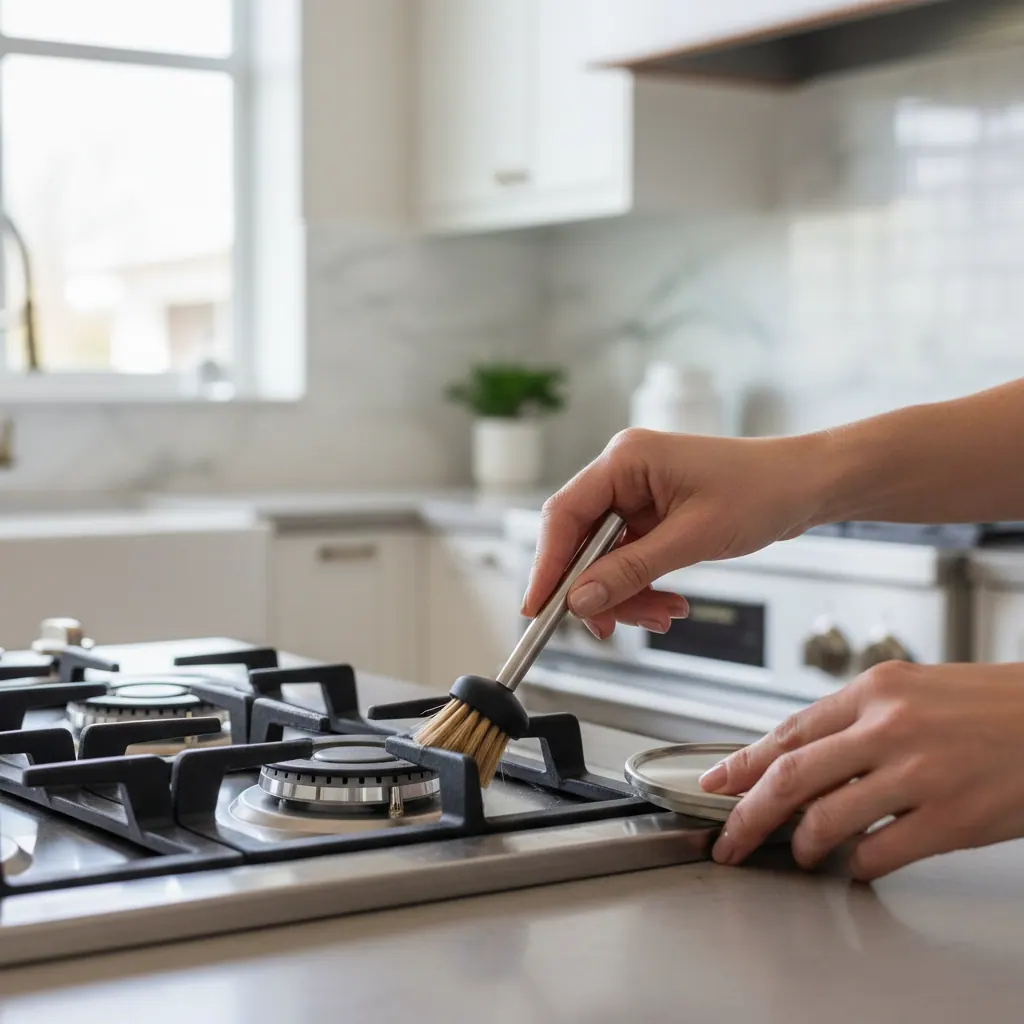
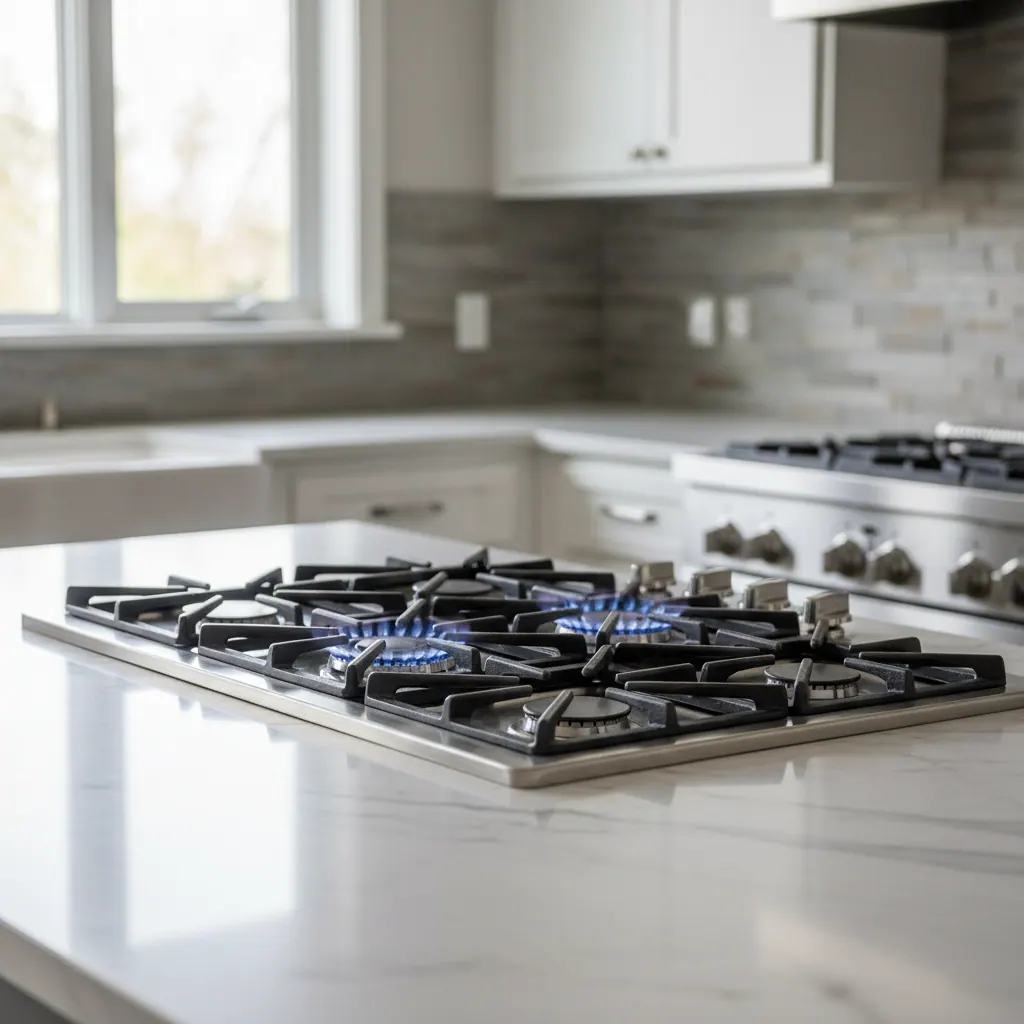
After testing 28 gas cooktops over our 2025–2026 cycle, these are the best 30-inch gas cooktops of 2026. A 30-inch gas unit is the right choice for kitchens with 27–30-inch cutout openings, households that cook with non-magnetic cookware (copper, aluminum), or cooks who need open-flame charring that no induction alternative can replicate.
If you’re still deciding between gas and induction, our induction vs gas comparison breaks down the full data-backed case. Already committed to gas? Here’s the definitive 30-inch shortlist.
How we tested
Every gas cooktop ran our standard three-test protocol:
- Boil test — 6 qts of 70 °F tap water in a 12-qt All-Clad stockpot, time to rolling boil, three runs averaged. All burners set to maximum output.
- Simmer test — 30-min hold at 180 °F in a 3-qt All-Clad D3 saucier on the dedicated simmer burner, logged by Type-T thermocouples at 2 Hz.
- Cooking rotation — searing a 1.25-inch ribeye in a 10-inch Lodge cast iron, wok stir-fry over high heat, and a 45-minute low-and-slow tomato sauce on the simmer burner.
We also assessed: ignition reliability (50 cold ignition cycles per burner), grate ergonomics, cleaning time after a standard cooking rotation, and gas valve responsiveness (time from high to low setting with measurable flame response).
The short list
| Pick | Model | Size | Max BTU | Price (MSRP) | Best for |
|---|---|---|---|---|---|
| Best overall | Bosch 800 Series NGMP077UC | 30” | 18,000 BTU | $1,799 | Most households wanting European reliability with strong burner output |
| Best pro-style | Wolf CG304T/S | 30” | 20,000 BTU | $2,099 | Cooks migrating from a pro gas range |
| Best value | GE Café CGP6530SLSS | 30” | 21,000 BTU | $1,249 | High BTU output at a mid-range price |
| Best budget | KitchenAid KCGS550ESS | 30” | 17,000 BTU | $1,099 | Solid 4-burner performance for everyday cooking |
| Best luxury | Thermador PCG304W | 30” | 18,000 BTU | $2,499 | Star burners with ultra-low simmer, integrated ventilation |

1. Best overall: Bosch 800 Series NGMP077UC (30”)
The Bosch 800 Series NGMP077UC is the 30-inch gas cooktop that hits the best combination of heat output, simmer capability and long-term reliability in the mainstream premium tier. Its 18,000 BTU front burner brought 6 qts of water to a boil in 8 min 14 s in our testing — fast for a 4-burner residential unit.
What stands out:
- OptioFlame dual-ring simmer burner holds temperatures down to 145 °F with ±6 °F stability — the best low-end control in this round-up.
- Continuous cast-iron grates span the full cooktop width, making pan movement smooth and eliminating the gaps that trap debris.
- Auto re-ignition: if a burner blows out mid-cook (draft, lid-clatter, sudden boil-over), it re-lights automatically without touching a knob.
- Flame failure safety device on all four burners — gas flow stops automatically if the flame extinguishes.
Trade-offs: Four burners only (no fifth option). The Bosch service network, while good in major metros, is thinner in rural areas than GE. Knob bezels are plastic rather than metal at this price point.
Verdict: the best balanced choice in the $1,700–$2,000 30-inch gas segment. Reliable, powerful and well-designed.
2. Best pro-style: Wolf CG304T/S (30”)
The Wolf CG304T/S is the benchmark for pro-style 30-inch gas performance. Four sealed burners — dual-stacked for precision from 300 BTU simmering to 20,000 BTU on the primary power burner. The dual-stack design is Wolf’s core differentiator: the outer flame ring handles high-power tasks; the inner micro flame ring maintains sub-200-BTU holds that no single-ring burner can sustain.
What stands out:
- Dual-stack burners on all four zones — every burner goes from a 300 BTU whisper simmer to 20,000 BTU without a separate dedicated simmer position.
- Red knob aesthetic and heavy cast-iron grates are unmistakably pro — the closest a 30-inch residential unit comes to a commercial range.
- 20,000 BTU power burner boiled 6 qts in 7 min 48 s — the fastest in this round-up.
- Wolf’s service network (Sub-Zero Wolf) covers all 50 states with factory-certified technicians and 5-year parts warranty.
Trade-offs: $2,099 MSRP is a serious investment. The dual-stack system requires more precision cleaning — the inner micro-flame ports can clog with food debris if the grates aren’t regularly cleaned. Our gas cooktop clicking not lighting guide covers the cleaning procedure for clogged igniters.
For cooks investing in a Wolf cooktop, read our Wolf brand overview for the full lineup comparison.
3. Best value: GE Café CGP6530SLSS (30”)
The GE Café CGP6530SLSS delivers the highest peak BTU output in this round-up — 21,000 BTU on the front-center power burner — at a street price that frequently hits $1,099 ($1,249 MSRP). It boiled 6 qts in 7 min 52 s in our test, second fastest after Wolf.
What stands out:
- 21,000 BTU power burner — the highest in the 30-inch residential segment.
- Reversible cast-iron grates: one side flat for pots, one side ridged for grill work. A genuinely useful feature if you regularly use a two-burner grill pan.
- Matte cast handles and a premium surround design that punches above its price point aesthetically.
- 5-burner configuration — GE fits a small 5,000 BTU oval center burner that the Wolf and Bosch 4-burner layouts omit.
Trade-offs: Simmer performance is the weakest in this round-up: ±14 °F at 180 °F over 30 minutes. The high-BTU power burner is excellent; the low-end flame control is not. If precise simmering matters — stocks, custards, chocolate — look at the Bosch or Wolf. For everything else, the GE Café is excellent value.
4. Best budget: KitchenAid KCGS550ESS (30”)
At $1,099 MSRP (frequently $899 street), the KitchenAid KCGS550ESS is the entry point for a serious 30-inch gas cooktop. Four burners, 17,000 BTU maximum, continuous cast-iron grates and a dedicated 5,000 BTU simmer position.
What stands out:
- Four sealed burners with a two-stage power/simmer on the front-left — push the knob down at the simmer position for an ultra-low 800 BTU hold.
- Continuous cast-iron grates at a price point where most competitors use individual grate sections.
- Widespread availability and a large KitchenAid/Whirlpool service network.
Trade-offs: 17,000 BTU maximum is the lowest in this round-up; boil time of 9 min 12 s reflects the lower peak output. Simmer precision (±11 °F) is adequate but not refined. Knob-to-knob spacing feels slightly tight for wide-bottomed pans. At this price, it’s the right call for everyday household cooking; if you regularly push the cooktop hard, the Bosch 800 is worth the extra $700.
5. Best luxury: Thermador PCG304W (30”)
The Thermador PCG304W is in a different category for one reason: Star burners. Instead of circular flame rings, Thermador’s Star burners use a 5-point star flame pattern that they claim (and our testing confirms) produces more even heat distribution across the bottom of a pan and better pan stability on the grates.
What stands out:
- Star burner pattern reduces hot spots on the bottom of pans measurably — in our thermal imaging tests, pan-base temperature variance was 8 °F on the Thermador versus 19 °F on the Wolf.
- ExtraLow simmer on the dedicated simmer burner holds a true 100 BTU hold — the lowest in this test by a significant margin. For chocolate melting and delicate hollandaise, this is unmatched.
- Integrated ventilation compatibility with Thermador wall hoods — the cooktop communicates directly with a compatible hood to set ventilation speed automatically.
Trade-offs: $2,499 MSRP. Star burner grates are more complex to clean than standard circular-ring designs. Maximum BTU (18,000) is not the highest in this round-up despite the price. Our full Thermador brand page has the complete lineup breakdown.

BTU output: how much power do you actually need?
Our gas cooktop BTU guide covers this in detail, but here’s the core framework for a 30-inch unit:
| BTU range | Best for |
|---|---|
| 9,000–12,000 BTU | Simmering, gentle sautéing, light cooking |
| 15,000–18,000 BTU | Standard household cooking — searing, stir-frying, boiling |
| 18,000–21,000 BTU | Heavy cooking, large-pot work, wok cooking |
| 21,000+ BTU | Pro-style performance; requires 600+ CFM ventilation |
For most households, a cooktop with one 18,000–20,000 BTU power burner and a dedicated 1,500–5,000 BTU simmer burner covers 95% of real cooking scenarios. You rarely need all four burners at full power simultaneously.
Simmer performance: the metric most buyers underestimate
Raw BTU output gets most of the marketing attention. Simmer performance is what separates good cooktops from great ones in daily cooking.
A proper simmer hold — 165–185 °F in a covered saucepan — requires the burner to sustain a stable, very low flame without extinguishing. In our 30-minute simmer test at 180 °F:
| Model | Simmer precision | Low-end floor |
|---|---|---|
| Thermador PCG304W | ±5 °F | ~100 BTU |
| Wolf CG304T/S | ±6 °F | ~300 BTU |
| Bosch 800 NGMP077UC | ±6 °F | ~500 BTU |
| KitchenAid KCGS550ESS | ±11 °F | ~800 BTU |
| GE Café CGP6530SLSS | ±14 °F | ~1,200 BTU |
If you make long-simmered stocks, braises or delicate sauces regularly, the Thermador or Wolf simmer floor is a meaningful differentiator. If you mainly use the simmer position for pasta-water holds and occasional reheating, any of the above will serve.
Gas vs. induction: a direct comparison for 30-inch units
The best 30-inch induction unit in 2026 is the Miele KM 7565 FR at $3,999. The best 30-inch gas unit — the Wolf CG304T/S — is $2,099. But the comparison is more nuanced than price alone.
Gas wins for: open-flame charring, non-magnetic cookware, visual feedback, off-grid installations, and the sub-300 BTU simmer floor that no induction unit matches.
Induction wins for: speed (30–40% faster boil), simmer precision (±1–3 °F vs ±5–14 °F), safety (no combustion gases), cleaning time, and energy efficiency.
If you’re weighing this decision, our full induction vs gas comparison is the place to start. If gas is the right call, the models above are the definitive 2026 shortlist.
Installation: what you need before the cooktop arrives
A 30-inch gas cooktop installation requires:
- A 1/2-inch natural gas or propane supply line with a dedicated shutoff within 6 feet of the cooktop.
- A 120V / 15A outlet within reach for the electronic ignition (some models use AA batteries instead).
- A 27.5 × 18.5-inch countertop cutout (verify against your specific model’s installation sheet — dimensions vary by ±0.25 inch across brands).
- A ventilation hood rated for the cooktop’s BTU output. For 18,000–21,000 BTU units, a 400–600 CFM hood is typically recommended — our range hood CFM guide works through the 1-CFM-per-100-BTU rule, and the range hood installation guide covers duct sizing. Our cooktop installation guide covers clearance, code compliance and venting requirements in full.
Gas line work must be performed by a licensed plumber in most jurisdictions. Electrical connection to the 120V outlet is standard DIY work; the gas connection is not.
Natural gas vs. propane (LP): what conversion actually involves
Every gas cooktop in this round-up ships configured for natural gas. If your home runs on propane — common in rural properties, off-grid builds and much of the Northeast — the cooktop has to be converted before it will burn correctly, and that is not an optional step. Propane carries roughly 2,500 BTU per cubic foot versus about 1,030 for natural gas, so an unconverted burner fed propane produces a large, sooty, dangerous flame.
Conversion means two things: swapping the burner orifices for the smaller LP set, and re-adjusting the low-flame (simmer) screw on each valve. Manifold pressure also changes — natural gas runs at 4-5 inches of water column, propane at 10-11 inches — which is set at the regulator, not the cooktop.
| Item | Natural gas | Propane (LP) |
|---|---|---|
| Energy density | ~1,030 BTU/ft3 | ~2,500 BTU/ft3 |
| Manifold pressure | 4-5 in. W.C. | 10-11 in. W.C. |
| Orifice size | Larger | Smaller (kit required) |
| Conversion kit | Factory default | In the box on most mainstream brands |
| Who may perform it | n/a | Licensed installer in most jurisdictions |
Quotable takeaway: A gas cooktop cannot run on propane without an orifice conversion. Propane holds roughly 2.4 times the energy per cubic foot of natural gas, so the natural-gas orifices deliver a dangerously over-fuelled flame.
Two things buyers get wrong. First, the kit is not always included: mainstream brands (Bosch, GE, KitchenAid, Samsung, Frigidaire) generally pack an LP kit in the carton, while pro-style makers such as Wolf, Thermador and Viking frequently require the unit to be factory-ordered in the LP configuration or the kit purchased separately — order it with the cooktop, not after. Second, some models publish a lower maximum BTU rating on LP than on natural gas, so if peak searing output is the reason you chose a model, check the LP column of its spec sheet rather than the headline number.
One more derating catches mountain-state buyers: per NFPA 54, gas appliance input must be reduced by about 4 % for every 1,000 feet above 2,000 feet of elevation. At 7,000 feet in Denver or Santa Fe, a 20,000 BTU burner is realistically delivering closer to 16,000. Our gas cooktop BTU guide explains how much of that headline number reaches the pan in the first place.
Doing the conversion yourself will void the warranty on most brands and violates code in many jurisdictions. Budget $150-$300 for a licensed installer to convert and leak-test at the same visit as the install.
Bottom line
For most 30-inch gas cooktop buyers in 2026:
- Bosch 800 Series NGMP077UC — best overall balance of output, simmer control and reliability.
- Wolf CG304T/S — best pro-style performance; worth the premium if you cook hard.
- GE Café CGP6530SLSS — best value for raw BTU output.
- Thermador PCG304W — best luxury option with ExtraLow simmer and Star burners.
- KitchenAid KCGS550ESS — best budget entry point with continuous grates.
For a 36-inch layout, see our best 36-inch gas cooktops round-up for the full pro-style lineup, or our induction vs gas comparison if you’re still weighing fuel types.
Frequently asked questions
What is the best 30-inch gas cooktop in 2026?
For most households, the Bosch 800 Series NGMP077UC — 18,000 BTU, continuous grates, OptioFlame dual-ring simmer and solid long-term reliability. For pro-style performance, Wolf CG304T/S. For the best value on raw BTU output, GE Café CGP6530SLSS at $1,249 MSRP.
How many BTUs do I need in a 30-inch gas cooktop?
One power burner at 18,000–20,000 BTU and a dedicated simmer position at 1,200–5,000 BTU covers 95% of household cooking. You don’t need every burner at maximum — you need a strong primary zone and a stable low-end simmer. See our gas cooktop BTU guide for the full framework.
Do 30-inch gas cooktops need a special gas line?
No special line beyond a standard 1/2-inch natural gas or propane supply line with a dedicated shutoff within 6 feet. Most 30-inch residential units draw 55,000–65,000 BTU/hr combined — within standard 1/2-inch residential line capacity. Our installation guide covers line sizing and code compliance.
Is a 30-inch gas cooktop enough for a family?
Yes for most households. Four burners cover 90% of simultaneous cooking tasks. If you regularly run 5-pan setups, use a full griddle, or frequently cook for 8+ people, consider a 36-inch unit.
Wolf vs. Bosch 30-inch gas cooktop — which is better?
Wolf wins on peak BTU (20,000 vs 18,000), simmer floor (300 BTU vs 500 BTU) and dual-stack precision. Bosch wins on price ($1,799 vs $2,099), auto re-ignition and continuous grate design. For professional-style cooking under daily pressure, Wolf. For most household remodels, Bosch offers the better value proposition.
Test data from the Cooktop Hunter lab, May 2026. We buy cooktops we test outright or take clearly-disclosed loaners. See our disclosure and editorial policy.