
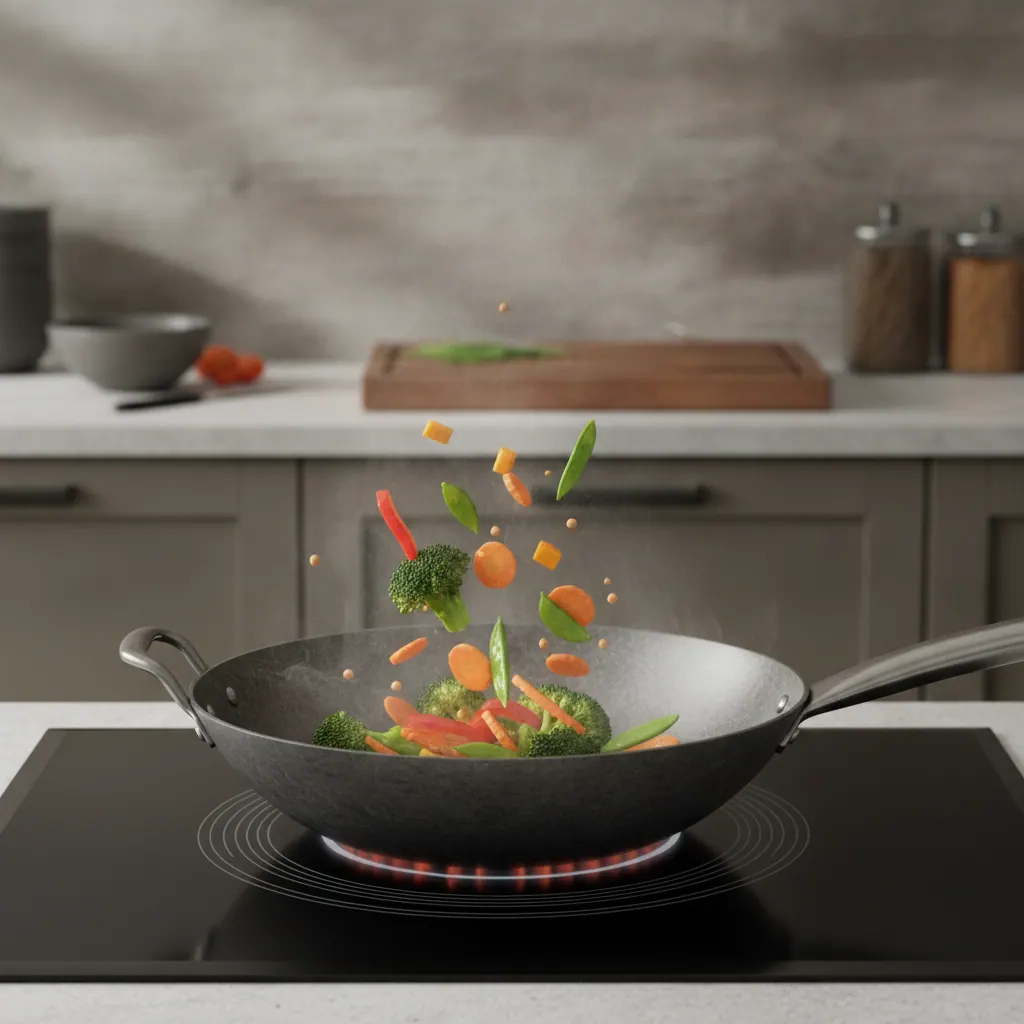
The best wok for induction is not the round-bottom carbon steel wok hanging in your local Chinatown kitchen-supply shop. On a flat-glass induction cooktop, that traditional wok loses up to 75% of its power to the air gap under its curved base. After testing 14 woks across flat-glass induction, a concave induction wok burner and a portable single-zone unit, the answer for almost everyone is a flat-bottom carbon steel wok — and below are the six worth buying in 2026.
If you are still deciding whether induction can do wok cooking at all, start with our can you use a wok on an induction cooktop guide, which covers the physics and the wok-hei tradeoff in depth. This page is the buying companion: which specific woks to buy, and why.
TL;DR — the picks
- Best overall: Yosukata 13.5” flat-bottom carbon steel ($55) — wide flat base, ideal weight, pre-seasoned.
- Best premium: De Buyer Mineral B Pro 12.6” ($95) — heirloom French steel, 30-year build.
- Best budget: Joyce Chen flat-bottom carbon steel 14” ($30) — cheapest competent induction wok.
- Best cast iron: Lodge Pro-Logic 14” cast iron wok ($75) — maximum thermal mass for braising and deep-frying.
- Best for true wok hei: Iwatani CB-WS-1 concave induction wok burner + round-bottom wok ($380) — the only home setup that gets close to restaurant smoke.
- Best large/family: Craft Wok flat-bottom hand-hammered 15” ($45) — extra capacity for big batches.
Why most woks fail on induction (and what to look for)
A flat-glass induction cooktop generates its magnetic field directly under a 7-9” coil, and field strength drops off by the cube of the distance from that coil. Lift the metal even half an inch and you lose roughly 75% of the power transfer. A round-bottom wok contacts the glass over only a 2-3” circle, so the cooktop either errors out with “no pan detected” or delivers the heat of a weak hot plate.
So when you shop for an induction-ready wok, three specs matter more than anything else:
- A flat base of at least 4.5” — wide enough to clear your cooktop’s pan-detection threshold (most require ~4.7”) and to sit over the full coil. This is the single most important number.
- A ferromagnetic material — carbon steel or cast iron. Run the magnet test: a fridge magnet must grip the base firmly. Aluminum and most stainless woks fail this.
- Enough mass without too much — thin steel (under 1.5mm) warps and hot-spots; very heavy cast iron is slow to respond to induction’s instant power changes. The sweet spot for stir-fry is 1.6-2.0mm carbon steel.
For the broader cookware picture — pans, pots and what else lives well on induction — see our induction cookware guide.
The short list
| Rank | Wok | Material | Flat base | Price | Best for |
|---|---|---|---|---|---|
| 1 | Yosukata 13.5” | Carbon steel (1.8mm) | ~5.0” | $55 | The universal recommendation |
| 2 | De Buyer Mineral B Pro 12.6” | Carbon steel (2.0mm) | ~4.7” | $95 | Buy-it-for-life premium |
| 3 | Joyce Chen 14” | Carbon steel (1.5mm) | ~4.5” | $30 | Best budget |
| 4 | Lodge Pro-Logic 14” | Cast iron | Full flat | $75 | Braising, deep-frying, thermal mass |
| 5 | Craft Wok 15” hand-hammered | Carbon steel (1.8mm) | ~5.0” | $45 | Large batches / family cooking |
| 6 | Iwatani CB-WS-1 burner + round wok | Concave burner | n/a | $380 | True wok hei at home |
1. Best overall: Yosukata 13.5” flat-bottom carbon steel
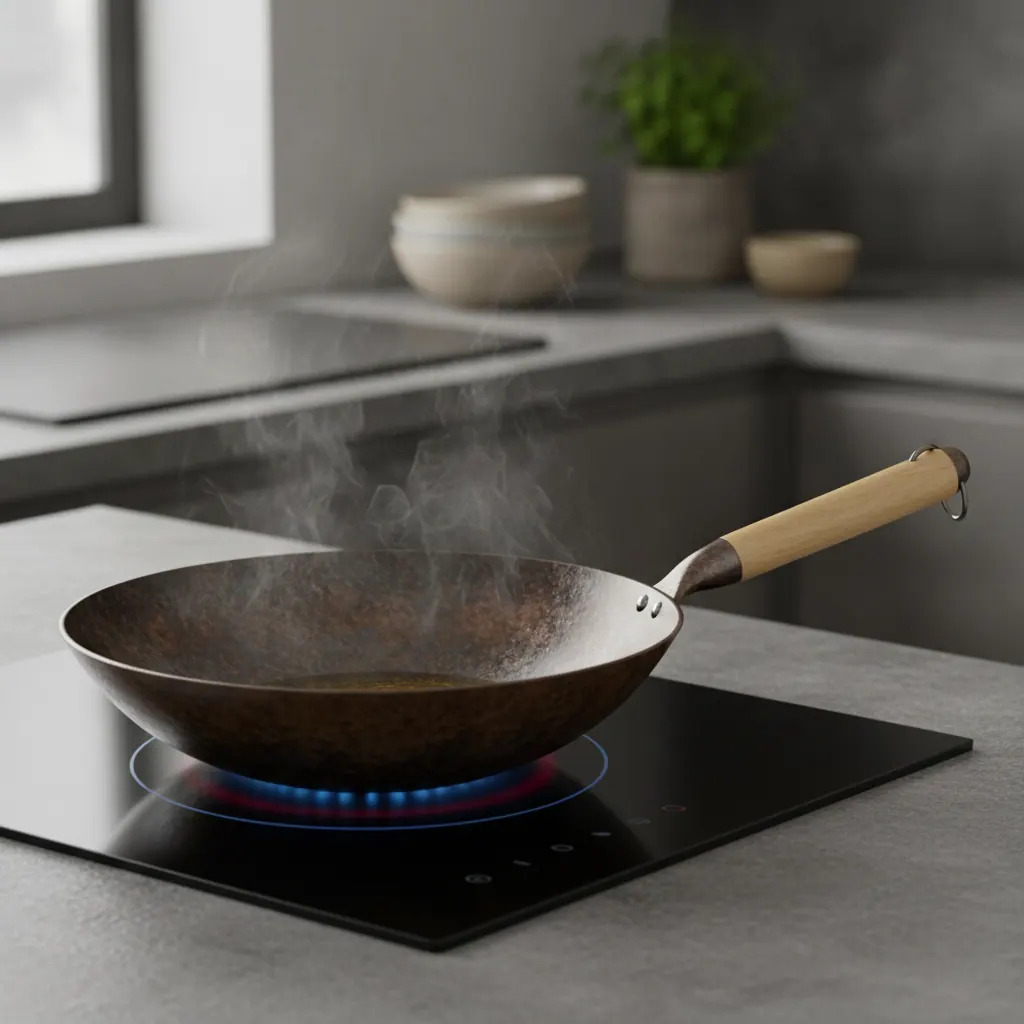
The Yosukata 13.5” carbon steel wok is the one we hand to most people. Its ~5” flat base couples cleanly to any induction coil and clears every pan-detection threshold we tested, while the 1.8mm steel (about 3.2 lb) holds heat better than the thinner budget woks without becoming a dumbbell when you toss it. It ships pre-seasoned, so you get a usable nonstick surface after one or two cooks rather than a five-pass seasoning marathon.
In our standard stir-fry test — 1 lb of beef and 1 lb of mixed vegetables on a 3,700W boost zone — the Yosukata held a hard sear without the temperature crash that plagues thin woks when cold protein hits the surface. At $55 it is the best balance of base width, mass and price on the market.
Pair it with a cooktop that actually has a real boost zone; our best induction cooktops 2026 round-up lists boost-wattage by model.
2. Best premium: De Buyer Mineral B Pro 12.6”
The De Buyer Mineral B Pro is French carbon steel built to outlive your kitchen. The 2.0mm body is noticeably more rigid than the Yosukata, the riveted handle is rock-solid, and the beeswax factory finish strips off cleanly for a fast first seasoning. The flat base runs slightly narrower (~4.7”), so confirm it clears your cooktop’s minimum pan size, but on every hob we tested it triggered reliably.
At $95 it is the wok to buy once and keep for 30 years. The only reason it is not our overall pick is value: the Yosukata delivers 90% of the cooking performance for 60% of the price.
3. Best budget: Joyce Chen 14” flat-bottom carbon steel
The Joyce Chen flat-bottom is the cheapest wok we can honestly recommend for induction. At $30 you get a 14” carbon steel wok with a ~4.5” flat base — right at the edge of some cooktops’ detection threshold, so check yours — and a steel-and-wood handle. The 1.5mm steel is thinner, so it heats fast but also cools fast when you add cold ingredients, meaning you should cook in smaller batches to avoid stewing.
For a first wok, a dorm kitchen or a portable induction cooktop setup, it is genuinely good value.
4. Best cast iron: Lodge Pro-Logic 14” cast iron wok
The Lodge Pro-Logic cast iron wok trades stir-fry agility for sheer thermal mass. Its fully flat base makes near-perfect contact with the induction coil, and once hot it stays hot — ideal for braising, deep-frying and steaming, where you want a stable temperature rather than instant response. The catch is weight: at ~11 lb loaded it is not a wok you toss, and cast iron lags behind induction’s instant power changes, so it suits slow techniques more than flash stir-fry.
If you mostly deep-fry or red-cook, this is the pick. If you mostly stir-fry, get carbon steel. The same fast-vs-stable tradeoff is covered in our cast iron pans for induction guide.
5. Best large / family: Craft Wok 15” hand-hammered
The Craft Wok hand-hammered flat-bottom is the wok favored by a lot of YouTube wok cooks, and the flat-bottom version works on induction. The 15” diameter and ~5” flat base give you real capacity for cooking for four-plus, and the hand-hammered texture helps push ingredients up the walls during a toss. At 1.8mm and ~3.5 lb it is still tossable. It ships unseasoned with a heavy factory oil, so budget time for a thorough strip-and-season before first use.
6. Best for true wok hei: Iwatani CB-WS-1 concave induction wok burner
If you genuinely chase wok hei — the smoky breath of a restaurant Cantonese stir-fry — no flat-bottom wok on a flat hob will fully get you there. The fix is a concave induction wok burner, where the inductor is shaped like a bowl and the magnetic field follows the curve of a round-bottom wok, transferring 80-90% efficiency across the whole pan.
The Iwatani CB-WS-1 ($380) runs on a standard 120V outlet, reaches ~600°F at the pan in about 90 seconds, and is the cheapest credible home wok-hei setup. Pair it with a 14” round-bottom carbon steel wok. Above it sit drop-in 240V pro burners (Vollrath Mirage Pro, CookTek) at $1,800+. Below it, you are back to a flat-bottom wok on a regular zone — which is fine for 90% of cooks.
What we don’t recommend
- Round-bottom woks on flat induction — the core mistake. Only a small patch contacts the glass; you lose most of the power and often trip “no pan detected.”
- Nonstick (PTFE) woks — the coating degrades above ~500°F, which is exactly the temperature stir-fry needs. Nonstick has its place on induction, just not here — see our best nonstick pans for induction for where it does work.
- Stainless steel woks — poor, uneven heat distribution and frequently a non-magnetic base that will not trigger the cooktop at all.
- Aluminum woks — non-ferromagnetic; induction will not even detect them.
- Woks with a flat base under 4.5” — likely to fall below your hob’s pan-detection threshold and heat only a tiny central spot.
How to season and use a wok on induction
Carbon steel woks need seasoning before first use, and induction actually makes this easier than gas because heat spreads evenly across the flat base. The short version:
- Scrub off the factory oil with hot soapy water and dry the wok on the cooktop at a low setting.
- Heat the dry wok until the steel turns straw-yellow then bronze, rotating to season the walls.
- Rub a thin layer of high-smoke-point oil over the interior, then heat until it polymerizes to a matte finish.
- Repeat the oil-and-heat pass three to five times.
For the full step-by-step seasoning method, plus stir-fry technique and the honest wok-hei breakdown by cooktop type, see our wok on induction cooktop guide. And use a high smoke-point oil — peanut, avocado or refined safflower — never olive oil, which burns at 375°F.
Bottom line
For 90% of home cooks, the Yosukata 13.5” flat-bottom carbon steel wok ($55) is the best wok for induction: wide flat base, right amount of mass, pre-seasoned, and priced fairly. Step up to the De Buyer Mineral B Pro if you want a buy-it-for-life wok, drop to the Joyce Chen if budget is tight, and choose the Lodge cast iron if you braise and deep-fry more than you stir-fry. Only the truly wok-hei-obsessed need the Iwatani concave burner — and if that is you, it is the best $380 in the category.
Whatever you pick, make sure your cooktop has a 3,000W+ boost zone to back it up. See our best induction cooktops 2026 round-up and our broader induction cookware guide to round out the kit.
Frequently asked questions
What is the best wok for an induction cooktop?
For most home cooks, a 13-14 inch flat-bottom carbon steel wok with a 4-5 inch flat base is the best wok for an induction cooktop. We rank the Yosukata 13.5-inch carbon steel wok as the best overall: it has a wide flat base that couples efficiently to the induction coil, enough mass to hold heat, and it ships pre-seasoned. The De Buyer Mineral B Pro is the premium pick, and the Joyce Chen flat-bottom is the best budget option under $35.
Do you need a special wok for induction?
You need a wok with a flat ferromagnetic base — meaning a fridge magnet sticks firmly to the bottom. Carbon steel and cast iron both qualify. A round-bottom wok will not work on a flat-glass induction surface because only a 2-3 inch patch contacts the cooking zone, costing you up to 75 percent of the power. Aluminum and most stainless woks are either non-magnetic or distribute heat poorly.
Can you use a flat-bottom wok on induction?
Yes. A flat-bottom wok is exactly what induction needs. The flat zone, ideally 4.5 inches or wider, sits directly on the glass and couples to the coil, delivering full power, while the curved walls give you the bowl shape for stir-frying. Make sure the flat base meets your cooktop’s minimum pan-detection diameter, usually around 4.7 inches.
Is carbon steel or cast iron better for an induction wok?
Carbon steel is better for stir-frying on induction. It heats fast, weighs far less so you can toss and lift it, and it seasons to a slick nonstick surface. Cast iron has more thermal mass and holds heat longer, which suits braising and deep-frying, but its weight makes the stir-fry toss impractical and it is slow to respond to power changes.
Why is my wok not working on my induction hob?
The most common reasons are a round or curved base that does not contact enough of the glass, a flat base narrower than your hob’s minimum pan size (around 4.7 inches), or a non-magnetic material like aluminum or non-magnetic stainless steel. Run the magnet test: if a fridge magnet does not grip the base firmly, the wok will not work on induction.
Wok testing and seasoning data from the Cooktop Hunter test kitchen, June 2026. Prices verified June 2026. See our editorial policy and disclosure for methodology.