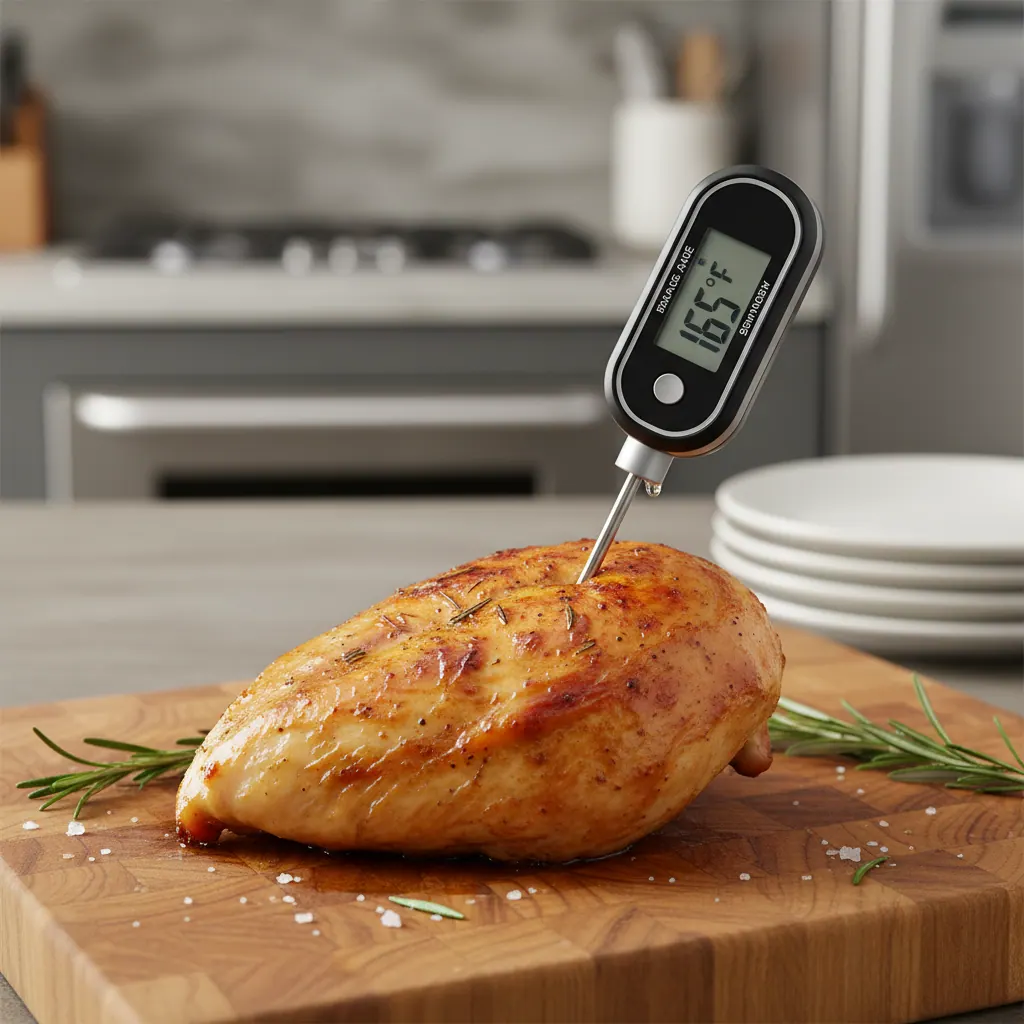
The temperature 165°F is the only number that matters for chicken safety. Everything else — pink color, juice clarity, “feel,” cook time — is a guess. After 22 years cooking chicken in commercial kitchens and hundreds of test runs in our kitchen, the lesson is the same: a $25 thermometer eliminates 95% of dry-chicken complaints and 100% of food-safety risk.
Here is the complete guide — internal temperatures by cut, the exact cooktop technique to reach them, and the science behind why pink chicken at 165°F is safer than brown chicken at 155°F.
For pan-cooking technique, our how to sear steak on induction covers the same searing principles applied to chicken. For oil temperature management when frying chicken, see how to deep fry on induction.
The internal temperature chart
USDA mandates 165°F internal temperature for all chicken — this is the temperature at which Salmonella and Campylobacter are killed instantly. The chart below shows USDA minimums plus chef-recommended pull temperatures for optimal eating quality:
| Cut | USDA safe temp | Chef pull temp | Rest target | Why |
|---|---|---|---|---|
| Boneless breast | 165°F | 160°F | 165°F | Lean — overcooks easily; carryover finishes |
| Bone-in breast | 165°F | 162°F | 165°F | Bone slows internal rise; pull slightly higher |
| Boneless thigh | 165°F | 170°F | 175°F | Fattier — needs higher to render |
| Bone-in thigh / drumstick | 165°F | 172°F | 175–180°F | Connective tissue needs heat to gelatinize |
| Whole roasted chicken | 165°F (in thigh) | 162°F (in thigh) | 165°F | Rest 15 min for juices to redistribute |
| Ground chicken | 165°F | 165°F | 165°F | No carryover needed — cook to temp |
| Stuffed chicken | 165°F (stuffing) | 165°F (stuffing) | 165°F | Stuffing is the limiting temperature |
Important: the temperature is measured at the coldest part of the meat (the thickest section, away from bone). For a whole chicken, that’s the thickest part of the thigh between the leg and the body, NOT the breast. The breast cooks faster than the thigh and reaching 165°F in the thigh of a whole bird means the breast is at 175°F+ — the source of “dry whole chicken” complaints.
Pull-and-rest math
Carryover cooking continues during rest. For chicken:
| Piece | Carryover rise during rest | Rest time |
|---|---|---|
| Boneless breast (0.75–1”) | 3–5°F | 5 minutes |
| Bone-in breast | 3–5°F | 7 minutes |
| Boneless thigh | 3–4°F | 5 minutes |
| Bone-in thigh / drumstick | 3–4°F | 7 minutes |
| Whole chicken (4–5 lb) | 5–8°F | 15–20 minutes |
| Whole chicken (6+ lb) | 8–12°F | 20–25 minutes |
This is why pulling boneless breast at 160°F gets you to 165°F after rest — and why pulling at 165°F gets you to 168–170°F (slightly dry).
Why 165°F? The science of pasteurization
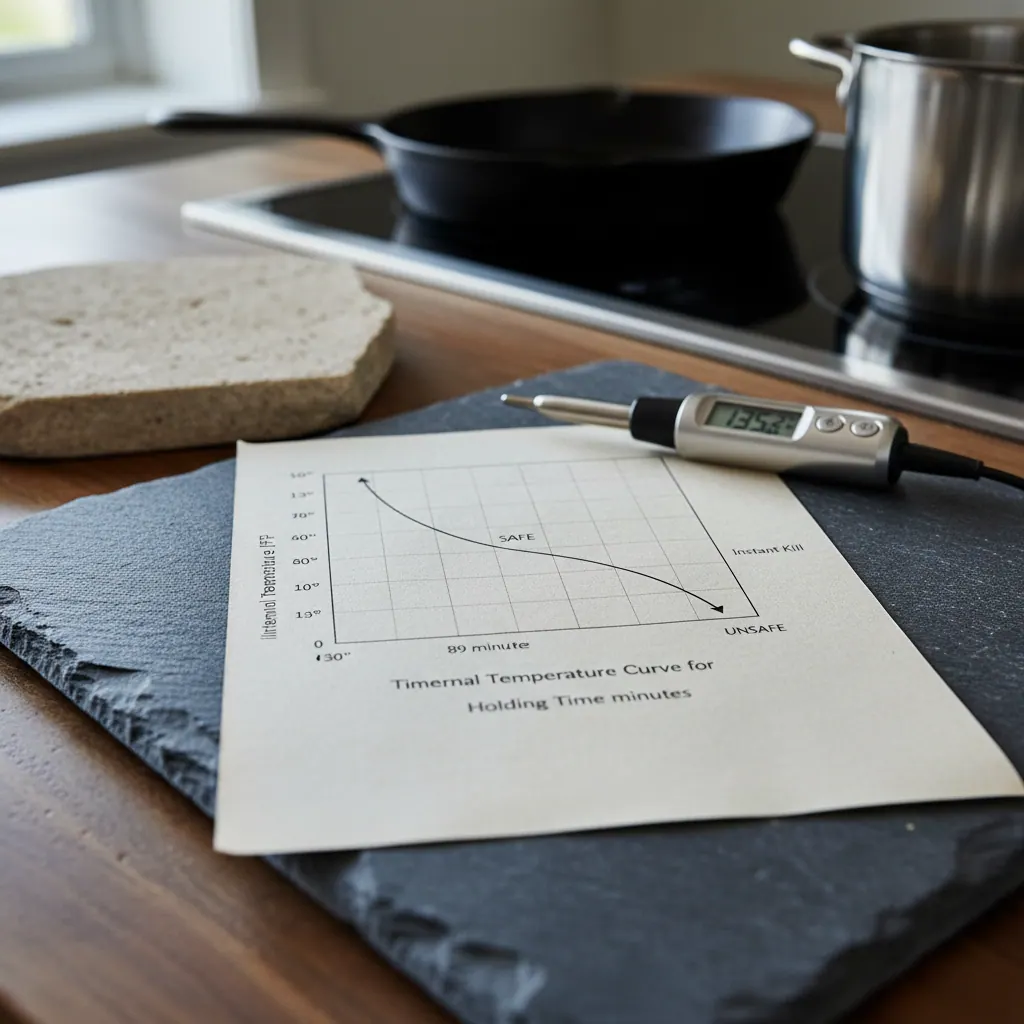
USDA’s 165°F target is the instant-kill temperature — Salmonella and Campylobacter (the two main concerns in chicken) are reduced by 7 logs (99.99999%) the moment the meat reaches 165°F. No holding time required.
Lower temperatures kill the same pathogens but require time to do so. The relationship is logarithmic — every 5°F you drop, the time required to achieve pasteurization roughly doubles:
| Internal temp | Hold time for 7-log reduction |
|---|---|
| 165°F | Instant |
| 160°F | 14 seconds |
| 155°F | 47 seconds |
| 150°F | 2 min 48 s |
| 145°F | 8 min 32 s |
| 140°F | 27 min 30 s |
| 135°F | 1 hour 30 min |
For sous vide cooking, lower temperatures + holding time produce safe chicken at 145°F — the meat is pasteurized but stays juicier than the 165°F endpoint. For pan-cooking on a cooktop, 165°F is the safe target because measured holding times are impractical.
The reason 165°F works for home cooking: chicken doesn’t go from “below 165°F” to “165°F” instantly. It passes through the lower kill zone (140–155°F) for several minutes during the cook, accumulating pasteurization “credit.” By the time it reaches 165°F, it’s been pasteurized multiple times over — there’s no marginal risk to pulling at 162°F and resting.
Pink color is not a safety indicator. Myoglobin (the muscle protein responsible for color) varies with chicken age, breed, freezing history, and the chemistry of the cooking environment. A 165°F chicken can be pink near the bone; a 145°F chicken can be uniformly white. Trust the thermometer, not your eyes.
Cooktop technique by cut
Boneless skinless chicken breast (the most common preparation)
Goal: golden exterior, moist interior at 165°F final, no pink.
- Pound to even thickness. Place breast between plastic wrap, pound with the flat side of a meat mallet until it’s an even 0.75–1 inch thick throughout. Uneven breasts cook unevenly — the thin tip dries out by the time the center reaches temperature.
- Salt 30+ minutes ahead — kosher salt at 0.75% by weight (about 1 tsp per pound). For a faster brine, sprinkle salt and refrigerate uncovered for 30+ min.
- Pat dry with paper towels right before cooking. Wet surface = no browning.
- Heat the pan — induction at level 7 (~2,200W) or gas at medium-high. Cast iron preferred for thermal mass; stainless tri-ply for faster cooks.
- Add 1 tablespoon high-smoke oil (avocado, refined peanut). Wait until it shimmers.
- Lay the breast in the pan smooth-side down. Resist moving for 3–4 minutes — the breast should release easily when properly seared.
- Flip and cook 4–5 minutes until instant-read reads 162°F at the thickest part.
- Rest 5 minutes on a wire rack — temperature rises to 165°F and juices redistribute.
Total time: 7–9 minutes active cooking + 5 minute rest.
Bone-in skin-on chicken thigh
Goal: crisp golden skin, fully rendered fat, internal at 175°F.
- Pat dry vigorously — the skin must be completely dry to render properly. Wet skin steams and never crisps.
- Season generously with salt and pepper, both sides. Salt at least 1 hour ahead is ideal for skin-on chicken.
- Heat a cold pan — start with thighs in a cold cast iron pan, skin-side down. Turn heat to medium (induction level 5, gas medium). The slow rendering of fat from the cold start produces the crispiest possible skin.
- Cook skin-side down 8–12 minutes without moving. The fat renders out, the skin crisps. Resist the urge to flip early.
- Flip and cook 12–14 minutes until internal reads 172°F at the thickest part of the thigh, away from bone.
- Rest 7 minutes — internal rises to 175–178°F. Connective tissue (collagen) has now converted to gelatin — the texture is tender, not rubbery.
Total time: 22–28 minutes active + 7 minute rest.
For pan selection, see our best cast iron for induction and gas — the lid trick (cover briefly during the bone-side cook) speeds the through-cook.
Whole chicken on the cooktop (spatchcock + pan-roasted)
A whole chicken pan-roasted on a cooktop with no oven is the under-appreciated method. Spatchcock the bird (remove the backbone, press flat) and cook in a 12-inch cast iron pan with a lid.
- Spatchcock: kitchen shears, cut along both sides of the backbone, remove. Press the bird flat with palms.
- Salt at least 4 hours ahead — overnight in the refrigerator, uncovered, is best for crisp skin.
- Pan-roast in cast iron: heat the pan over medium-low (induction level 4, gas medium-low) with 1 tablespoon oil. Place chicken skin-side down. Weight with another heavy pan or a foil-wrapped brick.
- Cook 25 minutes skin-side down — produces deeply crisp skin.
- Flip and continue 20–25 minutes with a lid (use a deflected lid that vents — full lid steams). Internal target: 162°F at thigh.
- Rest 15 minutes — internal rises to 168–170°F. Carve and serve.
Total time: 50–55 minutes active + 15 minute rest.
Pan-fried chicken cutlets (breaded)
For breaded cutlets, the breading IS the surface — Maillard happens in the breadcrumbs, not the meat. Target oil temperature in the pan: 325–340°F.
- Pound the breast to 0.5 inch thick.
- Standard breading: flour → egg → seasoned breadcrumbs.
- Pan: 1/4 inch of oil, induction level 6 (~2,000W) or gas medium. Verify oil temperature with a thermometer.
- Cook 3 minutes per side until golden and internal reads 165°F.
- Drain on a wire rack — paper towels make breading soggy.
For deep-frying technique, see our how to deep fry on induction which covers oil temperature management in detail.
The thermometer rules
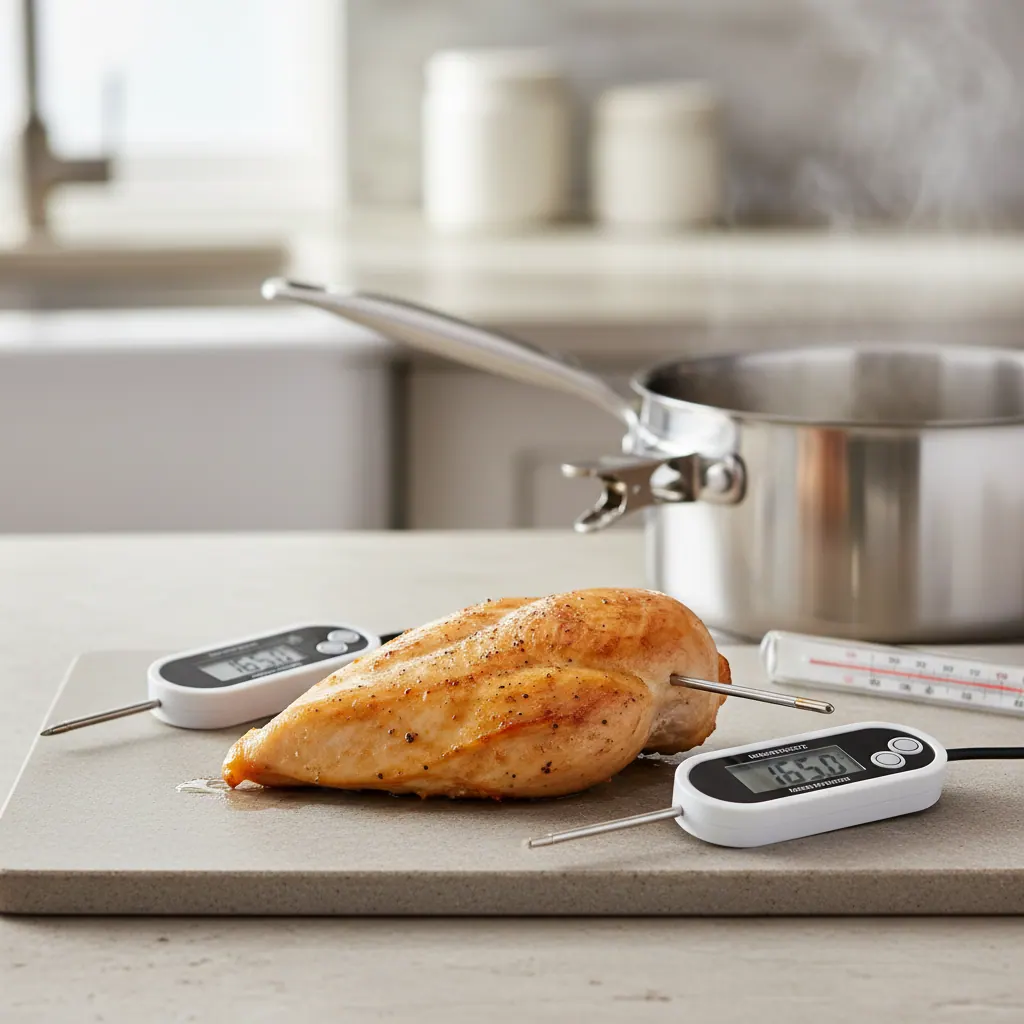
You cannot cook chicken safely without a thermometer. There is no exception to this rule.
Recommended thermometers:
| Model | Type | Use case | Price |
|---|---|---|---|
| ThermoWorks ThermaPen ONE | Instant-read | Best overall — 1 second read | $99 |
| ThermoWorks ThermoPop | Instant-read | Budget instant-read; 3-second read | $35 |
| Lavatools Javelin Pro | Instant-read | Mid-tier alternative; 3-second read | $40 |
| ThermoWorks ChefAlarm | Clip-on probe | Hands-free monitoring | $59 |
| Inkbird IBT-2X | Bluetooth dual-probe | Two pieces simultaneously | $40 |
How to use:
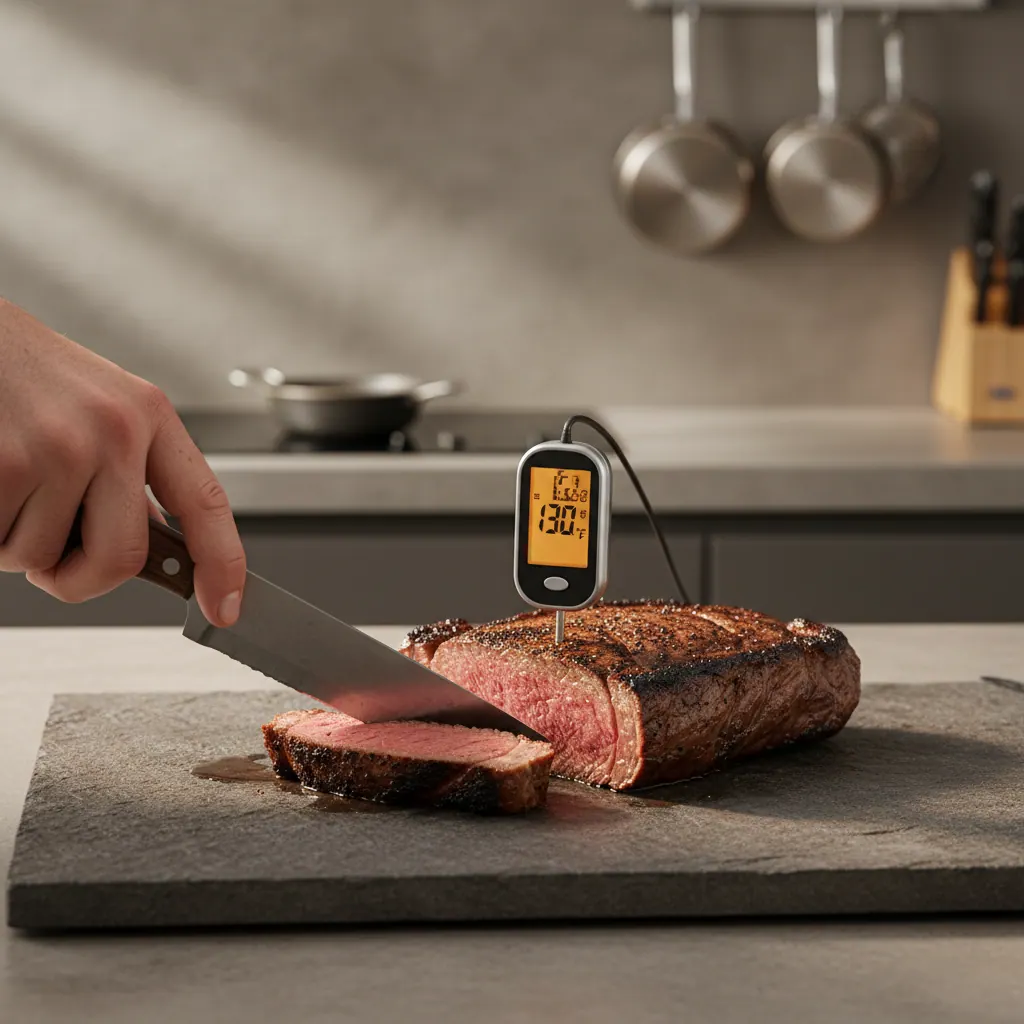
- Insert the probe horizontally into the thickest part of the meat — not against bone (bone reads cooler than meat).
- For breast, that’s the dome on the smooth side, perpendicular to the grain.
- For thigh, that’s the muscle between the bone and the joint, away from bone.
- For whole chicken, that’s the thickest part of the thigh, away from bone.
- Read after 3–5 seconds when the temperature stabilizes.
- Check multiple spots on larger cuts — temperature varies by 10–15°F across a thick breast or whole bird.
Calibrate periodically: in a glass of ice water (50% ice), the thermometer should read 32°F ±1°F. In rapidly boiling water at sea level, it should read 212°F ±1°F. Recalibrate or replace if off by more than 2°F.
Common mistakes and the fixes
| Mistake | Result | Fix |
|---|---|---|
| Cooking by time, not temperature | Inconsistent results — sometimes 145°F, sometimes 175°F | Use a thermometer always |
| Probing into the bone | Reads 5–15°F lower than meat | Insert into thickest meat, away from bone |
| Cooking refrigerator-cold chicken | Slow cook, dry exterior | Rest at room temp 20–30 min before cooking |
| Pulling at exactly 165°F | Carryover takes it to 170°F+ — slightly dry | Pull at 160°F for breast, rest 5 min |
| Pulling thigh at 165°F | Connective tissue not rendered, rubbery texture | Pull thigh at 172°F, rest to 175–180°F |
| Cutting immediately after cooking | Juices everywhere, dry meat | Rest 5–7 minutes per piece, 15+ for whole bird |
| Trusting “clear juices” | Unreliable indicator | Trust the thermometer reading |
| Trusting “no pink” | Brown can still be undercooked | Trust the thermometer reading |
Bottom line
165°F is the safe target for all chicken cuts — measured at the coldest part of the meat with a calibrated instant-read thermometer. Pull lean cuts (breast) 3–5°F early to compensate for carryover; pull dark cuts (thigh) 5–10°F higher than safe minimum to render connective tissue.
A thermometer is non-negotiable. Color, texture, juice clarity, and cook time are all unreliable. The time invested in proper internal temperature checking is repaid every time — no foodborne illness, no overcooked dry results, no anxious “is it done yet?” guessing.
For the gear we use to cook chicken in our test kitchen, see best stainless steel pans for induction and best cast iron pans for induction and gas. For chicken on induction specifically, our induction cooktop guides cover the precise control that makes induction so good for chicken cooking.
Frequently asked questions
What is the safe internal temperature for cooked chicken?
165°F (74°C) at the thickest part of the meat — USDA standard for all cuts. This is the instant-kill temperature for Salmonella and Campylobacter. Lower temperatures kill the same pathogens with longer holding times (160°F for 14 seconds, 145°F for 8.5 minutes), but 165°F is the simplest reliable home-cooking target.
Is chicken done at 160°F?
At 160°F internal, chicken is safe IF held 14 seconds. In practice, pulling at 160°F and resting 3–5 minutes brings the temperature to 165°F via carryover, which achieves pasteurization. For breast, this prevents overcooking. For thigh, target higher — 170–175°F — for connective tissue to render.
What is the difference between chicken breast and thigh cooking temperature?
Both are safe at 165°F. Breast is best at 162–165°F final (lean, dries fast); thigh is best at 175°F final (connective tissue must convert to gelatin for tender texture). Pulling a thigh at 165°F leaves it rubbery; pulling at 175°F gives proper texture.
How long does it take to cook chicken on a cooktop?
Pan-seared boneless breast (0.75-1 inch): 7–9 minutes active. Bone-in thigh, skin-on: 22–28 minutes. Whole spatchcocked chicken: 50–55 minutes. Always verify with thermometer; times vary with thickness, pan thermal mass, and starting temperature.
Can you eat chicken pink inside?
Yes — if the thermometer reads 165°F. Pink color is myoglobin chemistry, not raw meat. Color is not a reliable safety indicator. Brown chicken can be undercooked; pink chicken can be safe. Trust the thermometer, not your eyes.
Food safety information per USDA FSIS guidelines (Time-Temperature Tables for Cooking Ready-to-Eat Poultry Products) and Cooktop Hunter test kitchen data, May 2026. Pasteurization curve calculated for D-value of Salmonella enterica per USDA FSIS Appendix A. ThermoWorks ThermaPen ONE used as primary reference thermometer.