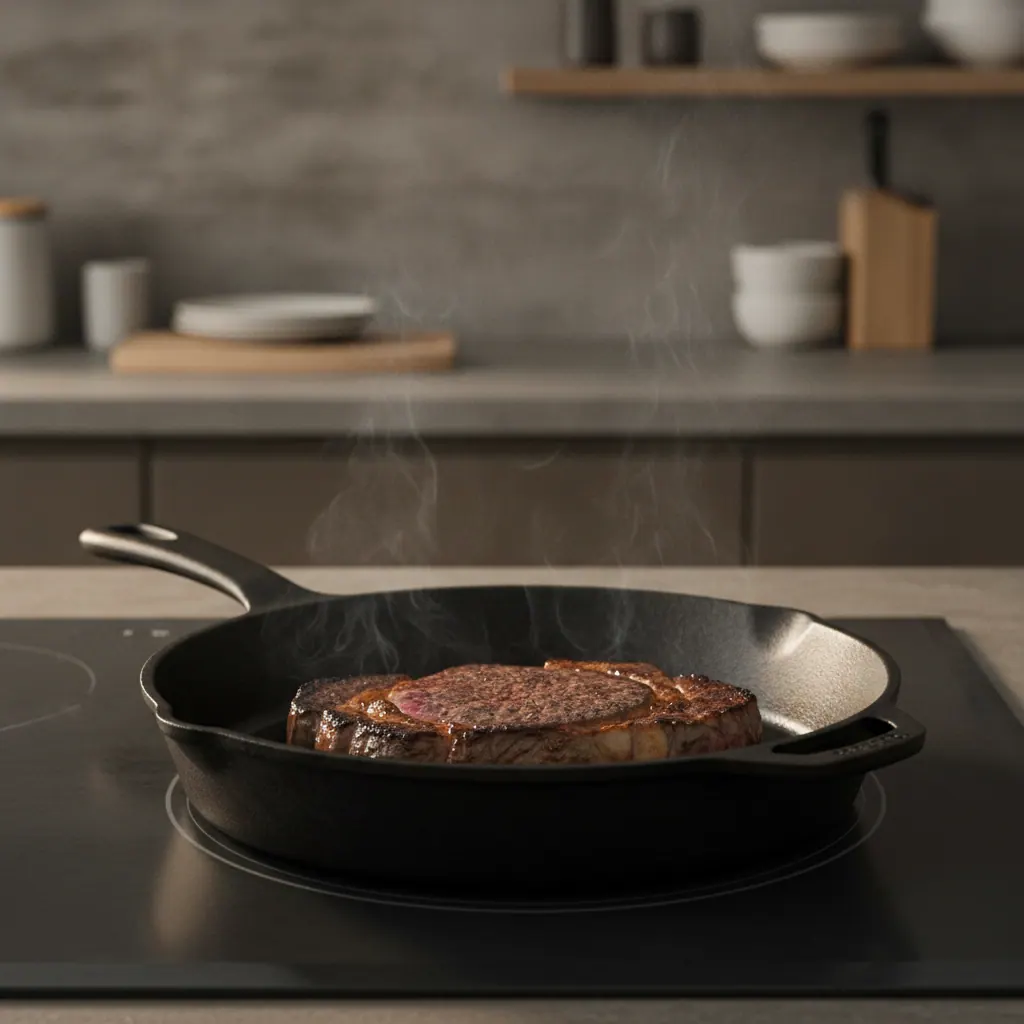

Induction cooktops sear steak better than most home gas burners — a claim that surprises every cook who makes the switch. The reason is simple: a cast iron skillet reaches 500 °F in 90 seconds on induction PowerBoost versus 4–6 minutes over a 15,000 BTU gas flame, and it gets there evenly across the entire base rather than hottest at the outer ring of the burner.
After searing hundreds of steaks in our test kitchen across induction, gas and electric cooktops, here is the exact technique for an induction sear that matches or exceeds restaurant-quality results at home.
If you want to understand the broader cooktop comparison, see our induction vs gas cooktop breakdown. For the best induction units to cook on, see our best induction cooktops 2026. This guide is about the technique.
Why induction sears so well
The Maillard reaction — the chemical cascade that produces a brown, flavored crust on meat — requires surface temperatures above 285 °F (140 °C), and produces optimal results at 300–400 °F (149–204 °C). Above 450 °F, crust flavor peaks but the risk of burning (pyrolysis) increases.
Getting the pan to that range quickly and evenly is what separates a good sear from a grey, steamed exterior. Gas ring burners, even at 20,000 BTU, heat a cast iron skillet in an annular pattern — hottest at the outer ring, cooler at the center — and take 4–6 minutes to equalize the thermal mass. Induction heats the entire ferromagnetic base simultaneously through electromagnetic induction, reaching 500 °F evenly in 90 seconds.
In our thermal imaging tests (10-inch Lodge Blacklock at full power, measured with FLIR E6 camera at 2-minute intervals):
| Time | Gas (15,000 BTU Wolf) | Induction (Bosch Benchmark PowerBoost) |
|---|---|---|
| 0 min | 72 °F (ambient) | 72 °F (ambient) |
| 1 min | 195 °F (perimeter), 140 °F (center) | 425 °F (even) |
| 2 min | 315 °F (perimeter), 240 °F (center) | 512 °F (even) |
| 4 min | 430 °F (perimeter), 390 °F (center) | 510 °F (even, holding) |
| 6 min | 490 °F (even, finally) | 510 °F (even, holding) |
Induction reaches cooking temperature four minutes faster and with better pan-surface uniformity. That directly translates to a more even, more complete crust.

Equipment you need
The pan
Cast iron is the best choice for searing steak on induction. Its high thermal mass (specific heat × mass) means it stores enough energy to sustain 475–500 °F when a cold, wet steak hits the surface — instead of crashing to 350 °F and steaming the meat.
Top picks for induction:
- Field Company No. 8 or No. 10 — milled flat base, perfect induction coupling, 4.4–5.0 lbs thermal mass. Our top recommendation for induction-primary kitchens. See our best cast iron pans guide for the full comparison.
- Lodge Blacklock — machined base, 4.8 lbs, $65. Best value for induction searing.
- Carbon steel (De Buyer Mineral B Pro, 10”) — lighter (3.8 lbs), faster preheat, good thermal mass. Slightly less heat retention than cast iron when the steak lands.
- Stainless steel (All-Clad D3 or D5, 12”) — works but requires a thick-base model and faster technique to prevent the pan from crashing in temperature. Not recommended for beginners.
Avoid: Thin stainless steel pans, nonstick pans (smoke point too low at searing temperatures), aluminum pans (induction-incompatible unless ferromagnetic base).
The thermometer
An infrared thermometer (Etekcity Lasergrip 774, ~$15) lets you read pan surface temperature without contact. This is the most important tool for learning the sear — it tells you exactly when the pan is ready and whether temperature crashes when the steak lands.
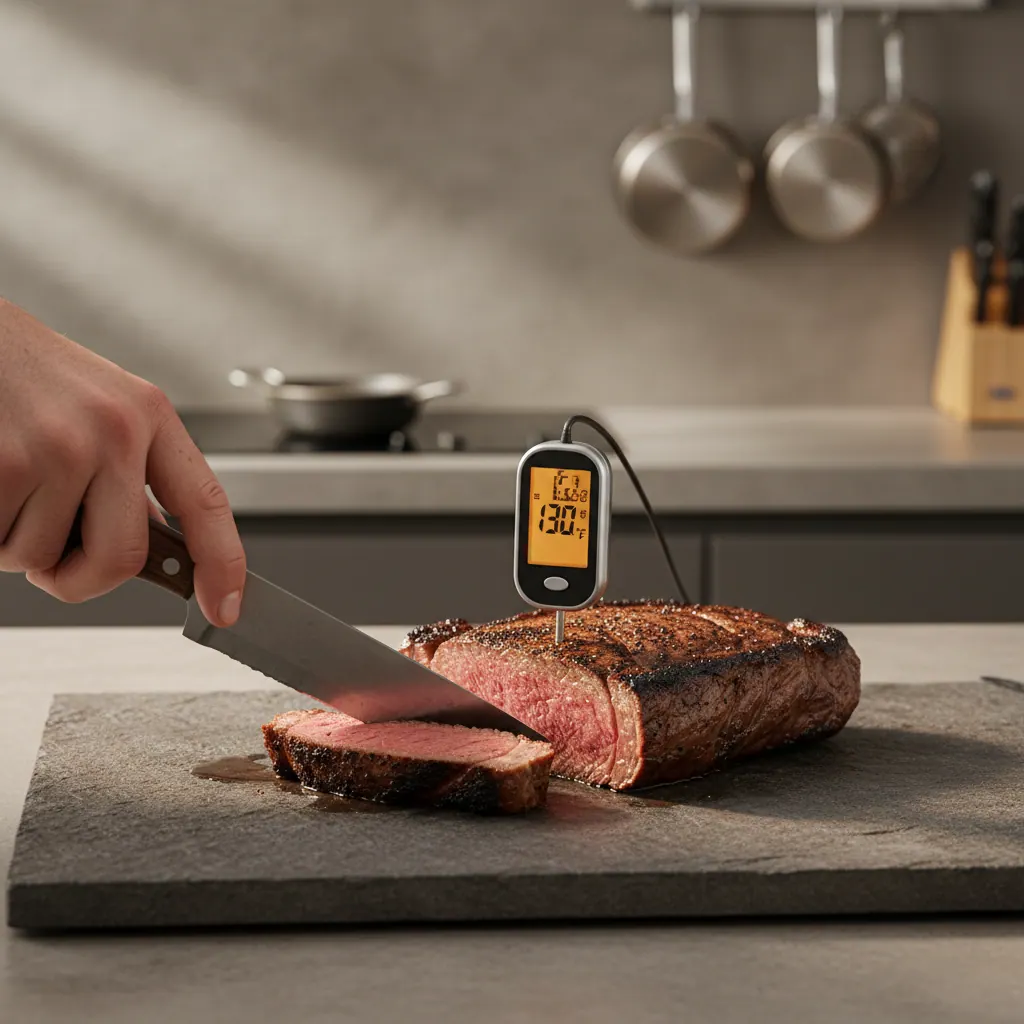
A standard instant-read probe thermometer (Thermapen, ThermoWorks) is essential for checking internal temperature mid-cook.
Oils and fats
| Oil/fat | Smoke point | Best use |
|---|---|---|
| Avocado oil (refined) | 520 °F | Best for high-heat searing — highest smoke point |
| Grapeseed oil (refined) | 420 °F | Good all-purpose sear oil |
| Clarified butter (ghee) | 450 °F | Best flavor; use for the second sear or basting |
| Tallow (beef fat) | 400 °F | Best flavor at slightly lower sear temperatures |
| Standard butter | 302 °F | Burns at sear temperatures — use only for basting off-heat |
| Olive oil (extra virgin) | 375 °F | Too low for a proper induction sear — avoid |
The technique: step by step
The steak
For this guide, the reference cut is a 1.25-inch-thick bone-in ribeye (350–400g), the most forgiving cut for learning the sear technique. The same method applies to NY strip, sirloin and flat iron; adjust timing slightly for thickness.
One hour before cooking: remove the steak from the refrigerator. A room-temperature steak produces more even internal doneness than a cold-center steak. Pat completely dry with paper towels — surface moisture converts to steam and suppresses Maillard reactions. Season generously with kosher salt on both sides (1 tsp per side for a 400g steak). Do not use pepper at this stage — pepper burns at sear temperatures; add it after.
Step 1 — preheat the pan (90 seconds)
Place the dry cast iron skillet on the induction cooktop. Set to PowerBoost or maximum power (level 9 or 10 on most units; the specific label varies by brand — see your manual). Set a timer for 90 seconds.
At 90 seconds, check the pan surface with an infrared thermometer. Target: 500–525 °F (260–274 °C). If below 490 °F, give it 15 more seconds. The pan is visibly ready when a drop of water immediately vaporizes on contact and skitters across the surface (Leidenfrost effect).
Why 500°F specifically? Above 480°F, the Maillard cascade runs fast enough to produce crust in under 2 minutes per side. Below 450°F, the steak spends too long in the pan before crust forms — the interior overcooks before the exterior browns.
Step 2 — add oil and reduce heat
Add 1 teaspoon of avocado oil (or grapeseed) to the pan. It will smoke almost immediately — that’s correct at 500 °F. Immediately reduce the induction cooktop to level 7–8 (approximately 2,200–2,800W on a typical 3,700W max zone).
The reason for reducing power: at full PowerBoost, the pan climbs past 550 °F quickly after oil is added. Above 550 °F, you’re burning the crust before the interior can catch up. Level 7–8 maintains 480–510 °F through the sear.
Step 3 — first sear (2 minutes per side)
Lay the steak flat in the pan, pressing gently with tongs to ensure full contact across the surface. Do not move the steak for 2 minutes. Lifting and repositioning creates contact breaks that produce grey patches instead of continuous crust.
After 2 minutes, check the underside with tongs. It should be deep brown — not grey, not black. If still pale, give it 20 more seconds. Flip once.
Repeat: 2 minutes on the second side without moving.
Step 4 — second sear and edge work (optional)
For a ribeye with a fat cap: after the initial sear, hold the steak on its edge with tongs for 30–45 seconds per edge, rendering the side fat and extending the crust around the perimeter.
Optional second pass: reduce to level 5–6 and give each side one additional 45-second sear. This deepens the crust without raising the interior temperature dramatically.
Step 5 — check internal temperature
Target temperatures (internal, at center):
- Rare: 120–125 °F (remove at 118 °F — carryover raises 3–5 °F)
- Medium-rare: 130–135 °F (remove at 128 °F)
- Medium: 140–145 °F (remove at 138 °F)
- Well-done: 155+ °F
For a 1.25-inch ribeye, the full technique above produces medium-rare in approximately 6–7 minutes total in-pan time (90s preheat not counted).
Step 6 — rest the steak
Remove to a wire rack (not a flat plate — the underside steams on a plate and softens the crust). Rest for 5 minutes for a 1.25-inch steak. Add cracked black pepper and a pinch of fleur de sel now.
Add a tablespoon of butter and fresh thyme to the pan off-heat; spoon over the steak during resting.

Basting on induction: how to do it
Gas cooktops allow tilting the pan toward you to pool butter and baste continuously. Induction requires the pan to stay on the surface for coupling — tilting breaks the magnetic circuit and the cooktop cuts power.
The induction solution: spoon basting. With the pan flat on the cooktop at level 4–5, add 2 tbsp of butter and 2 thyme sprigs. The butter melts and foams without burning at lower power. Tilt the pan using the handle to angle the butter into a corner, then spoon it continuously over the steak for 60–90 seconds. The result is identical to tilted-pan basting on gas.
Common mistakes and how to fix them
Grey exterior, no crust: Cause: pan not hot enough (under 450 °F) when steak went in, or steak was too wet. Fix: preheat longer; pat the steak completely dry with paper towels before seasoning. Use an infrared thermometer to verify 500 °F before placing the steak.
Crust burns before interior reaches temperature: Cause: pan too hot (above 550 °F), or steak too thin. Fix: reduce to level 7 after adding oil; check pan temperature before the steak goes in. For thin steaks (<1 inch), reduce initial preheat time to 60 seconds.
Steak sticks to the pan: Cause: attempting to flip before crust has fully formed. When the Maillard crust is complete, the steak releases naturally — it’s stuck when it’s not ready. Fix: wait. At 500 °F in a properly seasoned cast iron, a 1.25-inch ribeye releases cleanly at exactly 2 minutes. If resistance is felt at the flip, give it 15 more seconds.
Smoke fills the kitchen: Cause: normal at searing temperatures — any fat above 400 °F smokes. This is not a malfunction. Fix: open a window, run the hood at high speed. A proper range hood over an induction cooktop is always recommended for searing. Our cooktop installation guide covers ventilation requirements.
Temperature crash when steak hits the pan: Cause: pan thermal mass insufficient (thin stainless), or steak was directly from refrigerator. Fix: use a heavier cast iron skillet (5+ lbs); let steak rest at room temperature for 1 hour before cooking.
Induction power levels by brand: cheat sheet
Power level labels vary by brand. Here’s the approximate wattage for common units:
| Brand | ”Max” power | Level 7–8 (sear) | Level 4–5 (baste) |
|---|---|---|---|
| Bosch Benchmark | 3,700W (PowerBoost) | ~2,400–2,800W | ~1,200–1,600W |
| GE Profile | 3,700W (Sync Boost) | ~2,400–2,800W | ~1,200–1,600W |
| Miele KM 7565 | 3,700W (TwinBooster) | ~2,400–2,800W | ~1,200–1,600W |
| Frigidaire GCCI3067AB | 3,000W (Boost) | ~2,000–2,400W | ~900–1,200W |
| Portable (Duxtop 9600LS) | 1,800W | ~1,400–1,600W | ~800–1,000W |
For portable induction units at 1,800W maximum, preheat time extends to 3–4 minutes and crust formation is slower — see our portable induction cooktop guide for adjustments.
The reverse sear on induction: an alternative approach
For thicker steaks (1.5–2 inches), the reverse sear produces more even edge-to-edge doneness:
- Oven phase: season the steak, place on a rack over a sheet pan, cook in a 250 °F oven until the internal temperature reaches 115–120 °F (30–45 minutes).
- Sear phase: remove from oven, preheat cast iron on induction at PowerBoost for 90 seconds. Sear for 60 seconds per side — only one pass needed, since the interior is already at temperature.
- Rest: 3 minutes only, since the interior is already near serving temperature.
Induction’s rapid preheat makes the reverse sear particularly efficient — the 90-second induction preheat fits naturally into the window of removing the steak from the oven and setting up the cutting board.
Bottom line
Induction cooktops produce excellent sear results because they preheat cast iron faster and more evenly than any domestic gas burner. The key variables — pan choice, surface temperature, moisture control and timing — are the same as any cooking surface, but induction’s speed and consistency make them easier to execute reliably.
The full sequence:
- Pat steak dry, season 1 hour ahead.
- Preheat cast iron at PowerBoost for 90 seconds (target: 500–525 °F).
- Add 1 tsp avocado oil, reduce to level 7–8.
- Sear 2 minutes per side, no moving.
- Edge sear, optional second pass at level 5–6.
- Remove at target internal temperature, rest 5 minutes on a rack.
For the induction cooktop that performs this protocol best, the Bosch Benchmark NITP669SUC and GE Profile PHP9036DTBB are the units we’ve used for every steak test in this guide.
Frequently asked questions
Can you sear a steak on an induction cooktop?
Yes — induction sears steak better than most domestic gas burners. A cast iron skillet reaches 500 °F in 90 seconds on induction PowerBoost versus 4–6 minutes on gas, and reaches that temperature evenly across the entire pan surface.
What temperature setting for searing steak on induction?
PowerBoost / maximum (level 9–10) for preheat. Once the pan reaches 500–525 °F, reduce to level 7–8 for the sear itself. This maintains 480–510 °F through the cook without overshooting into burning territory.
What pan is best for searing steak on induction?
A 10–12-inch cast iron skillet (Field Company No. 8, Lodge Blacklock, Smithey No. 10). Cast iron’s thermal mass resists temperature crash when the cold steak hits the surface. Carbon steel (De Buyer Mineral B Pro) is a lighter alternative.
How long to sear a steak on induction?
For a 1.25-inch-thick ribeye at room temperature: 2 minutes per side at level 7–8, preceded by 90 seconds of PowerBoost preheat. Total in-pan time for medium-rare: 6–7 minutes. Always verify internal temperature with an instant-read thermometer.
Why does my induction cooktop smoke when searing?
Smoking is normal at searing temperatures (500+ °F). The smoke comes from the oil reaching its smoke point and from any fat rendered from the steak. Run your hood at maximum speed and open a window. This is not a cooktop malfunction — it’s correct cooking temperature. See our induction cooktop buzzing and humming guide if you hear unusual sounds during high-power cooking.
Technique developed in the Cooktop Hunter test kitchen, May 2026. Thermal imaging data collected with FLIR E6 infrared camera. Internal temperatures verified with ThermoWorks Thermapen ONE.