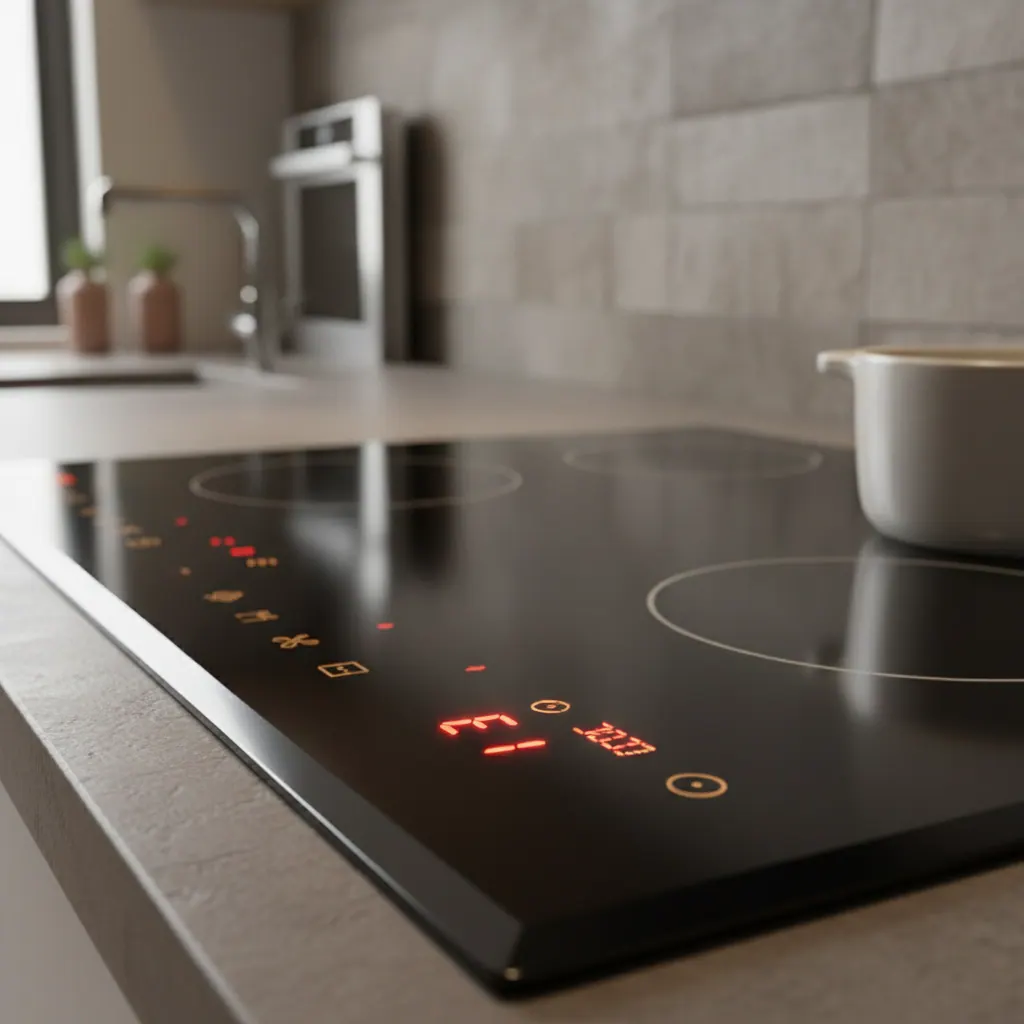
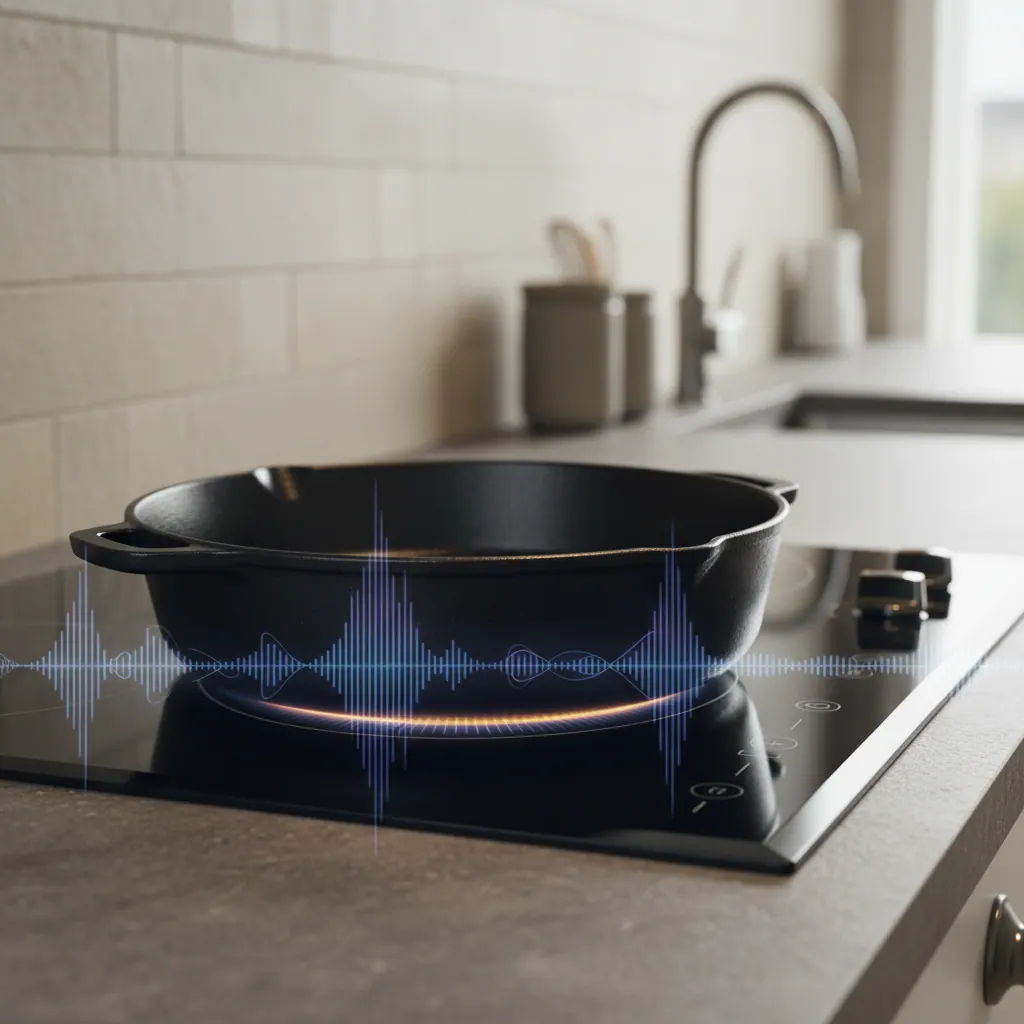
If your induction cooktop is buzzing or humming, the cause is almost always your pan, not the cooktop. The most common culprit — by a wide margin — is magnetostriction, the physical vibration of ferromagnetic metals when exposed to a rapidly switching magnetic field. It is normal, harmless, and physics is doing exactly what it’s supposed to do.
That said, induction cooktops produce five distinct types of noise, and only three of them are normal. After 12 years of testing induction units across every major brand, here’s the diagnostic chart we use to separate “your $3,000 Bosch is fine” from “this is a service call.”
If you’re new to induction or still shopping, our induction vs gas comparison covers the noise question briefly — this guide goes deep.
TL;DR — the 60-second triage
Match the sound to the cause:
| Sound | Likely cause | Normal? |
|---|---|---|
| Low-pitched hum at high power | Magnetostriction in pan base | ✅ Yes |
| Buzzing that gets louder when you boost | Pan-base layers vibrating against each other | ✅ Yes |
| Whirring or whooshing | Internal cooling fan | ✅ Yes |
| Sharp clicking when changing power levels | Power inverter switching frequency | ✅ Yes |
| High-pitched whine with no pan or at low power | Inverter or coil failure | ❌ Service call |
| Crackling or popping under the pan | Liquid trapped between pan layers | ⚠️ Use a different pan |
If you’ve heard a sound you can’t categorize, work through the five sections below — every audible noise an induction cooktop produces is one of these five.
1. Magnetostriction — the dominant cause of “humming”
When the cooktop’s coil generates its 20-50 kHz alternating magnetic field, the iron atoms inside your pan’s base physically expand and contract with each cycle. This is called magnetostriction, and it’s the same effect that makes power transformers hum.
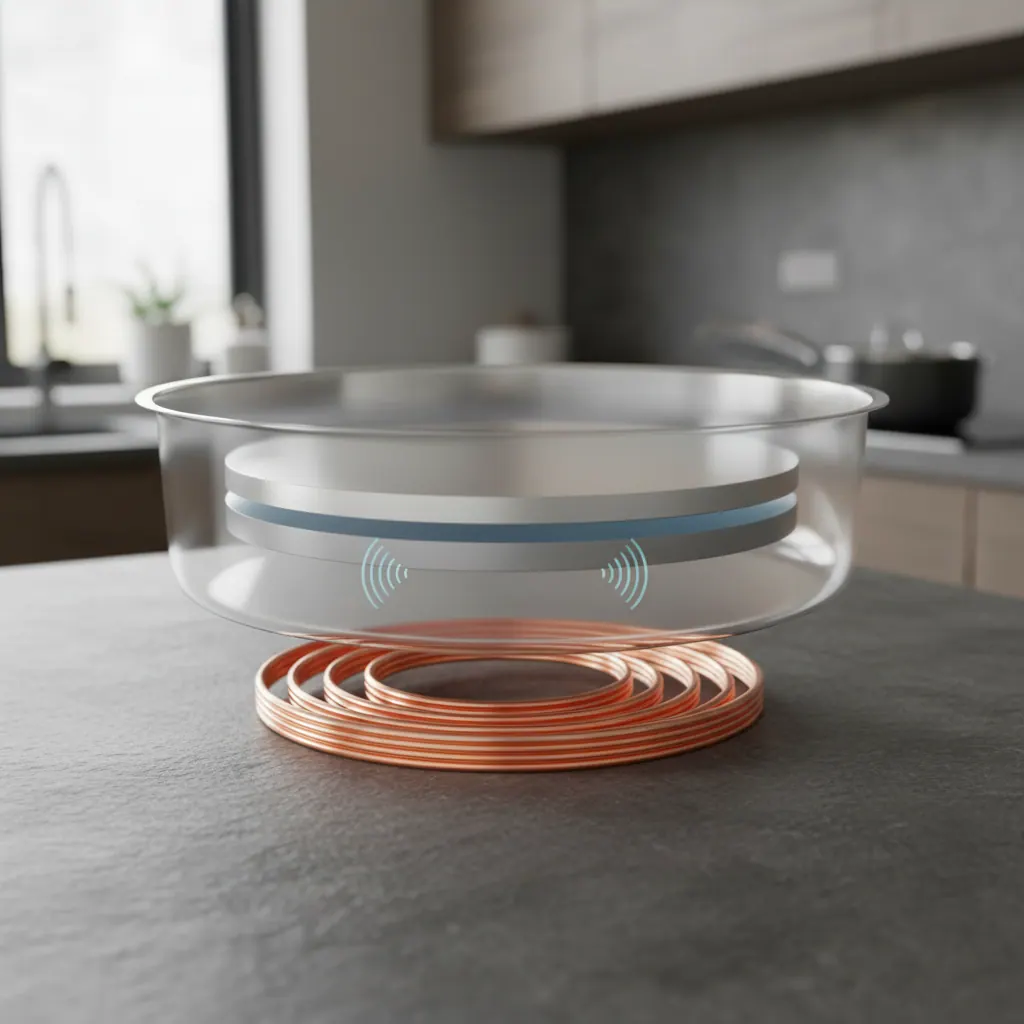
The vibration is small (microns of displacement) but at 20-50 kHz it produces audible harmonics — typically a 40-200 Hz hum or low buzz. The intensity depends on:
- Pan material: pure cast iron is quietest (single-piece, dense). Multi-layer stainless (All-Clad D5, Demeyere Atlantis) is the loudest because the layers vibrate against each other.
- Pan thickness: thinner = louder. A budget 1.5 mm stainless pan will buzz like a beehive at boost; a 4 mm cast iron skillet barely whispers.
- Power level: doubles in volume for each 30 % increase in power. Boost is always loudest.
- Liquid contents: a pan with water dampens the vibration significantly. A dry pan amplifies it.
This is normal physics, not a defect. Every induction cooktop on earth produces it, including the $4,000 Miele KM 7000 series.
2. The internal cooling fan — the second source of normal noise
Induction cooktops contain a switching power supply (inverter) that gets warm under load. To prevent thermal shutdown, every modern induction unit has an internal fan that runs:
- Whenever a zone is active
- For 5-15 minutes after you turn off the last zone (residual cooling)
- Continuously at low speed if the cooktop has been recently shut down (some Miele and Gaggenau units)

The fan produces a steady whirring or whooshing at 35-55 dB — about the volume of a quiet refrigerator. If it’s louder than that, or sounds like a coffee grinder, the fan bearing may be failing (uncommon, but documented on 2018-2020 GE Profile units that received a fan swap under recall).
The fan continuing after cooking is finished is not a fault. It’s protecting the inverter from heat soak. Disconnecting power before the fan finishes can shorten inverter life.
3. Inverter clicking or relay snap when changing power
When you tap a different power level on the touch panel, you may hear a soft click or snap from inside the cooktop. This is the switching relay changing the duty cycle of the inverter — typically a half-second click as the firmware reconfigures.
It’s most audible on:
- Bosch 800 Series (single click per power-level change)
- Samsung Flex Duo (a softer click)
- Frigidaire Gallery (occasionally a double-click on boost activation)
The Bosch Benchmark and Miele KM 7000 series use solid-state switching that produces no audible click — one of the small luxuries you pay for in the $3,000+ tier.
4. Crackling or popping — pan defect, not cooktop defect
A crackling, popping or sizzling sound coming from directly under the pan (not from the cooktop body) usually means liquid is trapped between the bonded layers of the pan base. As the metal heats and expands at slightly different rates per layer, the trapped moisture flashes to steam and pops the layers.
This is a sign of a damaged or counterfeit pan, not a cooktop fault. Common with:
- Counterfeit “All-Clad” pans bought from overseas marketplaces
- Old multi-layer cookware that was repeatedly heated empty until the layers delaminated
- Pans that were quenched (cold water on a hot pan) — Demeyere and All-Clad both warn against this
Replace the pan. The cooktop is fine. For a guide to known-good cookware, see our induction cookware guide.
5. High-pitched whine with no pan — the one sound that means service
A high-pitched whine, whistle, or screech from the cooktop body when:
- No pan is present
- The cooktop is “off” but powered
- Power level is at minimum (level 1-2)
This indicates the inverter is oscillating without a load — a sign that either the pan-detection circuit has failed or the inverter is starting to fail itself. Power down at the breaker and call service.
Other concerning sounds:
- Burnt-electrical smell + buzzing → stop using immediately, breaker off, service call.
- Loud bang followed by silence → an IGBT power transistor has failed. Service required.
- Buzzing that doesn’t stop when you remove the pan → control board fault.
Our full induction cooktop not heating troubleshooter covers the broader fault diagnostic process.
Why some induction cooktops are dramatically quieter than others
The quietest induction cooktops in our 2024-2026 testing rotation, ranked at boost on a 4 mm cast iron skillet:
| Cooktop | Noise at boost | Notes |
|---|---|---|
| Miele KM 7565 FR | 32 dB | Solid-state inverters, sealed coil mounting |
| Gaggenau CX 482 | 33 dB | Wool-insulated coil chamber |
| Bosch Benchmark NITP669SUC | 36 dB | Vibration-isolated coils |
| Bosch 800 Series NIT8068UC | 41 dB | Mid-tier coils, audible inverter clicks |
| GE Café CHP90362TSS | 43 dB | Slightly louder fan than peers |
| Samsung NZ36K7880UG | 45 dB | Lighter cooktop body resonates |
| Frigidaire Gallery FGIC3066TB | 48 dB | Entry-level construction |
The ~16 dB spread between the Miele and the Frigidaire is the difference between “is the cooktop on?” and “I need to raise my voice in the kitchen.” Coil vibration isolation, body mass and inverter switching design account for most of it.
For full reviews of our top picks, see our best induction cooktops 2026 round-up and our Bosch 800 Series review.
Five things you can do to reduce induction noise tonight
- Switch to a heavier pan. A 4 mm cast iron or 3-ply All-Clad D3 will be 8-15 dB quieter than a thin stainless.
- Keep the pan centered. Off-center pans put load on the edge of the coil, increasing vibration.
- Don’t run an empty pan. Empty pans amplify magnetostriction by removing the dampening effect of food.
- Step down from boost. Most boost-mode noise vanishes at level 8-9 with only a small speed penalty.
- Check cabinet venting. A cooktop that’s working harder to cool itself runs the fan louder. The bottom of the unit needs at least 2 inches of clear airflow under the cabinet floor.
Is induction cooktop noise dangerous? (no)
The audible noise from magnetostriction is mechanical vibration of the pan and cooktop body — it carries no electrical, magnetic or radiation risk to people, pets or pacemakers. The 20-50 kHz electromagnetic field is well below ICNIRP exposure limits at the standard 30 cm safety distance, and the audible harmonics are simply a side effect of an efficient power-transfer technology.
The one exception: if you have a pacemaker or implanted medical device, the manufacturer of your device (not the cooktop) will provide safe-distance guidance — typically 12-24 inches. This is unrelated to the noise; it’s about the EM field itself.
Bottom line
If your induction cooktop is humming, buzzing or making fan noise during cooking — it’s working correctly. Magnetostriction in the pan base, the internal cooling fan, and inverter switching clicks are all normal sounds of an efficient induction unit doing its job.
If you hear a high-pitched whine with no pan, a crackling under the pan, or a burnt-electrical smell — power down at the breaker and call service. Those are the only sounds that indicate a real fault.
For quieter induction in your next remodel, the 2026 best induction cooktops round-up ranks units by measured operating noise, and our how to choose a cooktop framework includes an “ambient noise” tier in the decision matrix.
Frequently asked questions
Why is my induction cooktop buzzing or humming?
The dominant cause is magnetostriction: ferromagnetic metal physically vibrates when exposed to a rapidly switching magnetic field. It is physics working as intended, it gets louder at higher power, and it is harmless. Multi-ply pans hum more than single-material ones because bonded layers of different metals vibrate against each other. Of the five distinct noises an induction cooktop makes, three are entirely normal.
Which induction cooktop noises are normal and which are not?
Normal: a low-pitched hum at high power from pan magnetostriction, buzzing that rises with boost, whirring or whooshing from the internal cooling fan, and sharp clicking as the power inverter switches levels. Not normal: a high-pitched whine that appears with no pan on the surface or at low power settings, which points to an inverter or coil fault and warrants a service call.
How do I stop my induction cooktop from buzzing?
Change the pan before you call anyone. A heavier, flat-bottomed, single-material or well-bonded pan will hum measurably less than a thin multi-ply one. Cooking below maximum power reduces it further, since magnetostriction scales with field strength. Make sure the pan is centred on the zone and that its base is genuinely flat — a slightly warped base rattles against the glass and adds a distinct chatter on top of the hum.
Is induction cooktop noise dangerous?
No. The hum, buzz, fan whir and inverter click are all normal operating sounds and none indicates a hazard. The electromagnetic field is confined closely to the cooking zone and the noise is a mechanical side effect of it, not a warning. The single sound worth acting on is a high-pitched whine with no pan present, which is an electronics fault rather than a safety emergency.
Sound-pressure measurements and pan-vibration data from the Cooktop Hunter test lab, April 2026. Full methodology on our editorial policy page.