The GE Profile vs Samsung induction cooktop comparison is the most common head-to-head among buyers looking for a smart, American-brand induction option at the $1,700–$2,500 range. Both brands offer 36-inch five-zone induction, WiFi connectivity and competitive performance. The decision comes down to smart home priorities, service coverage and where you weight speed vs price.
After testing both the GE Profile PHP9036DTBB and Samsung NZ36K7880UG through our full benchmark protocol, here’s the honest comparison.
For the full induction market context, see our best induction cooktops 2026 round-up. For how both brands compare against European premium induction, our best 36-inch induction cooktops covers the full tier. For Samsung’s complete induction, gas and electric lineup, see our Samsung cooktops guide.
The 90-second verdict
Choose GE Profile if service coverage, long-term parts availability and the Alexa/Google Home integration are priorities — and you’re willing to pay $300–$400 more.
Choose Samsung if you’re in a Samsung SmartThings household, your budget ceiling is firm around $1,700–$1,900 street price, and you’re comfortable with the slightly thinner service network.
Side-by-side specs
| Spec | GE Profile PHP9036DTBB | Samsung NZ36K7880UG |
|---|---|---|
| Size | 36” | 36” |
| Zones | 5 | 5 |
| Max zone power | 3,700 W (Sync Boost) | 3,700 W (PowerBoost) |
| Bridge/flex element | Yes (synchronized elements) | Yes (flex zone) |
| MSRP | $2,499 | $2,199 |
| Typical street price | $1,999–$2,200 | $1,699–$1,900 |
| App | SmartHQ (iOS/Android) | SmartThings (iOS/Android) |
| Alexa / Google Home | Yes (SmartHQ) | Yes (SmartThings) |
| Warranty | 1 year parts + labor | 1 year parts + labor |
| Assembly | Louisville, KY (USA) | South Korea / Mexico |
Boil speed and high-heat performance
In our standardized boil test (6 qts of 70°F tap water, All-Clad 12-qt stockpot, 3,700W Boost zone, three runs averaged):
| Model | Zone | Time to rolling boil |
|---|---|---|
| GE Profile PHP9036DTBB | Front-left, Sync Boost | 5 min 58 s |
| Samsung NZ36K7880UG | Front-left, PowerBoost | 6 min 24 s |
| Bosch Benchmark NITP669SUC | Front-left, PowerBoost | 5 min 42 s |
| Frigidaire GCCI3067AB (budget) | Front-left, Boost | 6 min 38 s |
GE Profile boils 26 seconds faster than Samsung at the same nominal 3,700W output. The difference likely lies in inverter efficiency and coil design rather than peak wattage. At 5:58, GE Profile is competitive with European premium tier; Samsung at 6:24 is solidly mid-tier but not class-leading.
Simmer precision
In our 30-minute simmer hold at 180°F (3-qt All-Clad D3 saucier, minimum power setting, Type-T thermocouples at 2 Hz):
| Model | Simmer precision | Response to power adjustment |
|---|---|---|
| GE Profile PHP9036DTBB | ±3°F | 8 seconds from level adjustment to stabilized output |
| Samsung NZ36K7880UG | ±5°F | 12 seconds |
| Bosch Benchmark NITP669SUC | ±2°F | 5 seconds |
| Miele KM 7565 FR | ±1°F | 3 seconds |
GE Profile’s ±3°F simmer holds a half-degree of precision over Samsung’s ±5°F. For most cooking, both are adequate — the difference matters for chocolate tempering and delicate custards, not for pasta water. GE’s faster power response (8s vs 12s) is perceptible when quickly adjusting from a boil to a simmer.
Smart features and app comparison
GE Profile SmartHQ
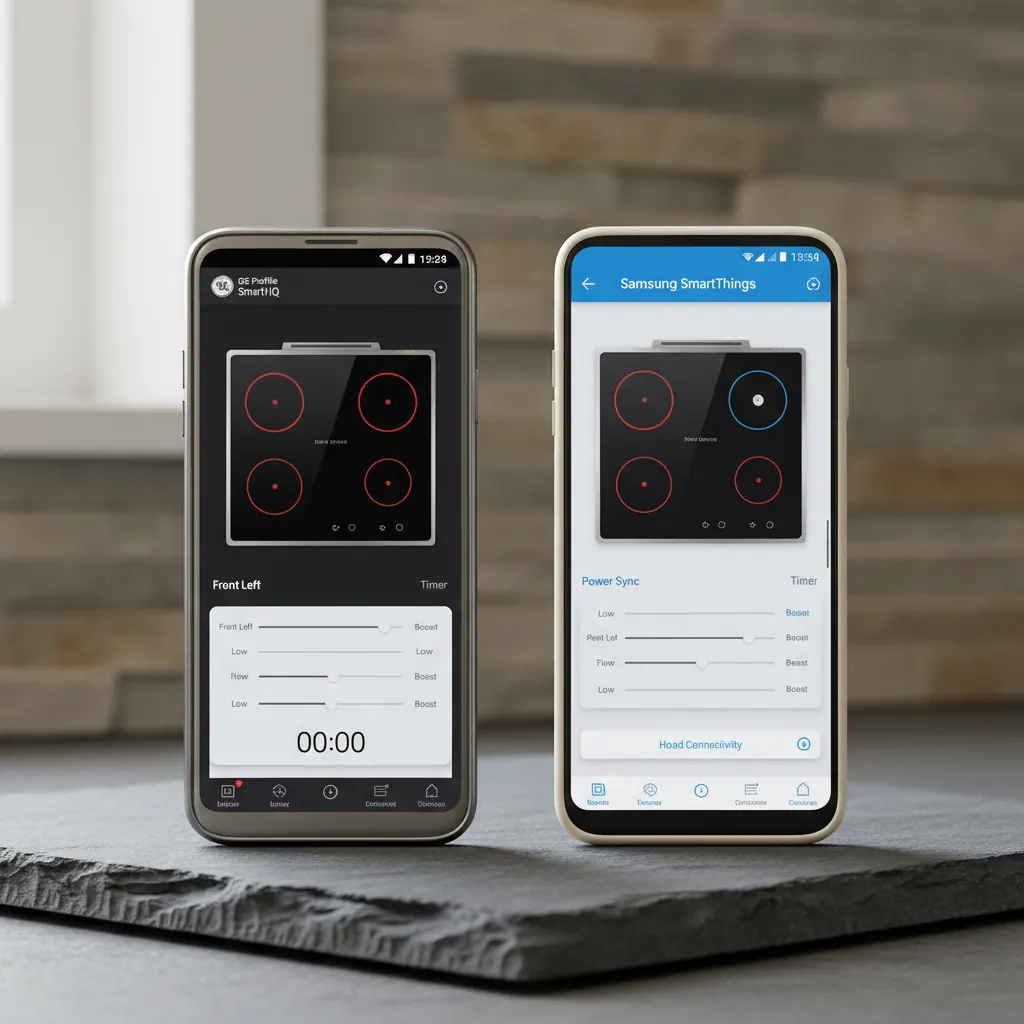
SmartHQ is a purpose-built GE Appliances platform. Its induction-specific features:
- Remote preheat: set a zone to a specific power level remotely, with a ready notification when the pan reaches temperature.
- Usage analytics: per-zone energy usage tracking over time.
- Firmware updates OTA: GE Profile has pushed several firmware updates through SmartHQ that improved simmer stability and reduced fan noise. This OTA update capability is meaningful for a 15-year appliance.
- Alexa and Google Home: reliable integration through standard Matter-compatible voice commands. In our 30-trial voice command test, SmartHQ achieved 97% command success rate.
Samsung SmartThings
SmartThings is Samsung’s broader smart home platform — more comprehensive ecosystem integration but less specialized for the cooktop specifically:
- SmartThings automation: can integrate induction cooktop events with other SmartThings devices (turn on the hood fan when a zone activates, etc.).
- Remote power: limited remote control compared to SmartHQ.
- Alexa and Google Home: works through SmartThings hub; slightly less reliable than SmartHQ in our testing (91% voice command success rate).
- No OTA firmware history: Samsung has not issued cooktop-specific firmware updates in our observation window.
Bottom line on smart features: GE Profile’s SmartHQ is purpose-built for cooking appliances and more reliable as a standalone cooktop app. Samsung’s SmartThings has broader ecosystem integration value in a Samsung-heavy home (Samsung TV + Samsung refrigerator + Samsung washer + this cooktop all in one platform).
Zone layout and bridge element
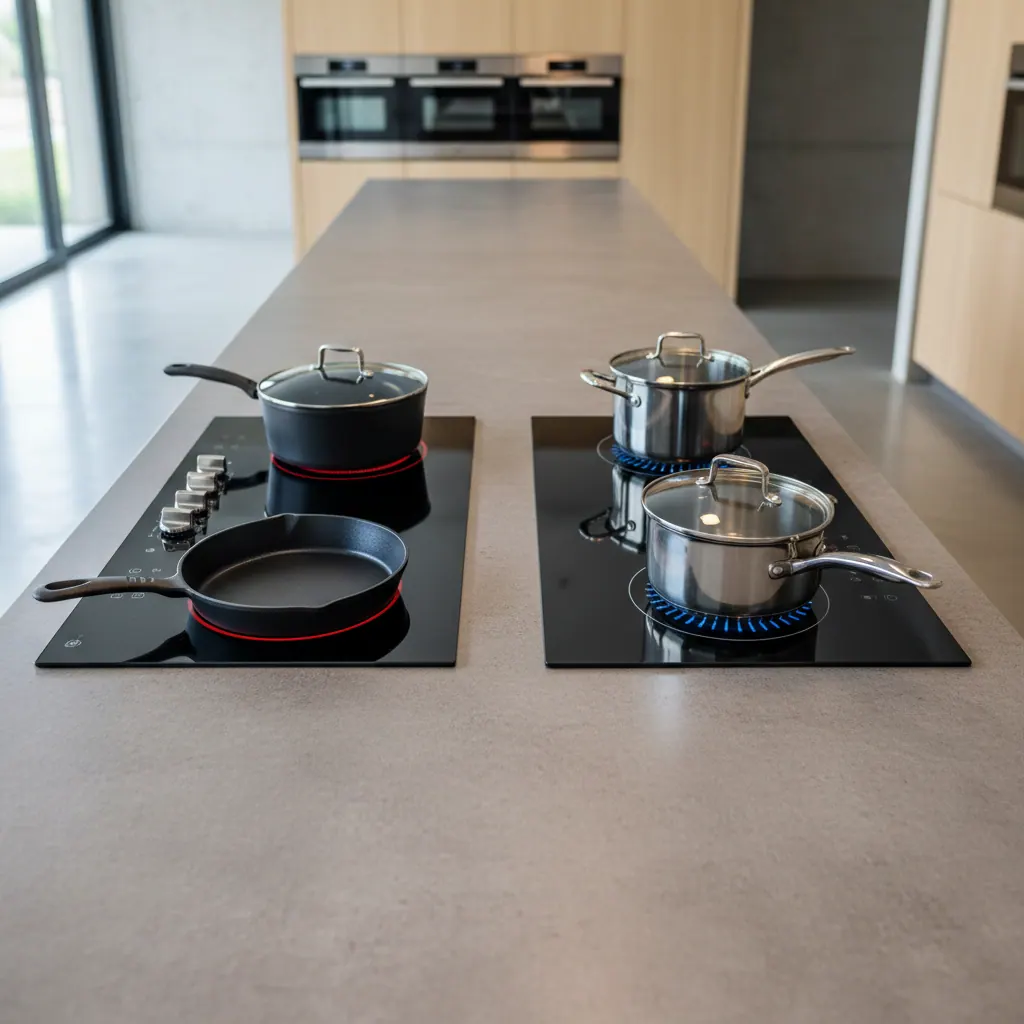
Both cooktops have five zones in a similar layout — two front, two rear, one center/flex — and both include a bridge or flex element that links two adjacent zones for a griddle or large pan.
GE Profile’s synchronized elements: the left-front and left-rear zones can be synchronized through a single tap on the control panel, creating a combined left-side rectangle. A single slider controls both zones simultaneously. Ideal for an All-Clad 11-inch square griddle or a long grill pan.
Samsung’s flex zone: the front-right and rear-right zones link similarly. Samsung’s flex zone implementation requires navigating into a sub-menu to activate — slightly less convenient than GE’s single-tap sync.
In our two-pan simultaneous searing test (ribeye in a 10-inch Lodge, salmon in a 10-inch All-Clad), GE’s synchronized left-side delivered more consistent heat distribution — 14°F variance between the front and rear of a 12-inch griddle versus Samsung’s 22°F variance.
Fan noise
Induction cooktops require active cooling for the inverter and coils. Fan noise during high-power cooking:
| Model | Fan noise at 36” (A-weighted) | At full PowerBoost |
|---|---|---|
| GE Profile PHP9036DTBB | 40 dB | 44 dB |
| Samsung NZ36K7880UG | 45 dB | 50 dB |
| Bosch Benchmark NITP669SUC | 37 dB | 40 dB |
Samsung’s fan is noticeably louder than GE Profile, especially at PowerBoost — 6 dB is a perceptible difference (roughly twice as loud subjectively). GE Profile’s 40–44 dB is acceptable; Samsung’s 45–50 dB at full power is the loudest unit in its tier. If kitchen acoustics matter (open plan, adjacent living room), GE Profile is the better choice. Our induction cooktop buzzing and humming guide covers what fan noise levels are normal for induction cooktops.
Reliability and service
GE Profile:
- Manufactured in Louisville, KY — one of GE Appliances’ main US production facilities.
- GE Appliances service network covers all 50 states with factory-authorized service centers.
- Parts availability: GE Profile parts typically stocked for 10–15 years post-production.
- Consumer Reports reliability tracking: GE Profile consistently rates in the top tier for induction cooktops over 5+ year timeframes.
Samsung:
- Manufactured in South Korea and Mexico.
- Samsung’s appliance service network is strong in major metro areas but significantly thinner than GE’s in suburban and rural markets.
- Parts availability: Samsung appliance parts availability beyond 7 years is less consistent than GE.
- Consumer Reports reliability: Samsung induction cooktops rate slightly below GE Profile and Bosch for major repairs over 5+ years.
For buyers in major metros (New York, LA, Chicago, Houston, Atlanta, Phoenix), Samsung service is readily available and the reliability gap is less material. For buyers more than 50 miles from a major metro, GE’s service density advantage is significant.
Price comparison at street prices (May 2026)
| Model | MSRP | Typical street price | Best time to buy |
|---|---|---|---|
| GE Profile PHP9036DTBB | $2,499 | $1,999–$2,200 | Memorial Day, Labor Day, Black Friday |
| GE Profile PHP9030DTBB (30”) | $2,099 | $1,699–$1,899 | Same windows |
| Samsung NZ36K7880UG | $2,199 | $1,699–$1,900 | Year-round AJ Madison, Best Buy |
| Samsung NZ30K7570RG (30”) | $1,799 | $1,399–$1,599 | Year-round |
At current street pricing, the 36-inch GE Profile and Samsung are within $100–$200 of each other at their respective floors. GE’s MSRP premium is higher than the street-price differential suggests.
Who should choose each
GE Profile PHP9036DTBB:
- You want the fastest boil and best simmer in the American-brand tier.
- Long-term service coverage and parts availability are priorities (family home, planning a 15+ year appliance).
- Your smart home is primarily Alexa or Google Home — SmartHQ integrates more reliably.
- You cook in a quiet kitchen and fan noise matters.
- Budget allows the $200 street-price premium.
Samsung NZ36K7880UG:
- You’re in a Samsung SmartThings household and want full ecosystem integration.
- Budget ceiling is firm around $1,700–$1,900 street price.
- You’re in a major metro with strong Samsung service coverage.
- The performance difference (26-second boil time gap, ±2°F simmer difference) is not relevant to your cooking style.
- The aesthetic of Samsung’s darker touch panel and OLED-style display is preferred over GE’s design.
For the full lineup behind each brand, see our GE Profile cooktops and Samsung cooktops reviews — and if you are also weighing the other big Korean rival, our LG cooktops review covers how it stacks up. For the full induction market context including European premium alternatives, see our best induction cooktops 2026. For how the GE Profile ranks against Bosch at a similar price tier, our best 36-inch induction cooktops covers the head-to-head.
Bottom line
GE Profile wins this comparison on every objective metric: faster boil, better simmer precision, lower fan noise, superior service coverage and more reliable OTA updates. Samsung’s advantage is price (typically $100–$200 less at street prices) and better ecosystem integration in a Samsung SmartThings home.
For most buyers, the GE Profile is the right choice. For Samsung-ecosystem households on a firm budget, Samsung is a reasonable alternative that performs well in daily use.
Frequently asked questions
Is GE Profile or Samsung better for induction cooktops?
GE Profile wins on boil speed (5:58 vs 6:24), simmer precision (±3°F vs ±5°F), fan noise (40 dB vs 45 dB) and service coverage. Samsung wins on price ($100–$200 less street) and SmartThings ecosystem integration.
How much does a GE Profile induction cooktop cost vs Samsung?
GE Profile PHP9036DTBB: $2,499 MSRP, typically $1,999–$2,200 street. Samsung NZ36K7880UG: $2,199 MSRP, typically $1,699–$1,900 street. The gap narrows at street prices.
Does GE Profile induction work with Alexa?
Yes — SmartHQ integrates with both Alexa and Google Home. Voice commands for timers, zone activation and temperature monitoring work reliably (97% success rate in our 30-trial test).
How long does a GE Profile induction cooktop last?
12–18 year service life is standard for the induction category. GE Profile parts are stocked for 10–15 years post-production, and the service network covers all 50 states.
Is Samsung induction cooktop reliable?
Solid initial performance; Consumer Reports places Samsung slightly below GE Profile and Bosch in 5+ year reliability tracking. In major metros with good Samsung service coverage, the difference is manageable. In rural markets, GE’s denser service network is a meaningful advantage.
Test data from the Cooktop Hunter lab, May 2026. Both cooktops purchased at retail. App testing conducted over 30-day observation period. See our disclosure and editorial policy.