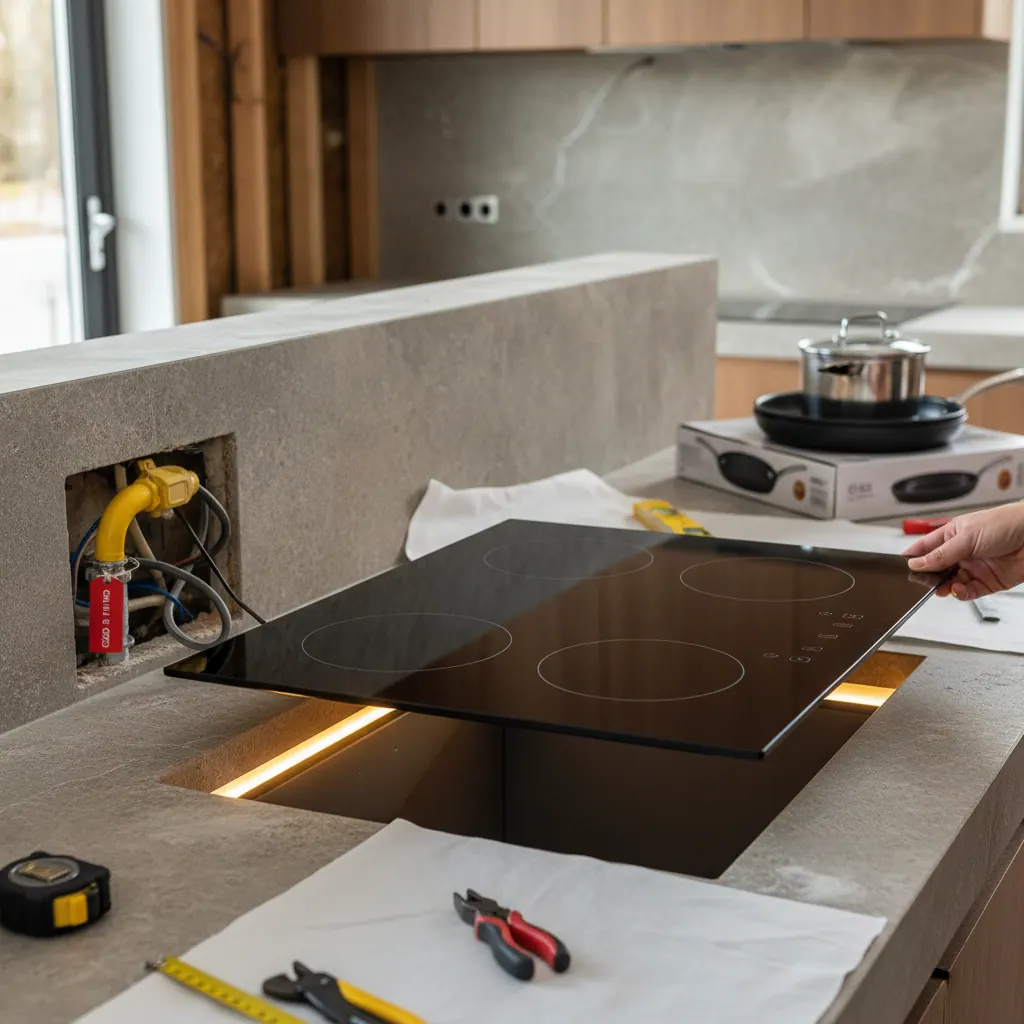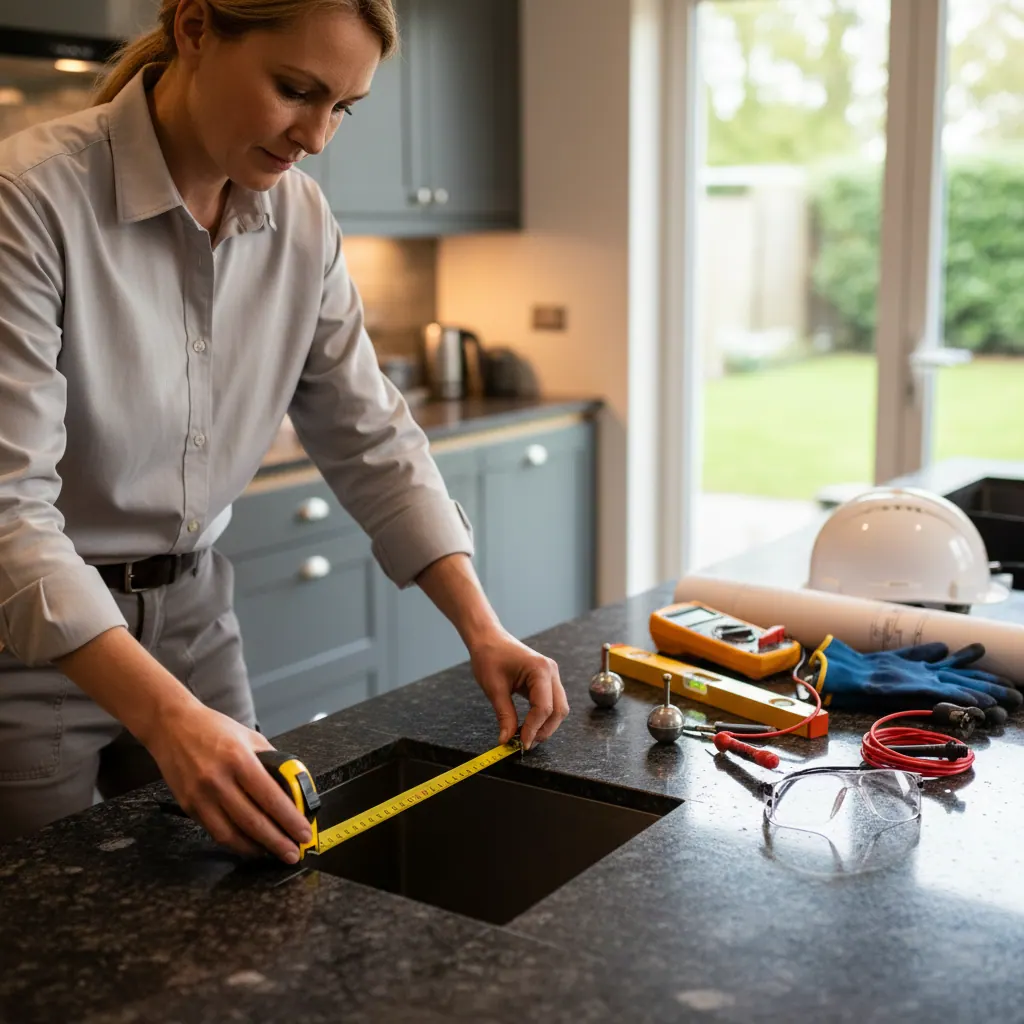
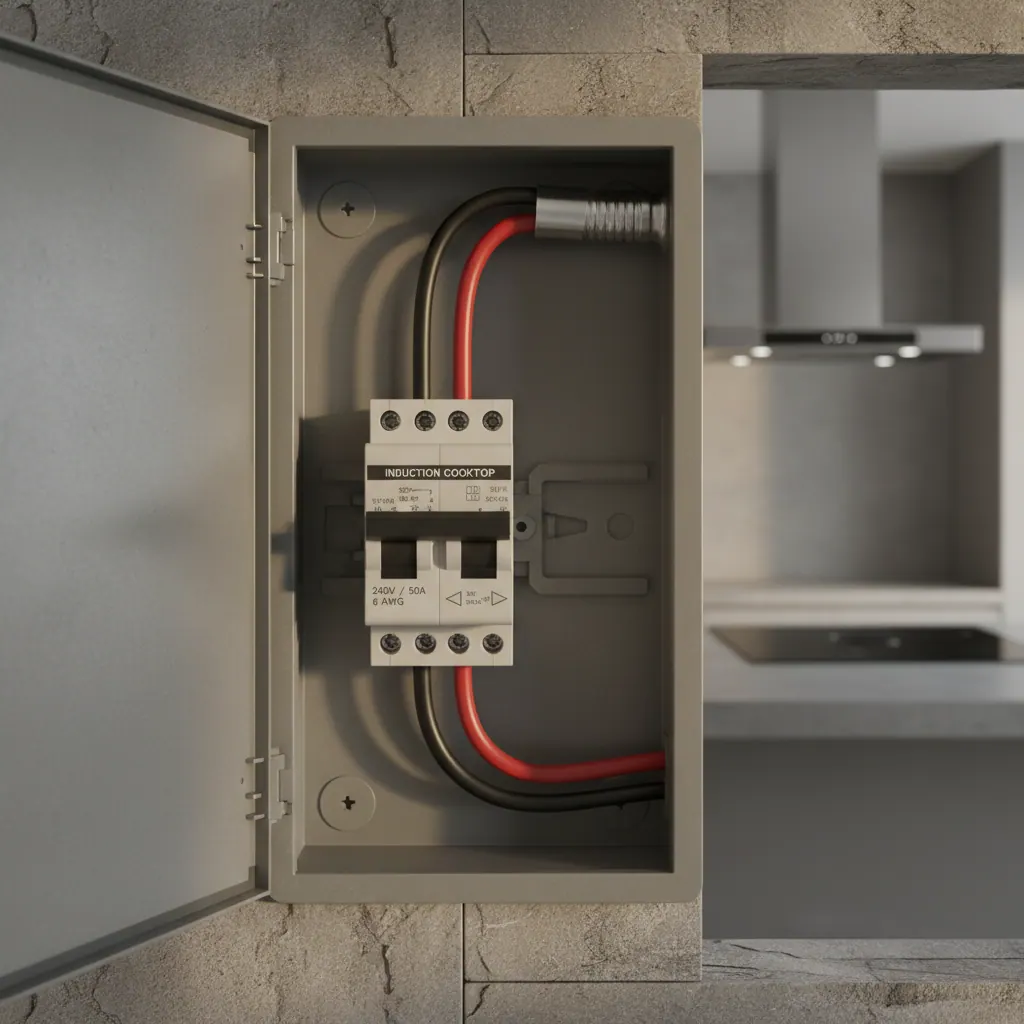
Do I need a 240V circuit for an induction cooktop? Short answer: yes for any built-in full-size unit, no for portable countertop models. Every 30-inch or 36-inch built-in induction cooktop sold in North America in 2026 requires a dedicated 240V circuit, typically 40A for entry-tier and 50A for boost-equipped premium units. Plug-in portable single-burner induction cooktops run fine on a standard 120V outlet.
This guide covers the full electrical picture: circuit sizing, wire gauge, breaker specs, receptacle types, permit requirements, panel-upgrade scenarios, and the four-way comparison of 120V vs 240V / 30A vs 50A that actually applies to real kitchens.
For the broader “should I go induction” question, see our induction vs gas comparison. If you’re planning a conversion, our convert gas to induction guide covers the full project cost and timeline.
TL;DR — the 60-second answer
| Cooktop type | Voltage | Amperage | Wire gauge | Total power |
|---|---|---|---|---|
| 30” built-in induction (entry) | 240V | 40A | 8 AWG copper | 7,200-8,400 W |
| 30” built-in induction (premium) | 240V | 50A | 6 AWG copper | 9,600-11,000 W |
| 36” built-in induction | 240V | 50A | 6 AWG copper | 10,800-12,000 W |
| 48” built-in induction | 240V | 50-60A | 6 AWG copper | 12,000-14,000 W |
| Portable 1,800W countertop | 120V | 15A | Standard outlet | 1,800 W |
| Portable 1,400W countertop | 120V | 12A | Standard outlet | 1,400 W |
If your home has any 240V service (standard for US houses built since 1960), an induction circuit install is straightforward. If you have only 120V throughout (very rare, only ultra-old or 100% off-grid installs), you’d need a service upgrade before any induction work.
Why induction needs 240V
An induction cooktop’s total connected load is 8-12 kW. At 120V, that would require 65-100A of current — impractical wire gauge, impractical breaker, and beyond what a standard receptacle can safely deliver.
At 240V, the same wattage flows at half the current (35-50A), which fits within standard residential wire gauges (8 AWG or 6 AWG copper) and standard double-pole breakers. Every high-wattage appliance in your home uses 240V for the same reason — electric dryer, electric water heater, EV charger, central AC, electric range.
Gas cooktops, by contrast, use only a small 120V circuit (1A or less) to power the igniter and the clock — the cooking energy comes from the gas, not the wire. If you’re replacing gas with induction, the existing 120V circuit is not reusable — you need a new dedicated 240V circuit.
Circuit specs by cooktop size
30-inch built-in induction
Most 30-inch induction cooktops are rated 7,200 W (entry) to 8,400 W (mid-tier) total connected load. NEC requires the circuit to be sized to 125 % of the continuous load, which works out to:
- 40A / 240V for most 30-inch units
- 50A / 240V for boost-heavy flagship 30-inch models like the Bosch Benchmark (when available in 30”)
Wire: 8 AWG copper for 40A runs under 100 feet. Longer runs or aluminum wire require upsizing (consult the NEC voltage-drop table; in practice most residential runs are well under 100 feet).
Breaker: 40A double-pole (takes 2 adjacent slots in the panel).
Receptacle: most 30-inch induction hardwires into a junction box. Check your specific model — Bosch 800 Series NIT8069UC hardwires; GE Profile PHP9030SJSS uses a NEMA 6-50 receptacle.
36-inch built-in induction
36-inch units are rated 8,400 W (GE Profile) to 11,400 W (Miele KM 7565 FR). The standard is:
- 50A / 240V
Wire: 6 AWG copper.
Breaker: 50A double-pole.
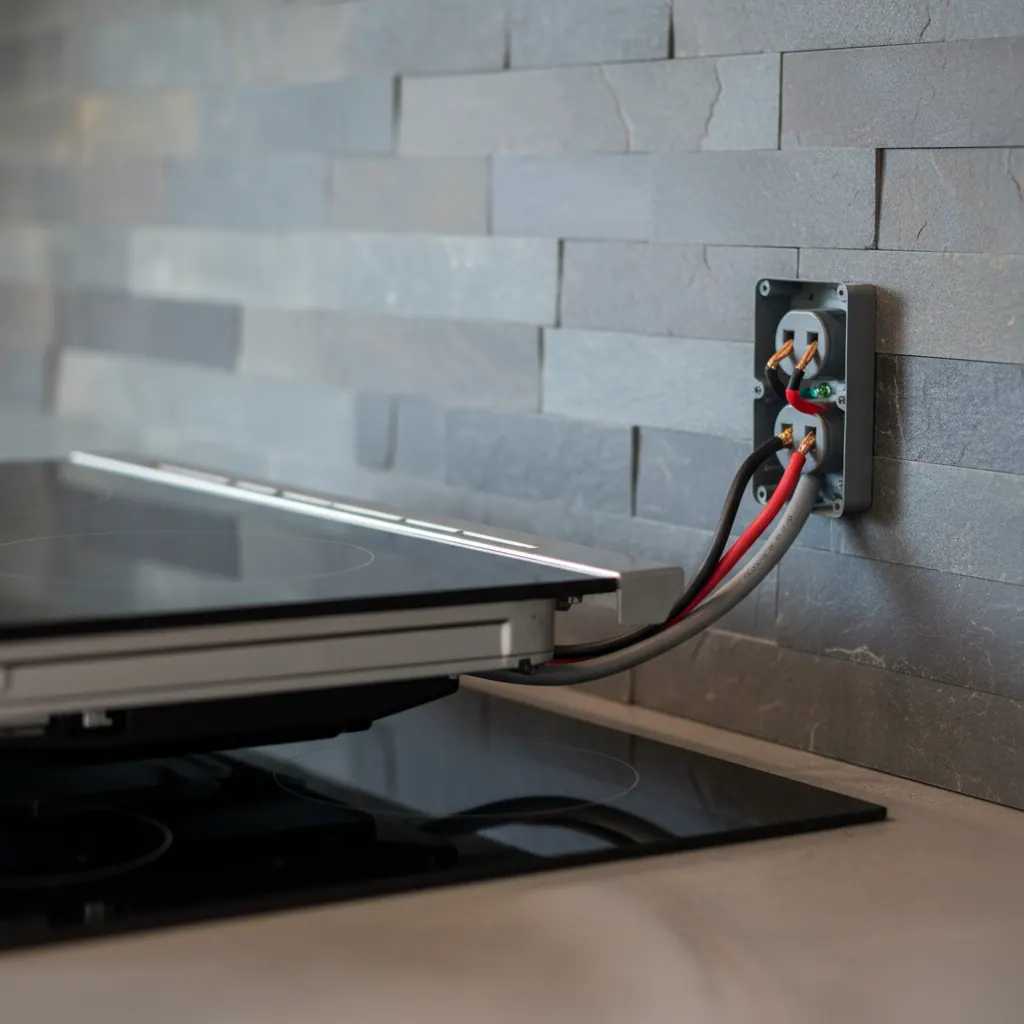
Receptacle: most 36-inch models hardwire. Bosch Benchmark, Miele, Thermador all hardwire. GE Profile and Frigidaire Gallery often ship with a NEMA 6-50 plug.
For the full 36-inch shortlist, see our best 36-inch induction cooktops 2026 round-up.
48-inch pro-style induction
Rare but available (Thermador, Miele Vario modular systems). Typical load is 12,000-14,000 W, requiring:
- 60A / 240V circuit on premium units
- 50A / 240V on some modular configurations
Wire: 6 AWG or 4 AWG copper depending on the specific unit and run length.
Portable 120V induction
Countertop single-burner induction cooktops run on standard 120V outlets. The practical cap is 1,800 W (the max a 15A, 120V outlet can deliver without tripping a properly-sized breaker).
You cannot run a built-in 30-inch or 36-inch induction cooktop on 120V — the total wattage would trip any breaker and overheat the wiring.
For the full portable-induction picture, see our best portable induction cooktops and best induction for RV & tiny kitchens guides.
What a proper 240V induction install looks like
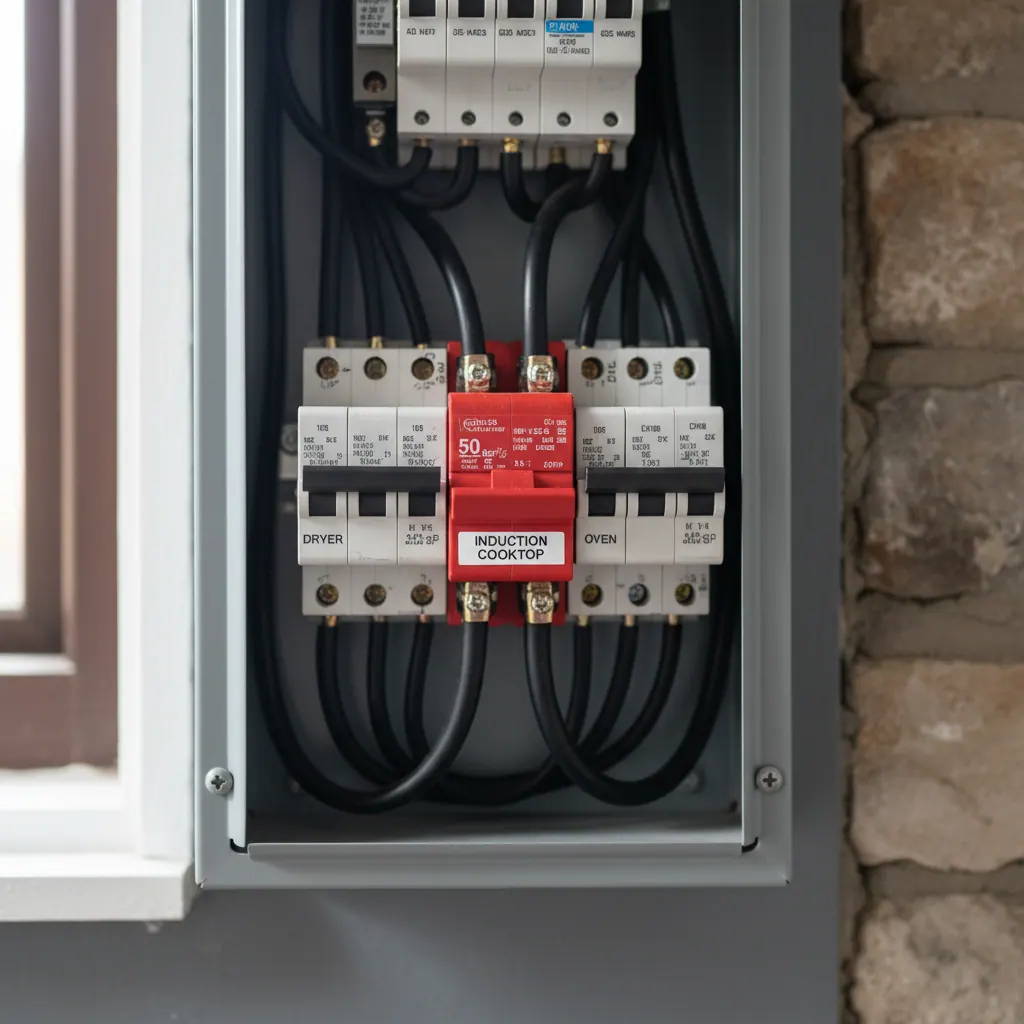
A compliant install has eight specific elements:
- Dedicated circuit — nothing else on this breaker
- Double-pole breaker sized per manufacturer spec (40A or 50A typical)
- Wire gauge matching breaker (8 AWG for 40A, 6 AWG for 50A)
- Ground conductor bonded to the grounding electrode system
- Accessible disconnect — either the breaker itself (if within reach of the cooktop) or a local disconnect switch
- Receptacle or junction box rated for 240V and matched to the wire gauge
- GFCI protection (required in 2023+ NEC jurisdictions for certain kitchen circuits)
- Manufacturer torque spec on all terminal connections (typically 12-20 in-lb; most DIY installs skip this and create a fire hazard over time)
The 2023 NEC is the current reference standard across nearly all US jurisdictions. Bring your electrician a copy of your specific cooktop’s installation manual — every major brand publishes the exact electrical requirements, and following them is the fastest path through permit inspection.
Panel capacity: the biggest variable
Before you buy the cooktop, check your panel:
- Main breaker size (the big one at the top): 100A is borderline, 150A is comfortable, 200A is ideal for modern all-electric homes
- Open breaker slots: you need 2 adjacent slots for a 240V double-pole
- Existing loads: add up HVAC, water heater, dryer, EV charger, any other 240V appliances
NEC demand calculation assumes induction cooktops pull 8 kW (30”) or 12 kW (36”) in the calc. If your panel’s total demand exceeds 80 % of service, you need one of:
- Service upgrade (100A → 200A): $2,500-$4,500 installed
- Subpanel dedicated to the kitchen: $800-$1,500 installed
- Load-management device (SPAN smart panel, Emporia Load Management, Schneider Square D Energy Center): $2,500-$4,500
Most 1990s-2020s US homes have 150A or 200A service and handle induction cooktop loads without a panel upgrade. Homes built before 1970 with original 60A or 100A service often require an upgrade first.
Common panel scenarios
Scenario 1: 200A panel, 6 open slots, low existing load
You’re fine. Just pull a new 40A or 50A circuit. Total electrician cost: $350-$700. Most common scenario in 2020+ builds.
Scenario 2: 150A panel, 2 open slots, heat pump already installed
Probably fine. Have the electrician run a demand calc — if you’re under 80 %, add the circuit. If you’re over, add a subpanel for the kitchen. Total: $700-$1,500.
Scenario 3: 100A panel, full slots
You need either a panel upgrade or a subpanel. Panel upgrade is cleaner but more expensive ($2,500-$4,500); subpanel is cheaper ($800-$1,500) but adds a nested breaker box. Most electricians recommend panel upgrade if you’re also planning an EV charger or heat pump in the next 5 years.
Scenario 4: 60A service, full slots
Service upgrade is non-negotiable. Budget $4,000-$6,500 total for the service upgrade + induction circuit. Worth doing if you’re staying in the home — the upgrade enables every future electric appliance (heat pump, EV charger, etc.) and typically adds more value than it costs at resale.
Labor and permit costs
A typical 240V induction circuit install breakdown:
- Labor (licensed electrician): $350-$1,200
- Materials (breaker, wire, receptacle, junction box, conduit if needed): $80-$180
- Permit: $45-$150 depending on jurisdiction
- Inspection: $0 (included in permit) or $50-$75 (separate fee)
- Total typical: $475-$1,600
DIY is legal in about 20 states for owner-occupants, but you still need to pull a permit and pass inspection. Most DIYers save $200-$500 but spend 6-8 hours doing what an electrician does in 3-5 hours. The break-even is marginal unless you have real electrical experience.
GFCI protection — the 2023+ wrinkle
The 2023 NEC expanded GFCI requirements to include dedicated appliance circuits in kitchens in some jurisdictions. This means your 40A or 50A induction circuit may require a GFCI breaker (not a standard breaker).
GFCI-breaker specifics:
- Adds $50-$120 to the circuit cost
- Some cooktops have known nuisance-trip issues with aggressive GFCI breakers (particularly older Miele and Bosch units — firmware updates have largely resolved this)
- Square D and Siemens GFCI breakers for 40A/50A are the most reliable pairings
Check your local adoption of NEC 2023 before specifying. About 38 US states have adopted it as of 2026; the rest are on NEC 2020 or earlier.
Common mistakes that fail inspection
Every jurisdiction is different but the recurring failures are:
- Undersized wire (10 AWG on a 40A circuit — unsafe, fails inspection)
- Non-dedicated circuit (sharing with a microwave or refrigerator — not allowed)
- Missing ground (the cooktop case must be grounded through the circuit)
- No local disconnect for circuits over 50 feet from the panel
- Improper box fill — cramming too many conductors into a junction box
- No torque on terminals — loose connections heat up and eventually fail
Pulling a permit forces correct work. Skipping a permit is a false economy — fire insurance claims can be denied for unpermitted electrical work.
Alternative: portable 120V induction
If pulling a 240V circuit is impractical (rental, budget constraint, old house with maxed panel), portable 120V induction is a legitimate solution for smaller kitchens:
- Duxtop 9620LS (1,800 W, $170) — single burner, the universal recommendation
- NuWave Gold Flex 2-burner (1,800 W shared, $210) — two zones on one outlet
- True Induction TI-2B (1,800 W shared, $499) — drop-in built-in, still 120V
The tradeoff is shared power — you can’t run two zones at full simultaneously, and the single-zone cap is 1,800 W (vs 3,700 W on a premium 240V unit). For 1-2 person households or secondary cooking, this is often adequate. For full-size kitchens and multi-pot cooking, you need 240V. Our best portable induction cooktops guide covers the full 120V lineup.
When 240V isn’t feasible — the honest alternatives
If panel upgrade is off the table and portable doesn’t cut it, realistic alternatives:
- Stay on gas (if you have existing service) — our gas cooktop BTU guide covers the decent 2026 gas options
- Electric ceramic (smooth-top radiant) — often runs on existing 30A / 240V circuits (the older standard for electric ranges), which is cheaper to upgrade to 40A than to install new
- Electric coil — the cheapest install, almost always reuses existing 30A circuits
- LP propane (off-grid or rural) — if natural gas isn’t available and electric capacity is constrained
For the full multi-fuel decision matrix, see our how to choose a cooktop framework.
Bottom line
Every built-in induction cooktop in North America in 2026 needs a dedicated 240V circuit — 40A for most 30-inch models, 50A for 36-inch and premium 30-inch. Wire gauge is 8 AWG copper (40A) or 6 AWG copper (50A). Portable countertop induction runs on standard 120V outlets but caps at 1,800 W per zone.
For typical 2000s-built US homes with 150-200A panels, adding the circuit is a $475-$1,600 project, 3-5 hours of electrician time, pulled as a permitted install. For older homes with 100A or 60A service, budget a panel or service upgrade ($2,500-$6,500) as the gating item.
If you’re early in the decision process, our convert gas to induction guide walks through the full project cost and timeline, and the best induction cooktops 2026 round-up covers the cooktop-side picks once your electrical plan is in hand.
Frequently asked questions
Do induction cooktops need 240V?
Every 30-inch and 36-inch built-in induction cooktop sold in North America requires a dedicated 240 V circuit. Entry-level 30-inch units need 40 A on 8 AWG copper and draw 7,200 to 8,400 W; premium 30-inch and most 36-inch units need 50 A on 6 AWG copper and draw up to 12,000 W. Portable countertop units are the exception, running 1,400 to 1,800 W from a standard 120 V 15 A outlet.
Can I plug an induction cooktop into a normal outlet?
Only a portable one. A 1,800 W countertop unit runs from a standard 120 V 15 A outlet, though it will be close to that circuit’s continuous-load limit, so avoid sharing it with other appliances. No built-in 30-inch or 36-inch induction cooktop can run on 120 V — the power requirement is several times what such a circuit can deliver, and there is no adapter that makes it possible.
What size breaker does an induction cooktop need?
Match it to the nameplate rather than to the size of the cooktop. A 40 A double-pole breaker with 8 AWG copper suits entry-level 30-inch units; 50 A with 6 AWG suits premium 30-inch, most 36-inch and some 48-inch models. Oversizing the breaker beyond what the wire is rated for is a fire hazard and will fail inspection, so the wire gauge and the breaker have to be specified together.
How much does it cost to add a 240V circuit for an induction cooktop?
The determining factor is your panel, not the cooktop. If the panel has a free double-pole slot and adequate capacity, a straightforward run is the cheap case. If the panel is full, a subpanel typically lands under 1,200 dollars, while a full service upgrade can reach 3,000 dollars or more and often changes the economics of the whole project. Price the panel work before committing to the cooktop.
Electrical spec and code guidance from Dave Kuhn, licensed electrician (NEC certified) with 20+ years of residential kitchen work. Methodology on our editorial policy page.