For most people with a modern device, an induction cooktop pacemaker interaction is unlikely to cause harm when you follow a simple safe-distance rule. Induction cooktops generate a strong electromagnetic field to heat pans, and that field is the reason this question matters. The short answer: keep a reasonable distance, choose your cooktop carefully, and confirm with your cardiologist. This guide explains the real science, the numbers manufacturers publish, and the practical steps that let cardiac device users cook with confidence.

How Induction Cooktops Create Electromagnetic Interference
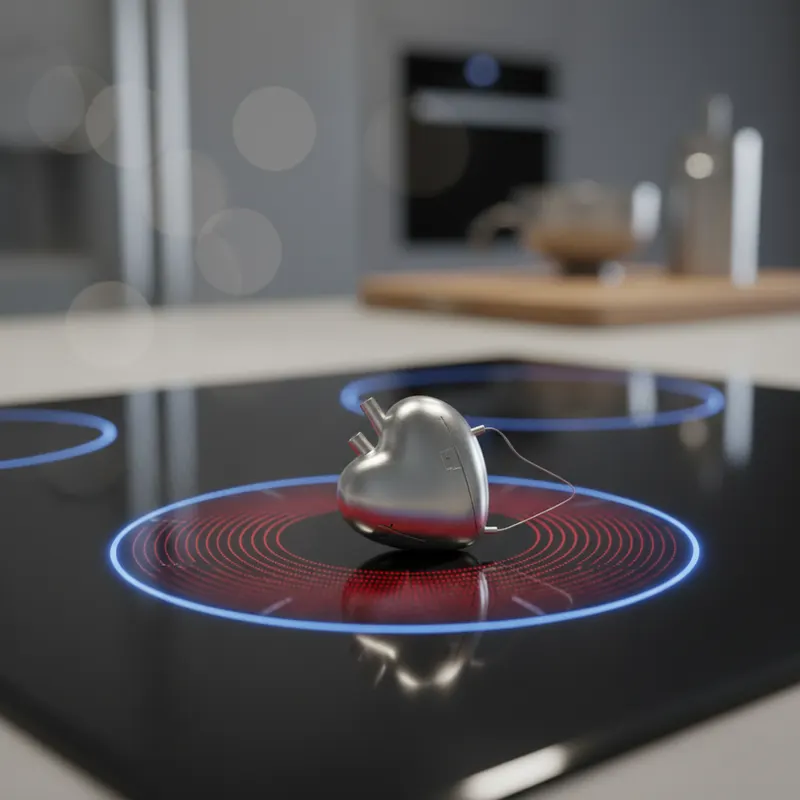
Induction cooktops create electromagnetic interference (EMI) because they use a powerful magnetic field operating at radio frequencies. Most consumer induction units run at roughly 20 to 100 kHz, with typical models clustered around 20 to 50 kHz. The coil draws significant power, and the field strength is highest directly above the active cooking zone, falling off sharply with distance.
This matters for cardiac devices because a pacemaker or implantable cardioverter-defibrillator (ICD) senses tiny electrical signals from the heart. A strong external field could, in theory, be misread as a cardiac signal. The concern is not heat or radiation in the harmful sense, but the device misinterpreting electromagnetic noise.
The key word is “in theory.” Field strength drops with the cube of distance in many practical scenarios, so even a modest gap dramatically reduces exposure. EMI is also far stronger when a pan is poorly centered or undersized for the zone, because stray field leaks past the cookware edge.
It also helps to understand how different appliances compare. The strongest EMI sources in a typical home are not cooktops at all but devices held directly against the chest, such as some power tools, arc welders, or large speaker magnets. An induction cooktop sits in the middle of the spectrum: meaningfully stronger than a microwave or refrigerator, but far weaker than the field you would experience pressing a running drill to your sternum. Because you naturally stand back from a cooktop while it operates, the realistic exposure is much lower than the peak field measured right at the glass.
Frequency matters too. Cardiac devices are most sensitive to interference in the range of roughly 5 to 60 Hz, which overlaps with natural heart signals. Induction cooktops operate tens of thousands of times higher, in the kilohertz band. Modern devices include filters tuned to reject this high-frequency noise, which is one reason laboratory testing so rarely reproduces clinically meaningful interference at normal distances.
What the FDA and Pacemaker Manufacturers Recommend
Regulators and manufacturers recommend maintaining a defined safe distance between a cardiac device and an active induction cooktop. The U.S. Food and Drug Administration (FDA) advises that people with implanted electronic devices be aware of electromagnetic compatibility issues with household appliances and consult their physician and device manufacturer for product-specific guidance.
Medtronic, one of the largest pacemaker and ICD makers, publishes the most cited concrete number. In its patient EMI precautions, Medtronic recommends keeping the cardiac device at least 60 cm (about 24 inches) away from the heating surface of an induction cooktop while it is switched on. This is a deliberately conservative buffer designed to cover worst-case scenarios across many device models.
Other major manufacturers such as Abbott (formerly St. Jude Medical), Boston Scientific, and Biotronik issue similar guidance, generally framing induction cooktops as low-risk appliances that warrant a sensible standoff distance rather than total avoidance.
It is worth understanding why these numbers exist. Manufacturers must publish guidance that protects the most sensitive patient with the most conservative device programming, not the average user. So the 60 cm figure builds in a wide safety margin. It is not a cliff edge where 59 cm is dangerous and 61 cm is safe. Instead, it is a buffer that virtually guarantees the field reaching the device is far below any threshold that could affect sensing. Think of it the way a speed limit is set below the maximum safe speed of a road.
The FDA’s broader position reinforces this. The agency does not ban or warn against induction cooktops for cardiac patients. Its electromagnetic compatibility guidance emphasizes awareness and individualized consultation, treating induction cooktops as part of a normal home environment rather than a special hazard. This regulatory stance, combined with manufacturer distance recommendations, gives consumers a clear and reassuring framework: maintain distance, and check with your care team about your specific device.
EMI Safe-Distance Recommendations by Source
| Source / device type | Recommended minimum distance | Basis |
|---|---|---|
| Medtronic (pacemakers & ICDs) | 60 cm (24 in) from heating zone | Conservative manufacturer buffer |
| General manufacturer consensus | 50–60 cm (20–24 in) | Patient EMI precaution sheets |
| 2021 Heart Rhythm study (42 devices) | No interference at >= 30 cm | Bench and clinical testing |
| Reduced-field zone (typical cook stance) | 25–40 cm torso distance | Field-strength measurements |
The takeaway: manufacturer guidance (around 60 cm) is more cautious than what controlled studies show is actually necessary (around 30 cm). Following the manufacturer number gives you a comfortable safety margin.
What the Research Actually Shows About Risk
Research shows the real-world risk of clinically meaningful interference is very low for modern devices at normal cooking distances. A frequently cited 2021 study published in Heart Rhythm tested 42 commonly prescribed pacemakers and ICDs from five leading brands against household induction cooktops. The investigators found no sustained inhibition, inappropriate mode switching, or inappropriate shocks once the device was 30 cm or more from the active cooking zone.
Earlier European work reached comparable conclusions: interference was only ever detectable when devices were brought unusually close to the coil, far closer than any normal cooking posture would place them. Devices manufactured after roughly 2015 typically include improved EMI shielding and digital noise-rejection algorithms validated against common appliances.
Several factors raise or lower individual risk:
- Device programming and sensitivity. Unipolar pacing leads are more susceptible to EMI than bipolar leads.
- Implant location. A device implanted on the side closest to the cooktop sits marginally closer to the field.
- Cookware and centering. Off-center or undersized pans leak more stray field.
- Leaning in. Bending directly over an active zone is the single most avoidable risk behavior.
It is also reassuring to consider scale. Millions of households use induction cooking daily, and induction has been the dominant cooking technology across much of Europe and Asia for decades. Despite this enormous installed base and the rising number of people living with cardiac devices, documented cases of an induction cooktop causing a clinically significant pacemaker event during normal use are extraordinarily rare. The few reported incidents in the medical literature typically involved people leaning their chest directly onto the cooktop edge or holding a device-side body part inches from an active coil.
If you are still weighing technology choices, our comparison of induction vs gas cooktops covers the broader trade-offs beyond EMI, including ventilation and indoor air quality considerations that also matter for health. For many cardiac patients, the cleaner combustion-free operation of induction is actually a health advantage, since it eliminates the nitrogen dioxide and fine particulates produced by gas flames.
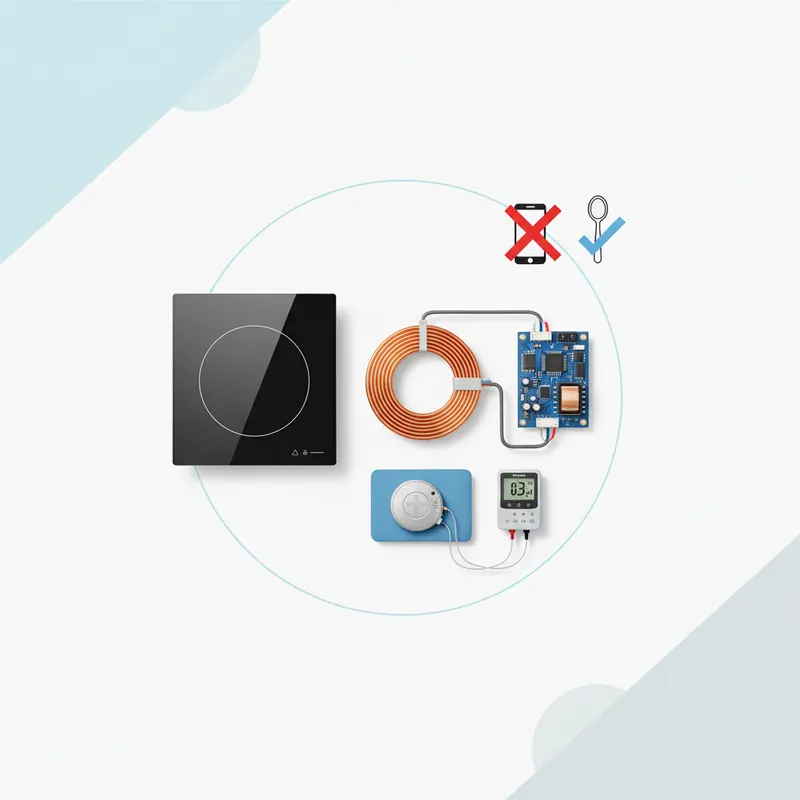
Practical Safety Tips for Cooking With a Pacemaker
The most effective safety strategy is distance plus a few simple habits. You do not need to give up induction cooking, but you should adopt sensible precautions that keep your cardiac device well outside the high-field zone.
- Stand at arm’s length. Keep your torso, where most devices are implanted, at least 60 cm from active zones to satisfy manufacturer guidance comfortably.
- Do not lean directly over a hot zone. Avoid reaching across an operating burner; reach from the side instead.
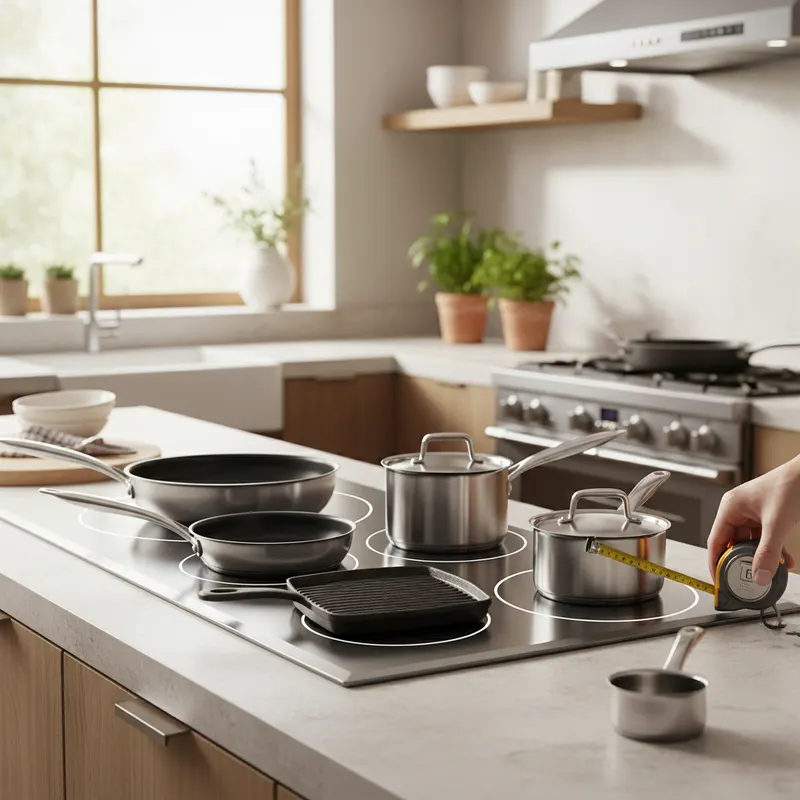
- Center your pans. Use flat, properly sized magnetic cookware so the field stays coupled to the pan. Our induction cookware guide explains how to pick pans that perform well and reduce stray field.
- Cook on the front burners when possible. This keeps you naturally farther from rear zones you must reach over.
- Turn the zone off before cleaning or adjusting pans. The field only exists while a zone is active.
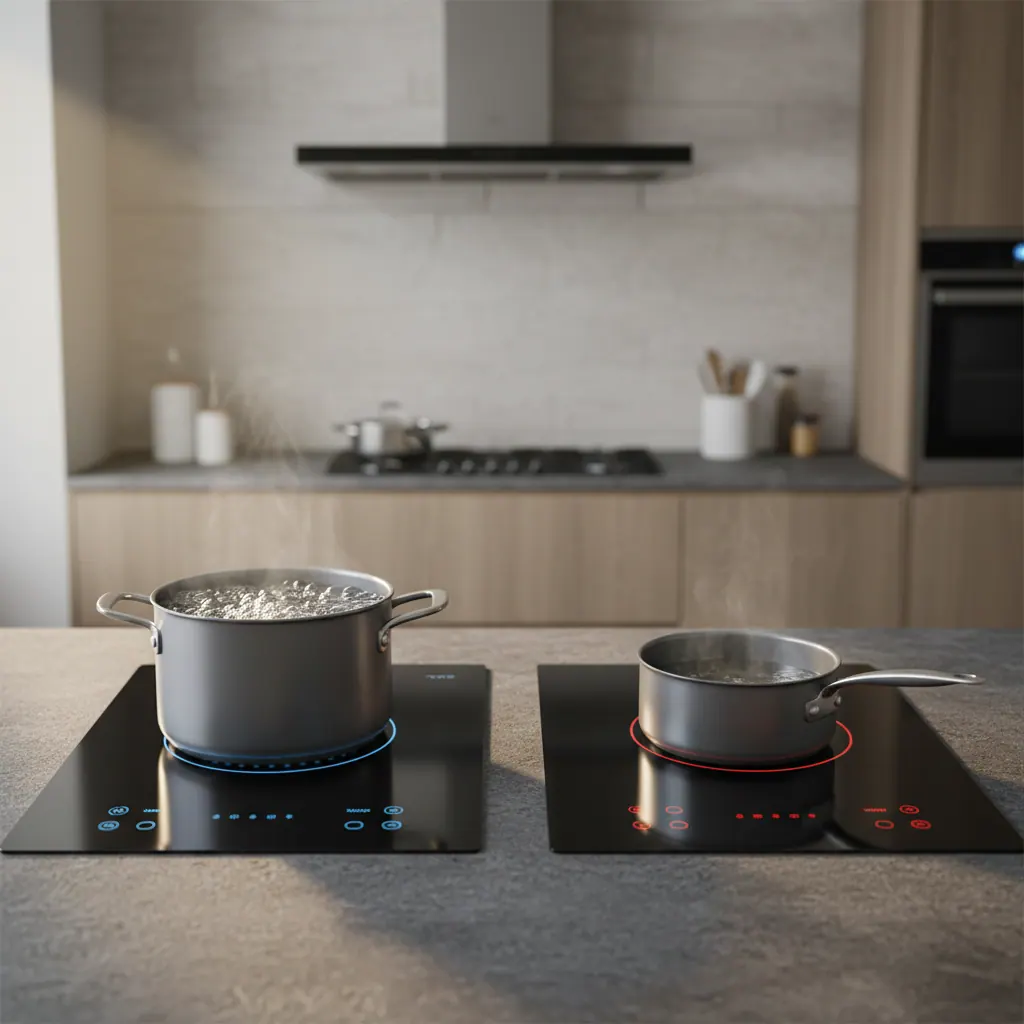
- Choose a cooktop with auto pan detection. Quality units shut the field off within seconds when no pan is present, cutting needless exposure.
When shopping, prioritize models with reliable pan detection and clear zone indicators. Our roundup of the best induction cooktops 2026 flags units with fast auto-shutoff, and our broader walkthrough on how to choose a cooktop helps you balance safety features against budget and kitchen layout.
It is also worth noting that induction’s efficiency means burners are often active for shorter periods than gas, reducing total exposure time. If running costs factor into your decision, see our breakdown of induction cooktop electricity cost to understand how usage patterns translate into real energy bills.

When to Talk to Your Cardiologist
You should talk to your cardiologist before relying on any general guidance, because your device model and programming determine your individual risk. The numbers in this article reflect population-level testing and manufacturer buffers, not personalized medical advice. Your care team can check your device’s sensitivity settings, lead configuration, and manufacturer-specific instructions.
Bring specifics to the appointment: the make and model of your pacemaker or ICD, and the type of cooktop you own or plan to buy. Ask whether your device uses unipolar or bipolar sensing, since unipolar configurations are slightly more EMI-sensitive. If you ever feel dizziness, palpitations, or lightheadedness while cooking, step away from the cooktop and contact your physician.
For added assurance, many device clinics can review interrogation logs to confirm whether any EMI events have been recorded during daily life. In the vast majority of cases, patients find no episodes attributable to kitchen appliances. Remote monitoring, now standard with most modern devices, makes this even easier: your clinic can often review months of data without an in-person visit.
A few situations warrant extra caution and a direct conversation with your cardiologist before cooking on induction:
- You are pacemaker-dependent, meaning your heart relies entirely on the device to maintain rhythm.
- Your device is older than roughly a decade and may lack modern EMI filtering.
- Your device uses unipolar sensing, which is more susceptible to external noise.
- You have a habit of leaning closely over the stove because of mobility or vision limitations.
In these cases your cardiologist might adjust device sensitivity, recommend a larger standoff distance, or simply confirm that your setup is safe. None of these scenarios automatically rules out induction cooking; they simply call for a personalized review.
The Bottom Line
For people with modern cardiac devices, an induction cooktop is generally considered safe when used with sensible distance precautions. Controlled testing shows no meaningful interference beyond about 30 cm, and manufacturers like Medtronic recommend a comfortable 60 cm buffer that is easy to maintain during normal cooking. Use properly fitted magnetic cookware, avoid leaning over active zones, and choose a cooktop with reliable pan detection.
Most importantly, treat this article as a starting point rather than a verdict. Confirm the specifics with your cardiologist, who can tailor advice to your exact device. With those steps, the induction cooktop pacemaker concern becomes a manageable precaution rather than a barrier to enjoying fast, efficient, precise cooking.
Ready to find a model with strong safety features? Start with our hands-on picks in the best induction cooktops 2026 guide, then match your choice to your kitchen.
Frequently asked questions
Are induction cooktops safe for people with pacemakers?
For most people with a modern implanted device, yes, with sensible precautions. Contemporary pacemakers and defibrillators are shielded against external electromagnetic interference, and the field from an induction cooktop falls off very sharply with distance. The usual guidance is to keep a distance of roughly 60 cm, about two feet, between the device and the active cooking zone, and to avoid leaning directly over an operating cooktop for extended periods.
How far should someone with a pacemaker stand from an induction cooktop?
Around 60 cm, about two feet, between the implanted device and the active zone is the commonly cited figure. The field strength drops off extremely quickly with distance, so normal cooking posture at the front edge of a counter already puts most of that distance between the coil and the chest. The situation to avoid is leaning far over the surface while a zone is running at high power.
Can someone with a pacemaker use an induction cooktop safely?
In the great majority of cases yes, but this is a question for the cardiologist or the device manufacturer rather than for a website. Devices differ in shielding and in how they are programmed, and unipolar configurations are more susceptible to interference than bipolar ones. Bring the specific model number to the appointment — the manufacturer publishes interference guidance for each device and can give a definitive answer.
Do induction cooktops interfere with other medical devices?
The same reasoning applies to insulin pumps, implanted defibrillators and neurostimulators: modern devices are shielded, the field is highly localised, and distance resolves most concern. As with pacemakers, the manufacturer of the specific device is the authority. Anyone who experiences dizziness, palpitations or unusual device behaviour while cooking should step away from the cooktop and contact their clinician.