Choosing the correct induction cooktop pan size is the single most important factor in whether your burner heats efficiently, switches on at all, or throws an error code. Induction works by inducing an electrical current in the magnetic base of your cookware, and that base must cover enough of the coil beneath the glass for the cooktop to detect it. Get the pan size wrong and the zone simply will not activate. In this guide we break down the minimum and maximum pan diameters, match them to burner sizes, and explain the magnetic base rules straight from leading manufacturer manuals.
The short answer: most induction zones require a pan with a flat, ferromagnetic base of at least 4.3 inches (11 cm) in diameter, and the pan should roughly match the size of the cooking zone for best efficiency. Below, we get into the precise numbers.

What Is the Minimum Induction Cooktop Pan Size?
The minimum induction cooktop pan size is set by each manufacturer based on their coil design and pan-detection electronics. Across the major brands, the minimum base diameter clusters between 9 cm and 12 cm (3.5 to 4.7 inches).
According to Bosch induction cooktop documentation, standard cooking zones require a minimum cookware base diameter of around 12 cm (4.7 inches), while their smallest zones can detect bases as small as 9–10 cm. Miele instruction manuals specify a minimum pan base of 12 cm for most zones, noting that the pan base must be magnetic and flat for the zone to register cookware.
Why does this minimum exist? The cooktop measures the electrical load above the coil. A base smaller than the threshold creates too weak a magnetic coupling, so the safety circuit treats the zone as empty and shuts it off. This is also why a magnetic base that only partially covers the coil — for example, a small espresso pot — often will not heat at all.
Quotable takeaway: If your pan’s flat magnetic base is smaller than about 4.3 inches (11 cm), most induction cooktops will refuse to switch the zone on, regardless of how powerful the cooktop is.
Burner Size vs. Minimum Pan Diameter Table
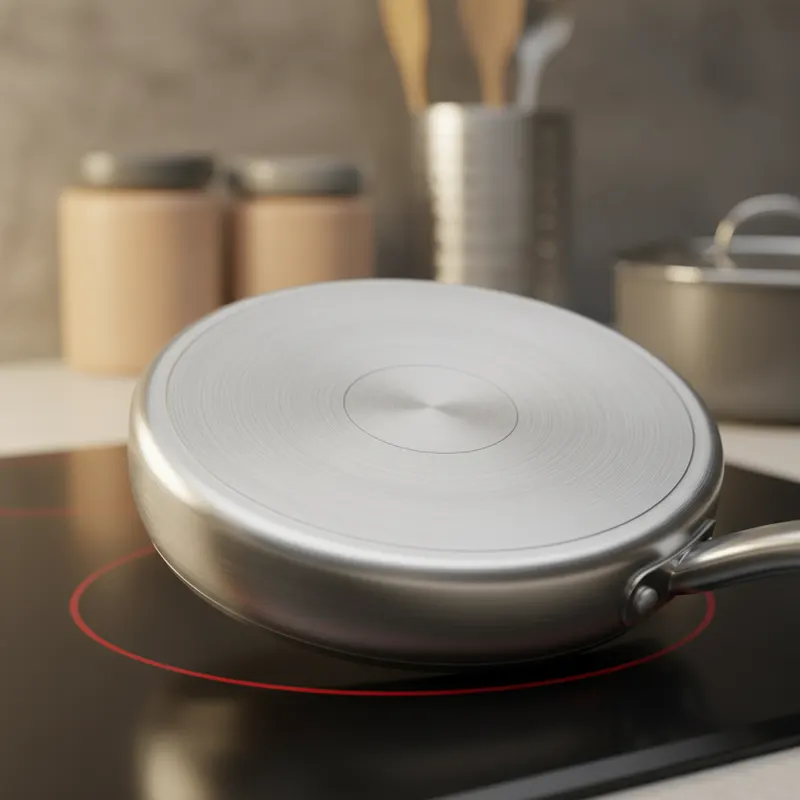
Cooking zones are usually labeled by their diameter, and each has a recommended pan range. Use the table below to match your cookware to the zone for proper detection and even heating.
| Cooking zone diameter | Minimum pan base diameter | Recommended pan diameter | Typical use |
|---|---|---|---|
| 5.1 in (13 cm) | 4.3 in (11 cm) | 4.7–5.5 in (12–14 cm) | Sauce pots, small saucepans |
| 6.3 in (16 cm) | 4.3 in (11 cm) | 5.9–7.1 in (15–18 cm) | Saucepans, milk pans |
| 7.1 in (18 cm) | 4.7 in (12 cm) | 7.1–8.3 in (18–21 cm) | Medium pots, sauté pans |
| 8.3 in (21 cm) | 5.5 in (14 cm) | 8.3–9.4 in (21–24 cm) | Frying pans, stockpots |
| 9.4 in (24 cm) | 5.9 in (15 cm) | 9.4–11 in (24–28 cm) | Large skillets, woks |
| 11 in (28 cm)+ | 7.1 in (18 cm) | 11–12.5 in (28–32 cm) | Large frying pans, paella |
The pattern is clear: the larger the cooking zone, the larger the minimum base it expects. A small pan on a large zone wastes energy and may trigger an error, while an oversized pan on a small zone heats only at its center.
What Is the Maximum Induction Cooktop Pan Size?
There is no single maximum diameter in the same strict sense as the minimum, but two practical limits apply.
First, the physical footprint. The pan base should fit within the marked cooking zone. If it overhangs significantly, the overhanging metal sits above unheated glass and stays cold, creating hot and cold spots. The cooktop coil only generates a magnetic field directly above itself.
Second, bridge zones and flex zones. Premium cooktops feature flexible induction areas that combine two or more coils to power oversized cookware such as griddles, fish kettles, or rectangular grill plates. On these models the maximum usable pan can stretch to 15.7 inches (40 cm) or longer. If you cook with very large pans regularly, a flex-zone model is worth prioritizing — see our roundup of the best induction cooktops 2026 for models with bridging capability.
For everyday round cookware, aim for a pan whose base does not exceed the cooking zone diameter by more than about 1 inch. Going larger does not increase heating power; it just spreads heat into areas the coil cannot reach.
The Magnetic Base Requirement Explained
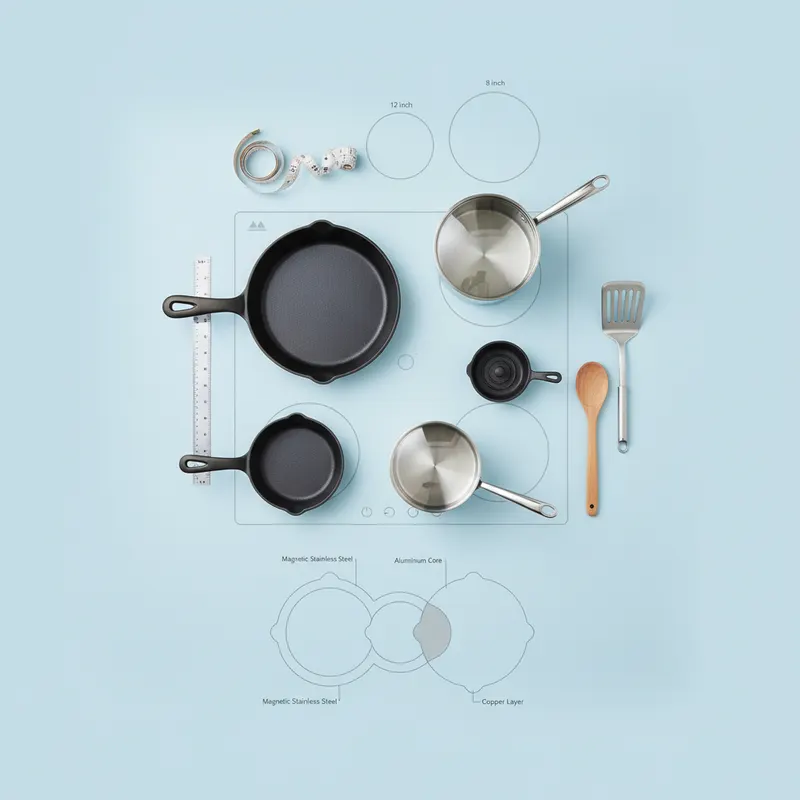
Size alone is not enough — the base must be both flat and magnetic. Manufacturer manuals are consistent on this point. Miele states that cookware must have a base “made of magnetizable material” and that a household magnet should adhere firmly to the base when held against it. Bosch echoes this, noting that pans suitable for induction are marked with an induction symbol (a looped coil icon) and that a magnet should stick to the underside.
A few practical implications of the magnetic requirement:
- Flatness counts. A warped or convex base reduces contact and lowers efficiency. A gap of more than a couple of millimeters between base and glass weakens the magnetic coupling.
- Sandwich bases vary. Some clad pans have a magnetic disk smaller than the visible base. That disk diameter — not the rim — must meet the zone minimum.
- Cast iron excels. Solid cast iron is intensely magnetic and works on every induction surface. See our picks for the best cast iron pans for induction and gas if you want maximum compatibility.
- Stainless can be hit or miss. Only magnetic-grade stainless works. Our guide to the best stainless steel pans for induction lists tested, induction-ready sets.
Quotable takeaway: If a refrigerator magnet sticks firmly and evenly across the entire base of your pan, and that base meets the zone’s minimum diameter, the pan will work on virtually any induction cooktop.
Special Case: Woks and Curved Bases
Traditional round-bottom woks are a problem on flat induction because only a tiny point of the curve touches the glass — far below the minimum contact area. Flat-bottom induction woks solve this, but their flat base diameter still needs to meet the zone minimum, typically 5.5 inches or more. For technique and equipment advice, read our piece on using a wok on an induction cooktop.
How to Measure Your Pan Correctly
Getting the right induction cooktop pan size starts with accurate measurement. Follow these steps:
- Flip the pan over and measure the flat, contact base — the part that actually touches the glass — not the wider top rim.
- Use the magnet test across the whole base to confirm the magnetic area matches the flat area.
- Compare to the zone size printed or etched on your cooktop, or listed in the manual.
- Aim for a base equal to or slightly larger than the zone, up to about one inch over.
If you are buying new cookware, look for the induction coil symbol stamped on the base and check the manufacturer’s stated base diameter. Reputable brands list both the rim diameter (the marketing number) and the base diameter (the functional number).

Quick Reference: Matching Pans to Power
Even with a correctly sized pan, undersizing on a high-power zone wastes the burner’s potential. A 1.5 kW small zone pairs well with 5–7 inch pans, a 2.3 kW mid zone with 8–10 inch pans, and a 3.7 kW booster zone with 10–12 inch pans. Larger pans on powerful zones distribute that energy across more surface for faster, more even results — provided the base stays in full contact with the glass.
When in doubt, match the pan to the zone, confirm the magnet sticks, and keep the base flat. Those three habits cover almost every induction sizing scenario you will encounter.
Conclusion
The right induction cooktop pan size comes down to three checks: a flat magnetic base of at least 4.3 inches (11 cm), a diameter that matches the cooking zone, and full, even contact with the glass. Manufacturers like Bosch and Miele set minimums around 11–12 cm precisely because their pan-detection electronics need enough magnetic coupling to power on safely. Stay at or slightly above the zone diameter, never significantly below, and confirm magnetism with a simple fridge-magnet test.
Ready to upgrade your kitchen? Pair the right cookware with the right appliance by exploring our reviews of the best induction cooktops 2026, then round out your kit with the cookware recommendations in our induction cookware guide. Measure once, match well, and every burner on your cooktop will heat exactly the way it should.
Frequently asked questions
What is the minimum pan size for an induction cooktop?
Most induction zones need a flat ferromagnetic base of at least 4.3 inches, about 11 cm, in diameter. Bosch documentation specifies roughly 12 cm for standard zones, with the smallest zones detecting bases down to 9 or 10 cm, and Miele specifies 12 cm for most zones. Below the threshold the cooktop reads the magnetic coupling as too weak, treats the zone as empty, and refuses to switch on regardless of how powerful it is.
What happens if a pan is too big for the induction zone?
It heats unevenly rather than failing outright. Only the portion of the base sitting over the coil receives energy; the overhanging edges sit above cold glass and heat by conduction through the pan alone. The practical result is a hot centre and cool rim, which matters for searing and for anything that scorches. Match the pan base roughly to the zone diameter, or use a bridge or flex zone if your cooktop has one.
Does the pan size have to match the burner size exactly?
No, but closer is better. Manufacturers publish a usable range per zone rather than a single figure, and a base within about an inch of the zone diameter gives the best efficiency and the most even heat. Undersized bases risk failing detection entirely; oversized bases waste energy at the rim. The base diameter is what counts, not the rim measurement usually printed on cookware packaging.
Why does my small pan not work on my induction cooktop?
Almost certainly because its flat magnetic base falls under the detection threshold. Small espresso pots, milk pans and single-egg skillets frequently have bases below 11 cm even when the rim looks large enough, and a base that only partially covers the coil produces too weak a coupling for the safety circuit to register. Some cooktops offer a dedicated small zone with a lower threshold; otherwise an induction interface disc is the workaround.