Miele cooktops sit at the premium end of the kitchen market, and for good reason. The German manufacturer has built its reputation on engineering tolerances, long-life testing and quiet, precise performance. If you are weighing Miele cooktops against other luxury brands, this guide breaks down the real 2026 lineup, the standout technology, who each model suits, and where Miele is genuinely worth the money versus where you are paying for the badge.
Answer first: Miele cooktops are best for cooks who want precision and longevity. The induction range leads with TempControl temperature holding, PowerFlex flex zones and TwinBooster power up to roughly 7,400 W, while the modular SmartLine system lets you mix induction, gas, wok and Teppan Yaki elements. Expect to pay a premium, but build quality and service are class-leading.
Why Miele cooktops command a premium
Miele engineers many of its appliances to a 20-year durability standard, and that philosophy shows in the cooktops. The glass-ceramic surfaces are thick, the electronics are well shielded, and the touch controls are responsive rather than laggy. Miele’s induction cooktops also tend to run quieter than rivals because the cooling fans and inverters are tuned for low noise.
The trade-off is price. Miele cooktops typically cost more than comparable Bosch cooktops and sit closer to, or above, Wolf cooktops at the top of the range. You are paying for materials, testing and a service network rather than gimmicks. For a broader view of how induction stacks up across brands, our best induction cooktops 2026 roundup puts Miele in context.
Miele induction cooktops: the core of the lineup
Induction is where Miele invests most heavily, and it is the range most US buyers will consider. The KM 7000 series spans 30-inch and 36-inch widths with several control philosophies.
TempControl
TempControl is Miele’s signature feature. Embedded sensors continuously monitor the temperature of the pan and adjust power automatically to hold a chosen frying or simmer temperature. In practice this means you can sear at a stable heat without scorching, melt chocolate without a bain-marie, or hold a low simmer hands-free. It removes much of the guesswork that catches out new induction users.
PowerFlex and flex zones
PowerFlex zones let you combine two cooking areas into one large bridged zone, so an oblong griddle or a fish kettle heats evenly across its full length. Higher models such as the 36-inch KM 7745 FL offer multiple PowerFlex areas across six zones, giving real flexibility for large or oddly shaped cookware. The system also includes automatic pan-size recognition, so power concentrates only under the cookware actually present.
TwinBooster power
For fast boiling, Miele’s TwinBooster temporarily channels extra power to a single zone, with peak output reaching roughly 7,400 W on the strongest models. That brings a large pot of water to a rolling boil quickly, which is the headline advantage of induction over gas.
Con@ctivity hood communication
Con@ctivity 3.0 lets a compatible Miele cooktop talk to a Miele extraction hood over Wi-Fi. The hood automatically adjusts its extraction power based on what is happening on the cooktop, so you are not constantly reaching for the fan controls. It is a genuine convenience feature for open-plan kitchens.
Control types: touch versus knobs
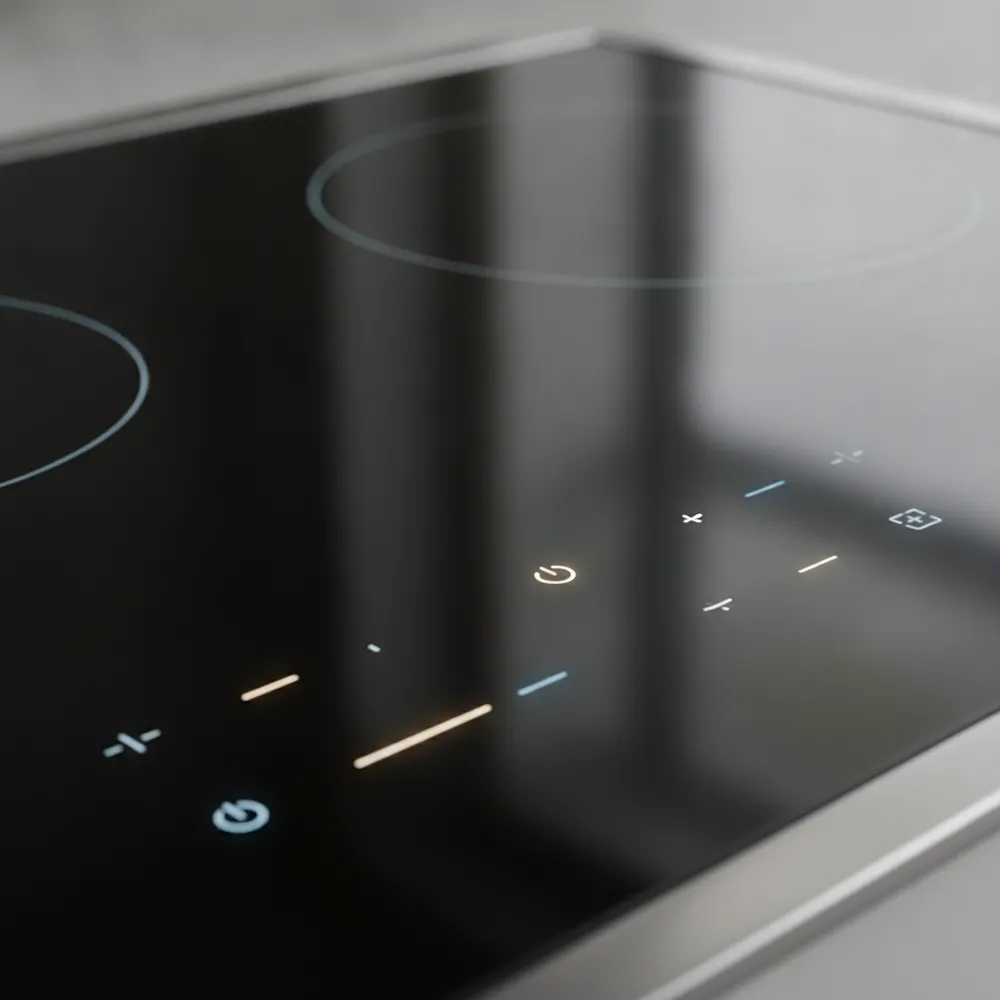
Most Miele induction cooktops use the SmartSelect touch interface, a row of numbers along the front edge that lets you set each zone directly rather than tapping plus and minus repeatedly. Some models, including the KM 7740 FR, add a physical control knob for tactile adjustment. If you dislike all-touch controls, look for the knob-equipped variants or the modular SmartLine gas elements, which keep classic metal knobs.
SmartLine and CombiSet: the modular approach
Miele’s most distinctive offering is its modular cooktop system. SmartLine and the long-running CombiSet program let you build a cooking surface from individual elements rather than buying one fixed slab.
The element library includes:
- PowerFlex induction elements in 60 cm and 38 cm widths
- Gas burners with classic metal knobs, in single dual-wok and twin-burner versions
- Induction wok for high-sided round-bottomed cooking
- Teppan Yaki induction griddle for direct searing on the surface
- Countertop extractor with a building-in depth of only 16 cm
- Single-zone induction modules such as the 15-inch CS 1221 I
All modules share a 52 cm depth and frameless glass-ceramic edges so they sit flush and combine into a uniform run. This is ideal for serious home cooks who want, say, induction plus a dedicated wok plus a Teppan Yaki griddle in one continuous surface. The catch is cost and installation complexity: each module is priced separately and the total can climb quickly.
Miele gas cooktops
Miele still makes gas, even though induction dominates the catalog. The 24-inch KM 3010 G uses four sealed burners with one high-speed burner rated around 9,300 BTU, two normal burners near 5,800 BTU and a simmer burner near 3,750 BTU. QuickStart delivers fast ignition, GasStop & ReStart automatically reignites if a flame blows out, and the enameled cast-iron grates are dishwasher safe.
Gas burners are also available as SmartLine and CombiSet modules, so you can pair a gas element with induction in the same surface. For most US kitchens, however, Miele’s strongest argument is induction, and gas is a secondary line.
Miele cooktops at a glance
| Series / model | Type | Key feature | Size | Approx. price (USD) |
|---|---|---|---|---|
| KM 7735 FL | Induction | PowerFlex + TempControl, SmartSelect touch | 30 in | $2,800–$3,200 |
| KM 7745 FL | Induction | 6 zones, 3 PowerFlex areas, TwinBooster | 36 in | $3,300–$3,800 |
| KM 7755 FL | Induction | 5 zones, 2 PowerFlex, TwinBooster | 42 in | $3,900–$4,500 |
| KM 3010 G | Gas | 4 sealed burners, QuickStart, cast-iron grates | 24 in | ~$1,199 |
| SmartLine / CS series | Modular | Mix induction, gas, wok, Teppan Yaki | 15 in modules | $900+ per module |
Prices are approximate US street prices as of 2026 and vary by retailer and finish; confirm current figures with an authorized Miele dealer.
Sizing: 30-inch versus 36-inch
The 30-inch KM 7735 FL suits standard cutouts and smaller kitchens, typically offering four zones with one PowerFlex area. The 36-inch models such as the KM 7745 FL add zones and PowerFlex flexibility, which matters if you regularly run multiple large pans or a long griddle. If you are specifically shopping the larger format, our guide to the best 36-inch induction cooktops compares Miele against its main rivals at that width.
Build quality, warranty and longevity
Miele’s reputation for durability is its core selling point. With few moving parts, an induction cooktop’s main wear item is the glass-ceramic surface, and the most common real-world failure is a crack from a dropped pot rather than electronic failure. Miele offers a standard limited warranty (commonly one year on parts and labor in the US, with extended coverage available) and an authorized service network that is genuinely a differentiator versus budget brands. With sensible care, a Miele induction cooktop can realistically serve 15 to 20 years.
To keep that surface looking new, follow our how to clean induction cooktop routine and avoid dragging cast-iron cookware across the glass.
”Why won’t my Miele induction cooktop work?” Common causes
Induction relies on a magnetic field, so the cooktop will not heat unless the cookware is ferromagnetic. Before assuming a fault, run through these:
- Cookware is not magnetic. Test the base with a fridge magnet; if it does not stick firmly, the pan will not work. See our induction cookware guide for compatible materials.
- Child lock or System Lock is active. The cooktop ignores inputs until you deactivate the lock per the manual.
- Pan is too small or off-center. Each zone has a minimum detectable diameter; undersized pans are not recognized.
- An error code is displayed. Miele shows fault codes such as F-numbers; match the code to the manual before calling service.
If the cooktop powers on but produces no heat, our induction cooktop not heating walkthrough covers the same diagnostics in more depth, and the induction cooktop error codes reference explains what specific codes mean and when a repair is needed.
Honest pros and cons
Pros
- Excellent build quality and long-life engineering
- TempControl genuinely improves frying and simmering precision
- PowerFlex flex zones handle large and oddly shaped cookware
- Quiet operation versus many competitors
- Modular SmartLine system is unmatched for customization
- Strong authorized service network
Cons
- Premium pricing, often above Bosch and near Wolf
- All-touch controls on most models will not suit everyone
- Modular systems get expensive fast
- Gas lineup is limited compared with the induction range
- Some advanced features (Con@ctivity) only pay off within the Miele ecosystem
Who should buy Miele cooktops?
Miele cooktops make the most sense for cooks who plan to keep their appliance for a decade or more, value precision features like TempControl, and want the reassurance of premium build quality and service. If you cook seriously, the SmartLine modular range offers configurations no mainstream brand matches. If your needs are basic, or budget is the priority, a well-reviewed mid-tier induction unit will boil and fry just as effectively for far less. Compare the full field in our best induction cooktops 2026 guide before committing.
Frequently Asked Questions
Are Miele induction cooktops worth the price?
For buyers who value precision, build quality and quiet operation, yes. TempControl, PowerFlex flex zones and TwinBooster (up to ~7,400 W) deliver consistent results, and Miele backs its appliances with strong service. If you only need basic boiling and frying, cheaper brands suffice.
What is Miele TempControl?
TempControl is Miele’s temperature-holding system. Sensors monitor the pan and automatically adjust power to maintain a steady frying or simmering temperature, so food does not scorch or boil over. It is ideal for searing, melting chocolate or holding a gentle simmer hands-free.
Why won’t my Miele induction cooktop work?
The most common causes are non-magnetic cookware (induction needs ferromagnetic pans), an active child lock or System Lock, a pan that is too small for the zone, or a displayed error code. Check the pan with a magnet, deactivate the lock, and consult the error-code list.
Does Miele make gas cooktops?
Yes. Miele offers sealed-burner gas cooktops such as the 24-inch KM 3010 G, plus gas modules in the modular SmartLine and CombiSet ranges. They feature QuickStart ignition, GasStop & ReStart auto-reignition, and dishwasher-safe enameled cast-iron grates.
How long do Miele cooktops last?
Miele tests many appliances to a 20-year standard, and induction cooktops have few moving parts, so a well-maintained unit can realistically last 15 to 20 years. The glass-ceramic surface is the main wear item, and cracks from impacts are the most common failure.